

A YES buyer can trade with a YES seller—or with a NO buyer who helps fund a complete pair. YES and NO sellers can also exit together by merging their tokens. These three settlement paths connect buying and selling interest across a binary market.
This fourth article in How Polymarket and Kuest work builds on split, merge and redeem. We now use those inventory operations to explain prices, available size and what actually moves when an order fills.
One complete set anchors the arithmetic
Keep our hypothetical question: “Will Observatory A publish a temperature of at least 30.0°C for City B at 12:00 UTC on Date C?” Assume its measurement, timing, fallback and cancellation rules are specified.
In our standard binary Conditional Tokens Framework (CTF) condition, one YES plus one matching NO can merge into one collateral unit. The network, token contract, condition, collateral and collection path must match; identical question titles do not establish that identity.
All worked examples exclude fees, gas and financing unless a cost is explicitly added. A collateral unit is not automatically a dollar, and these examples do not assume a stablecoin always retains its value.
That complete-set relationship connects prices before costs: if one side contributes 0.60 to create a pair, the other must contribute 0.40. It does not mean every pair of displayed YES and NO numbers sums to one: bids, asks, midpoints and last trades measure different things.
Read price and quantity together
A central limit order book (CLOB) records buying and selling interest at specified prices and quantities. A bid is an offer to buy; an ask is an offer to sell.
Suppose the best YES bid is 0.58 and the best ask is 0.60. Their 0.02 difference is the spread, and their midpoint is 0.59; neither side has offered to trade at that midpoint.
Now suppose there are only 30 YES offered at 0.60 and another 20 at 0.62. Buying 50 costs 30 × 0.60 + 20 × 0.62 = 30.40, averaging 0.608 per YES rather than the first level’s 0.60.
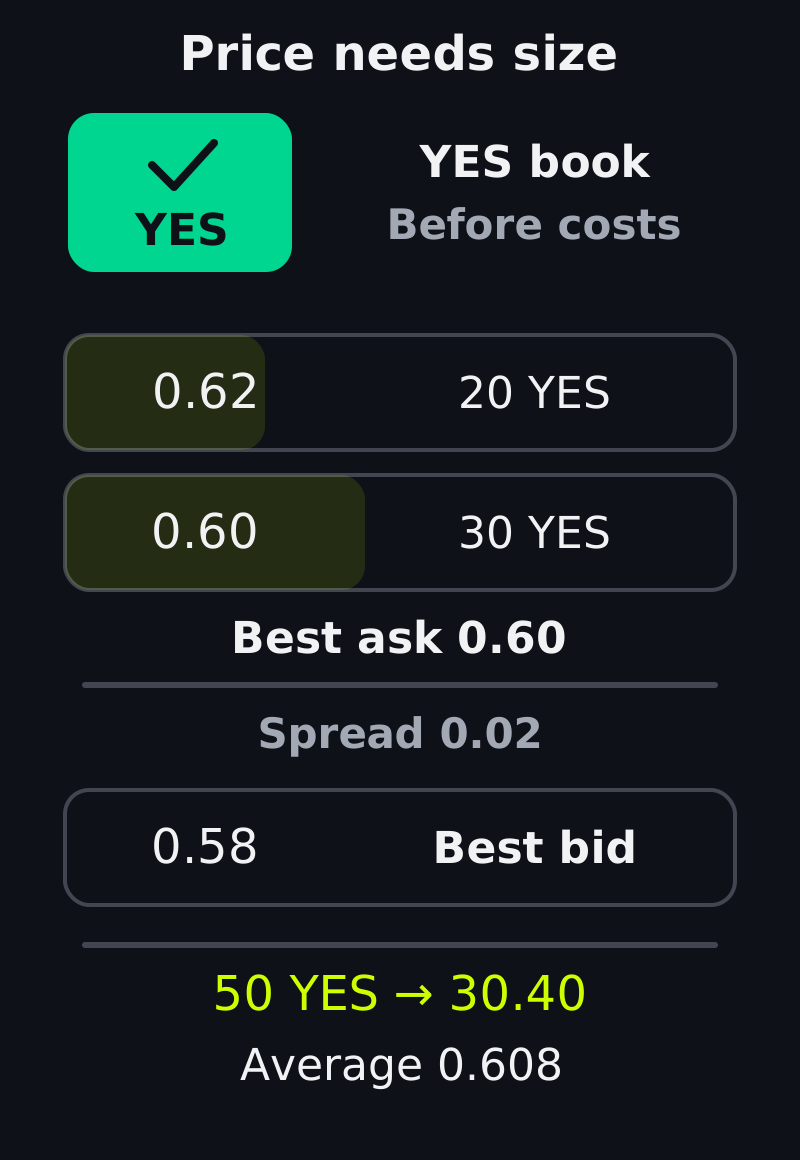
Hypothetical direct depth, with no additional liquidity from the NO book. The second price level raises the average execution price.
Depth measures quantity across price levels: here cumulative asking depth is 30 through 0.60 and 50 through 0.62. A 0.60 buy limit can reach only the first 30; a 0.62 limit can reach both levels, assuming the quotes remain available.
A marketable order has a limit compatible with available interest. The venue’s published execution rules determine priority among eligible orders; the economic examples here do not specify a particular matching algorithm.
Fill and kill (FAK) allows an immediate partial fill and discards the unfilled remainder. Fill or kill (FOK) requires the entire requested size to be executable or fills none.
Polymarket’s public order lifecycle documentation describes order types and execution states. Check the selected venue’s documented support before relying on a particular instruction.
Assuming unchanged quotes and no other executable interest, a request for 70 YES with a 0.62 limit can fill 50 under FAK and discard 20; FOK fills none. Those instructions control matching, while successful on-chain settlement remains a separate requirement.
Direct trade: a buyer meets an existing holder
A direct trade matches BUY YES with SELL YES: for 100 YES at 0.60, the buyer pays 60 collateral and receives the seller’s existing 100 YES. The seller must supply those tokens; placing a sell order does not create an unsecured short position.
Gross flows below exclude fees, gas and financing.
Account | Pays | Receives |
|---|---|---|
| YES buyer | 60 collateral | 100 YES |
| YES seller | 100 YES | 60 collateral |
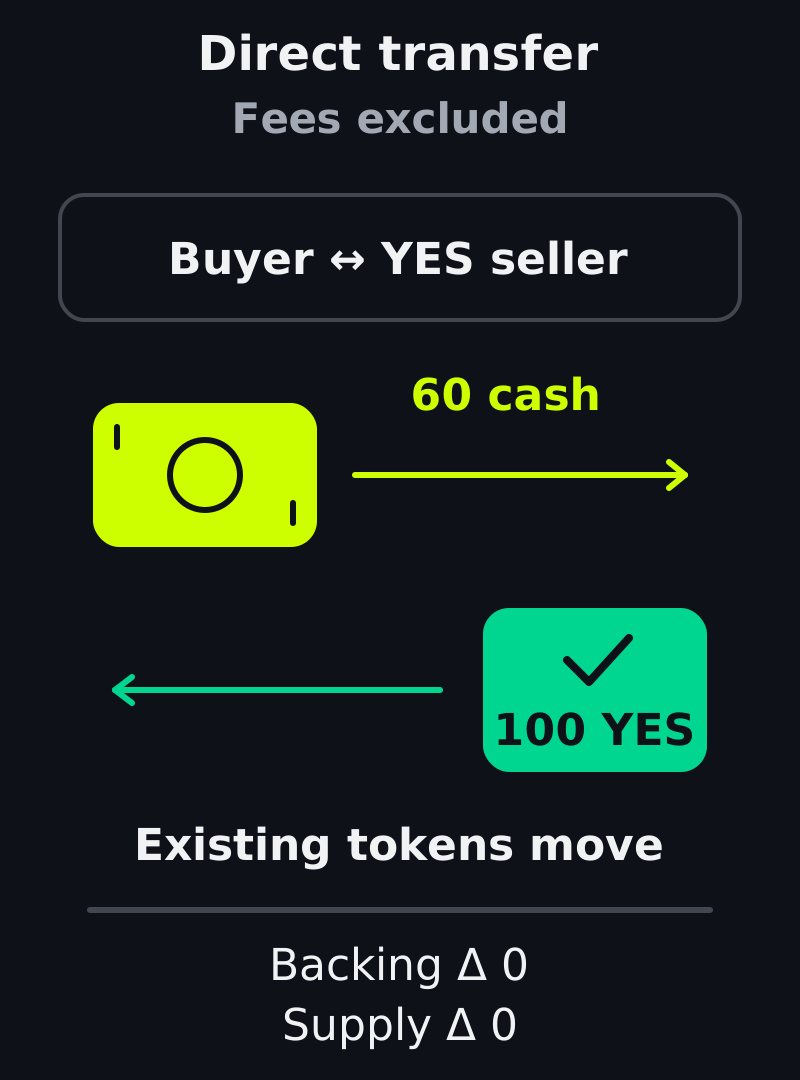
BUY YES × SELL YES. Gross balance changes for 100 existing tokens; fees, gas and financing excluded.
Total YES supply, total NO supply and locked backing remain unchanged. This transfer of ownership needs no split; the same mechanism works for BUY NO against SELL NO.
The public CTF Exchange V2 source provides a concrete example of direct, mint and merge settlement. Here, direct trade means that an existing outcome token changes hands; the label does not describe every exchange’s internal classification.
Mint trade: two buyers finance the pair
A YES buyer and a NO buyer do not need an existing token seller if their contributions can finance new complete sets. At actual execution prices of 0.60 YES and 0.40 NO, buying 100 of each contributes 60 + 40 = 100 collateral.
Gross flows below exclude fees, gas and financing. The collateral enters the backing pool rather than becoming another trader’s sale receipt.
Account | Pays | Receives |
|---|---|---|
| YES buyer | 60 collateral | 100 YES |
| NO buyer | 40 collateral | 100 NO |
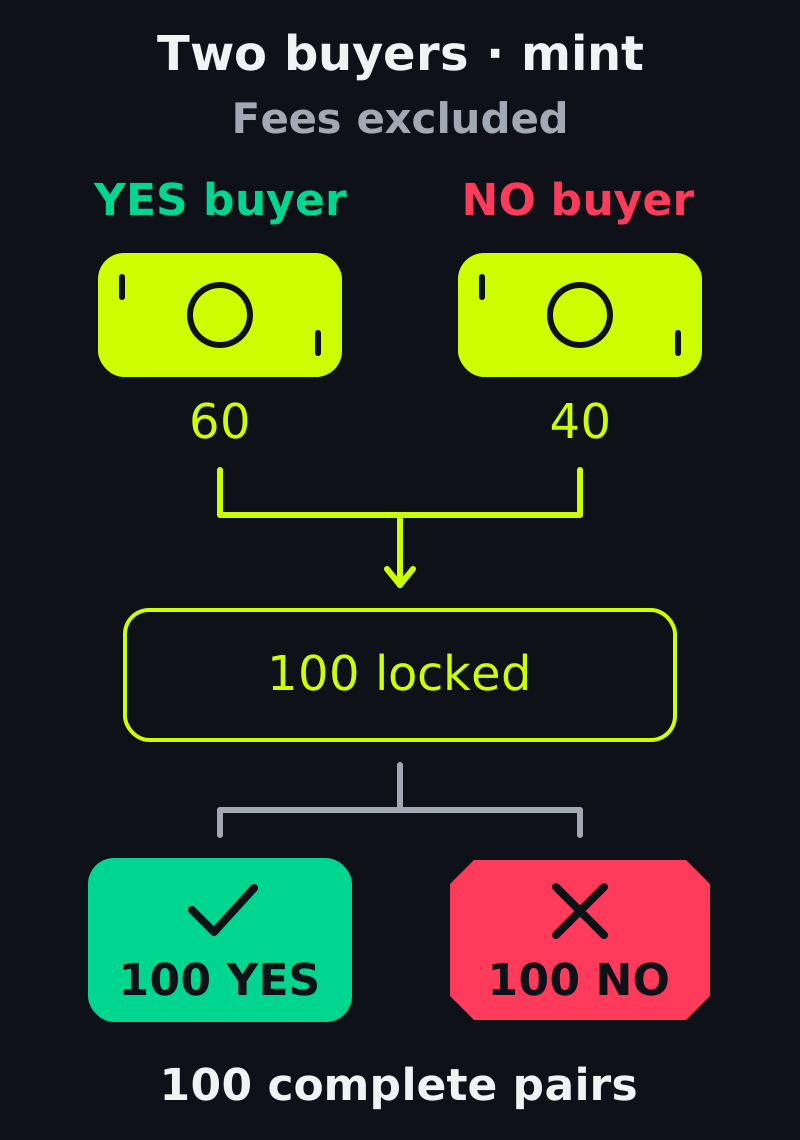
BUY YES × BUY NO. The 100 newly created pairs have 100 collateral backing; fees, gas and financing excluded.
Splitting the 100 collateral creates 100 YES for one buyer and 100 NO for the other. Locked collateral and the supply of each outcome rise by 100: that is 100 complete sets, not 200 units of backing.
Buy limits can sum to more than one without the excess being locked.
A maker supplies resting interest; a taker submits the incoming order that consumes it. For a hypothetical mint execution, assume the YES buyer pays 0.15 and the NO buyer pays 0.85, despite having allowed up to 0.90.
Execution is 0.15 YES and 0.85 NO: scaling that price relationship to 100 pairs, the maker contributes 15 and the taker 85. The taker’s limit allowed 90, but its unused five units are neither extra backing nor an unexplained fee.
If buy limits total only 0.99, the buyers cannot finance a one-unit pair through this path under the model. A higher limit improves compatibility; it does not guarantee available size or a completed settlement.
Merge trade: two sellers release the backing
A YES seller and a NO seller can instead supply equal quantities of matching tokens. Merging 100 YES and 100 NO burns 100 complete pairs and releases 100 collateral, which can pay 60 to the YES seller and 40 to the NO seller.
Gross flows below exclude fees, gas and financing. The sellers already own the tokens they supply.
Account | Pays | Receives |
|---|---|---|
| YES seller | 100 YES | 60 collateral |
| NO seller | 100 NO | 40 collateral |
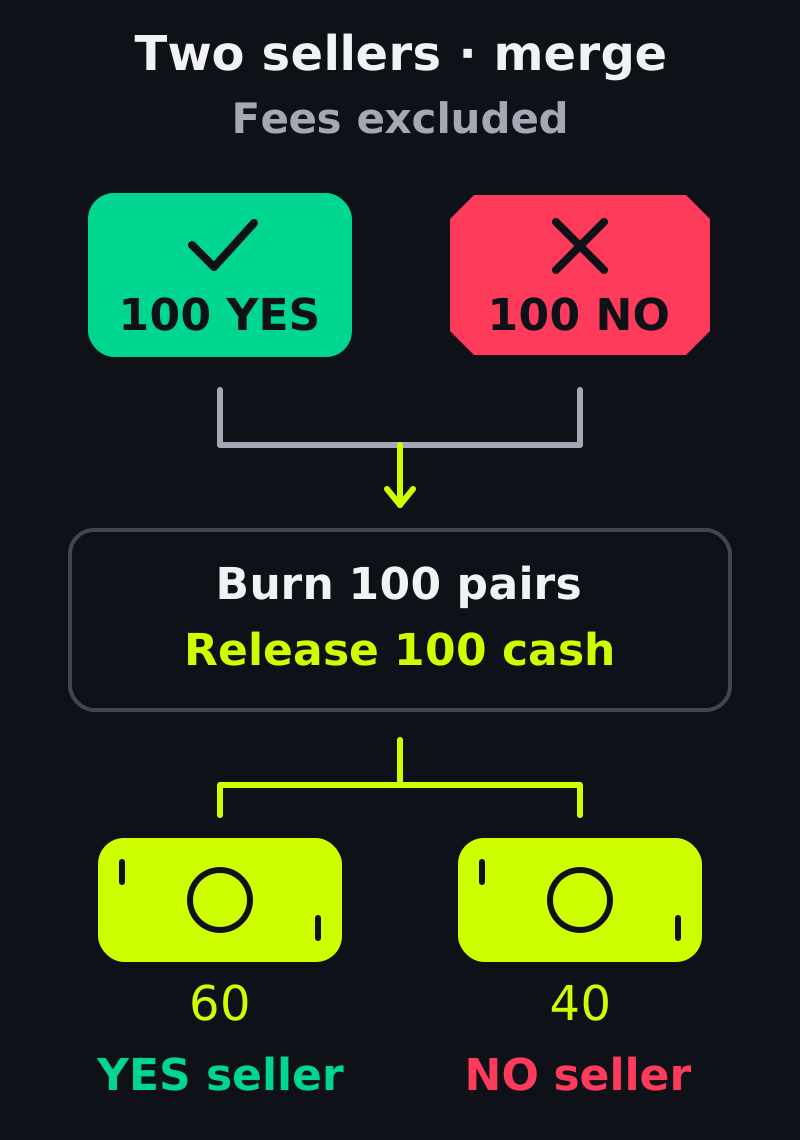
SELL YES × SELL NO. The 100 burned pairs release 100 collateral; fees, gas and financing excluded.
Locked collateral falls by 100 and each outcome’s supply falls by 100. The proceeds come from existing backing rather than a new buyer, while the sellers’ acquisition costs still determine whether these receipts represent a gain or a loss.
Sell limits can total less than one and leave room for price improvement. Suppose a hypothetical execution pays 0.30 to the NO seller and 0.70 to the YES seller, whose minimum was 0.60. The next calculation follows those assumed fills, not a claim about a venue’s allocation algorithm.
For 100 pairs, the maker receives 30 and the taker receives 70, exceeding the taker’s 60-unit minimum. All 100 released units are accounted for; the ten above the taker’s minimum are price improvement.
If minimum sale prices total 1.01, a pair releasing one unit cannot meet both minima before costs. Compatibility is therefore reversed: complementary buys need enough combined willingness to pay; complementary sells need combined minimum proceeds that the backing can cover.
One order can appear in two book views
Physical order A, bidding for 200 YES at 0.58, can support an implied NO ask at 1 − 0.58 = 0.42 for 200 NO through minting. An incoming NO buyer supplies the rest of the pair’s backing.
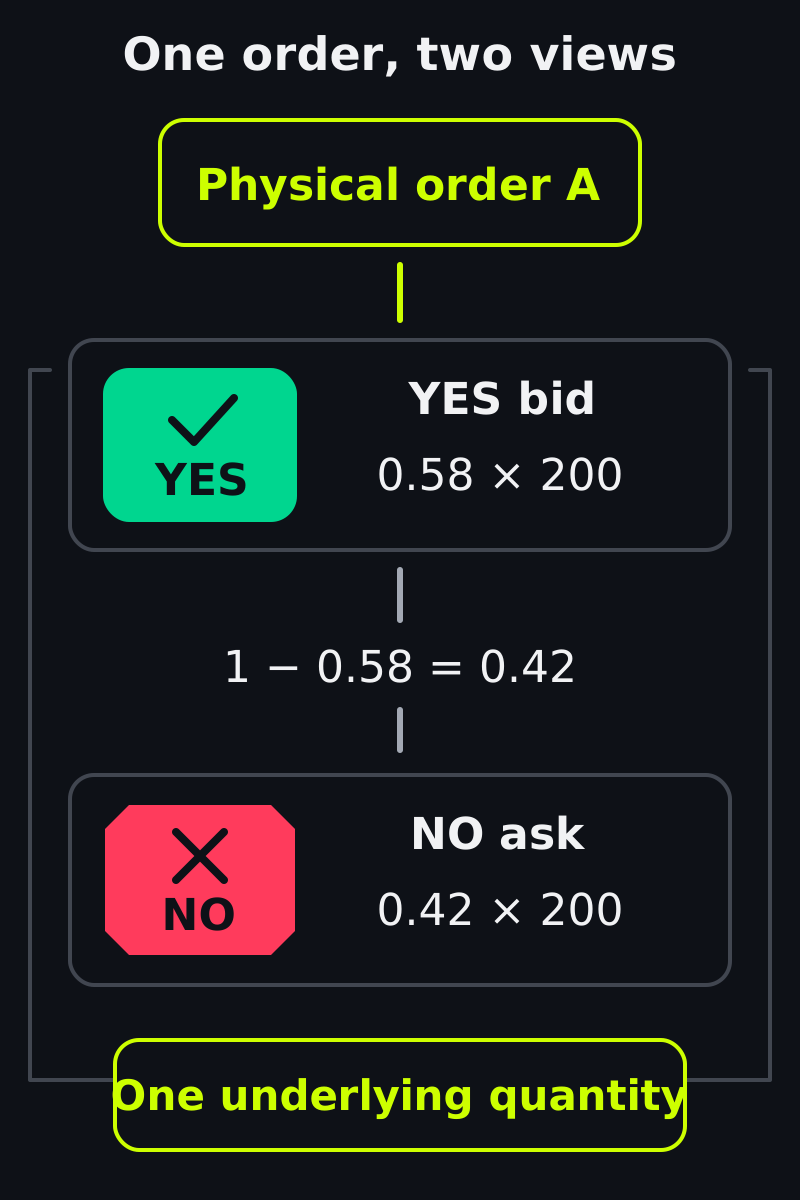
Two views of one order, not twice the liquidity. Prices are before costs, for the same binary complete set.
Those views do not provide 400 independent shares of liquidity. If A first buys 80 existing YES in a direct fill, only 120 remains to support either view; summing the two displayed quantities would count the same order twice.
Likewise, a YES ask at 0.60 can imply a NO bid at 0.40 through merging. The incoming NO seller must own the corresponding tokens; the implied bid is not an invitation to sell tokens the account lacks.
Removing the underlying unfilled order also removes the quantity that could support a corresponding implied execution. A displayed second view is not independent capital, and cancellation cannot reverse a transaction that has already settled.
Buying NO is not always the same as selling YES
Starting with 100 collateral and no tokens, buying 100 NO at 0.40 leaves 60 collateral and 100 NO. Splitting 100 collateral and then selling the resulting 100 YES at 0.60 leaves that same final portfolio.
The second route temporarily commits 100 collateral and requires a split plus executable YES demand, while the first needs only 40 before costs. Fees, approvals, latency and failure between operations can make the routes materially different even when their final balances match.
Starting instead with 100 YES already owned, selling it at 0.60 leaves 60 collateral and no outcome tokens. An economic equivalence needs starting balances and every intermediate operation: this sale closes the YES holding without creating NO.
Costs and versions change the execution details
A hypothetical 0.60 fee added to a 60-unit purchase makes cash required 60.60; deducting that fee from a 60-unit sale leaves 59.40. These are bookkeeping examples, not a fee schedule; obtain the actual fee quote, basis and rounding for the market.
Polymarket’s current documentation, checked 30 October 2026, describes off-chain matching and on-chain settlement. Its positions guide distinguishes CTF from Protocol V2 positions; our examples use CTF mechanics rather than a universal integration recipe.
In the separate Polymarket CTF Exchange V2 source, multi-maker mint/merge totals are aggregated before the CTF operations. Its specialized direct path also differs by taker direction: collateral can still pass through the exchange.
These are CTF Exchange V2 paths, not the separate Protocol V2 position architecture. Transaction batching does not establish a universal gas saving.
How Kuest differs: a branded site can use the common book
Kuest’s public architecture documentation describes complementary outcome settlement. That public product description supports the direct/mint/merge explanation without revealing how a matching service implements it.
The same public guide describes shared Kuest books and operator-selected catalogs. A branded interface can use common execution infrastructure while presenting a focused set of markets.
That sharing applies to frontends connected to the same Kuest backend, network and market assets. It does not combine Polymarket and Kuest liquidity, make mirrored tokens fungible, or guarantee funded quotes.
The worked examples are derived from complete-set accounting and explicit hypothetical fills. They do not attest to current available depth or a particular deployment’s execution parameters.
For an operator, the practical test is to quote a realistic order size across distinct underlying orders, include fees, and reconcile resulting inventory and backing. Showing more rows or more branded pages does not create additional counterparty capital.
Create your own prediction market with Kuest with that execution plan in hand: bring your intended audience jurisdictions, market rules, resolution policy and required trading sizes so the branded experience can be evaluated against its actual liquidity needs.