

“A does not win” can mean “B or C wins.” It only does if B and C cover every remaining possibility. That small condition explains both the capital efficiency of negative risk, or NegRisk, and the mistakes people make when treating any collection of related markets as interchangeable positions.
This eighth article in How Polymarket and Kuest work builds on split, merge and redemption and resolution authority. We will follow a fictional three-candidate event, compare payouts in every possible winning state, then account for what a conversion actually returns.
A group on a screen is not a payoff relationship
“Will A win?”, “Will turnout exceed 60%?” and “Will the result be announced on Sunday?” can all belong to one election page. Several can resolve YES together, or all can resolve NO. Their shared topic provides no right to exchange one claim for another.
For our teaching event, the rules instead select exactly one winner from A, B and C, using the same contest, official result and cutoff. Mutually exclusive means two cannot win together. Exhaustive means one of them must win. Together, these conditions create an exactly-one-winner set. Each candidate still has a binary question, with its own YES and NO positions; NegRisk links those questions through a compatible contract mechanism.
The rules must say what happens to withdrawals, replacement candidates, ties and a contest with no valid result. A withdrawal might make that candidate lose without changing the others. A tie needs a defined winner-selection rule or a different supported market design. If the event can end outside A/B/C, the three-outcome identity below no longer covers every state. A cancellation does not automatically authorize an all-NO result or a refund.
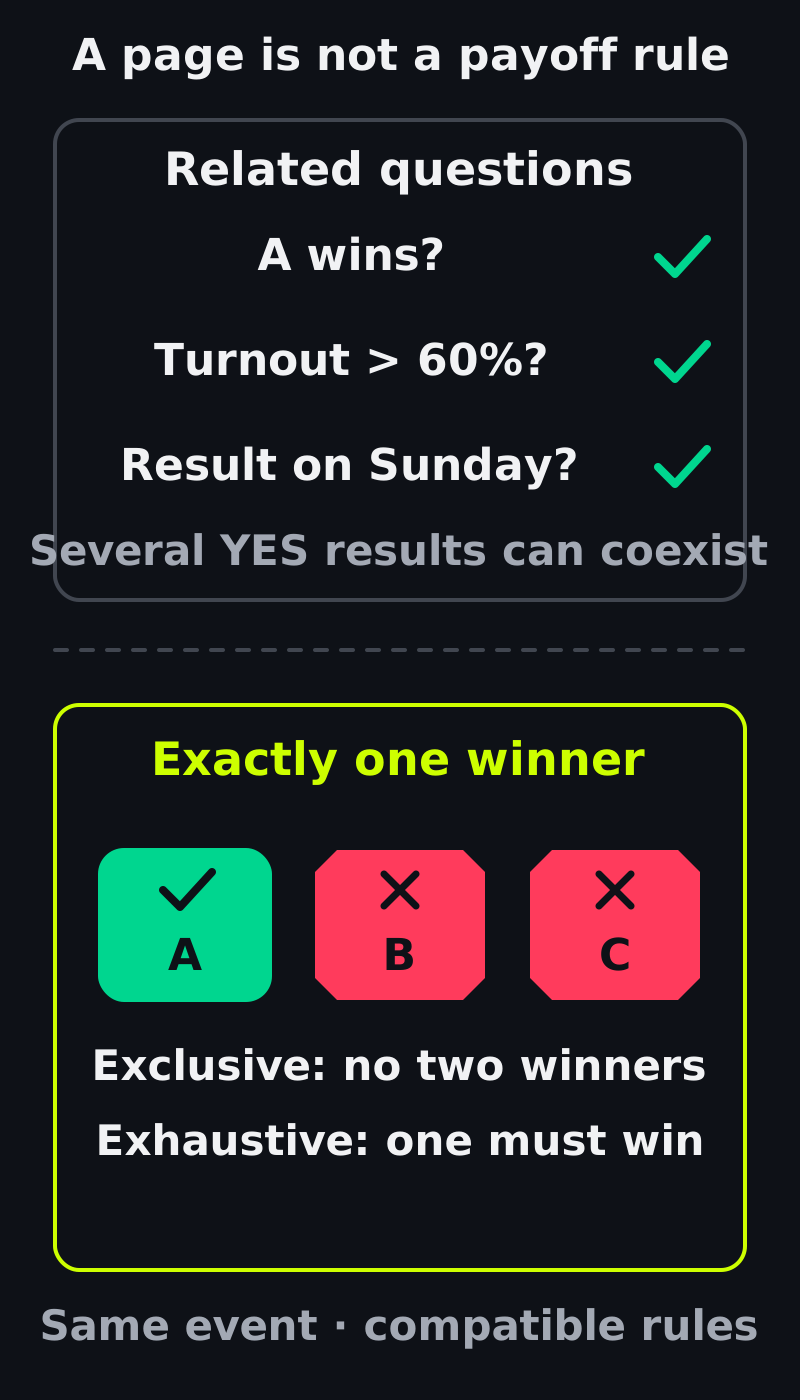
A shared topic does not establish the payout identity. The rules must support exactly one winning outcome.
Prove the relationship by writing the payouts
Assume one winning YES token pays one collateral unit, losing YES pays zero, and each NO pays the opposite of its question’s YES. Ignore conversion fees for this first comparison.
| Final winner | NO(A) | YES(B) | YES(C) | YES(B) + YES(C) |
|---|---|---|---|---|
| A | 0 | 0 | 0 | 0 |
| B | 1 | 1 | 0 | 1 |
| C | 1 | 0 | 1 | 1 |
The NO(A) and basket-total columns match in every permitted state: NO(A) has the same terminal payoff as YES(B) plus YES(C). Holding both YES tokens does not pay two units when B wins; C loses. This is a comparison of claims, not a claim that today’s purchase prices or execution costs are equal.
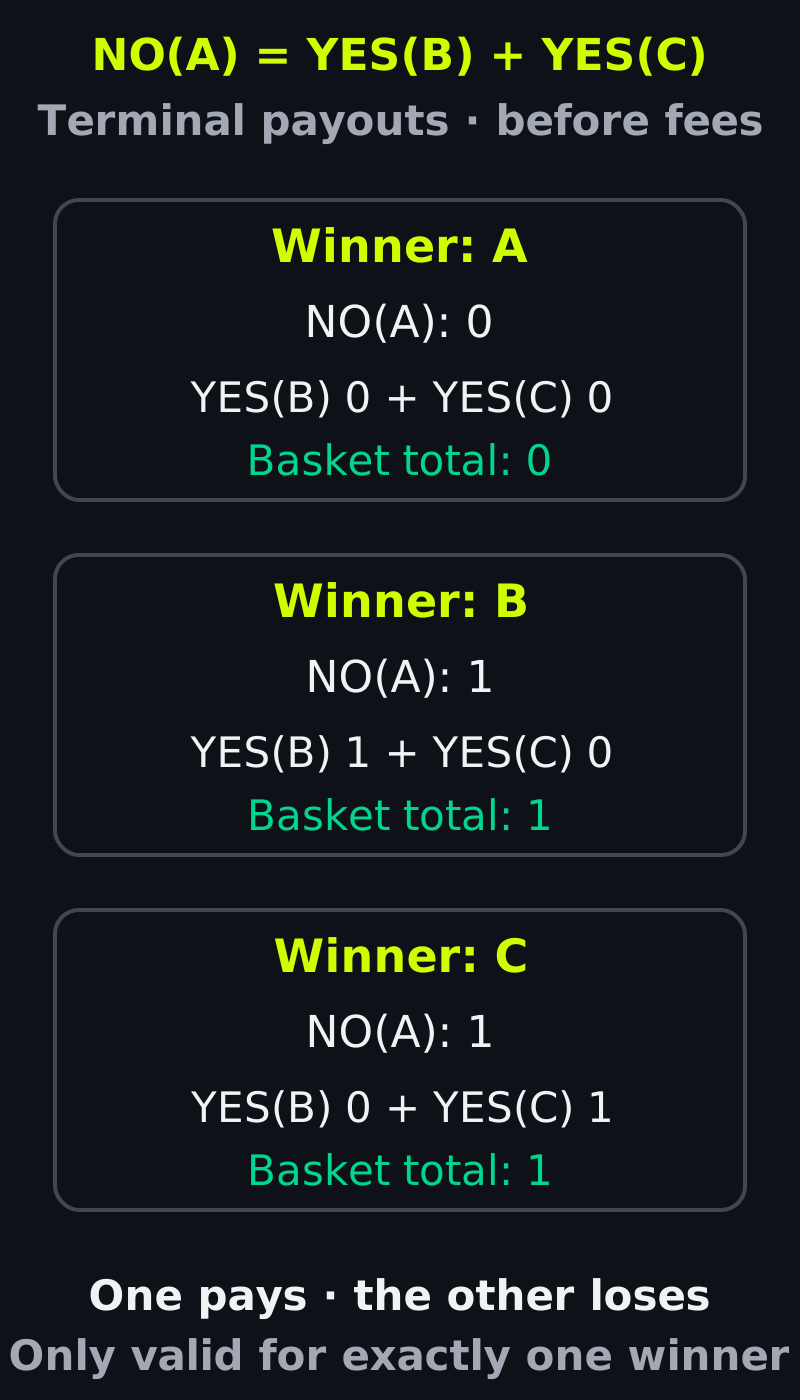
Two YES tokens do not mean two winning claims: under the stated rules, at most one of B and C can win.
Now add a possible winner D without adding its position. If D wins, NO(A) pays one while YES(B) plus YES(C) pays zero. Or let B and C both win: their basket pays two while NO(A) pays one. These counterexamples show why exclusivity and exhaustiveness must both be checked before using the identity.
There is a matching public example: the Polymarket CTF state manager rejects a second YES report after a winner is determined. That does not prove some question must eventually receive YES. At-most-one contract enforcement cannot repair incomplete real-world rules.
Conversion turns that relationship into usable inventory
Polymarket’s current documentation distinguishes the CTF NegRisk Adapter from Protocol V2’s Router and NegRiskModule. The implementation examples below concern the named public CTF adapter. They are not instructions for every current Polymarket or Kuest position system.
In the CTF conversion, selecting A and converting 100 NO(A) returns 100 YES(B) and 100 YES(C) when the conversion fee is zero. No cash is released in this single-NO case. The caller gives up the original NO claim; the transaction does not leave both versions available to spend.
This makes capital efficiency concrete. Suppose a liquidity provider deposits 100 collateral units and splits the A question into 100 YES(A) and 100 NO(A). Converting the NO leg produces 100 YES(B) and 100 YES(C), leaving 100 YES of every candidate backed by the original 100 units, before fees. Exactly one candidate’s YES set can pay 100. Independently splitting all three unrelated binary questions would require 300 gross collateral and also create three NO inventories.
The provider has reorganized existing claims and can quote the resulting inventory. Selling it changes their exposure; the conversion itself earns no trading profit. A nonzero fee reduces the converted legs, and market-making still requires buyers, executable prices and inventory management.
Several NO positions can also release collateral
The more general operation accepts the same amount from each selected NO position. With N questions and K selected NOs, zero-fee conversion returns that amount of YES in each of the N−K unselected questions, plus K−1 times the amount in collateral.
For A/B/C, convert 100 NO(A) and 100 NO(B). The output is 100 collateral units now, plus 100 YES(C). If A or B wins, the original NO basket pays 100; the output’s cash already supplies 100 and YES(C) pays zero. If C wins, both original NOs pay, totaling 200; the output supplies 100 cash plus a 100-unit winning claim.
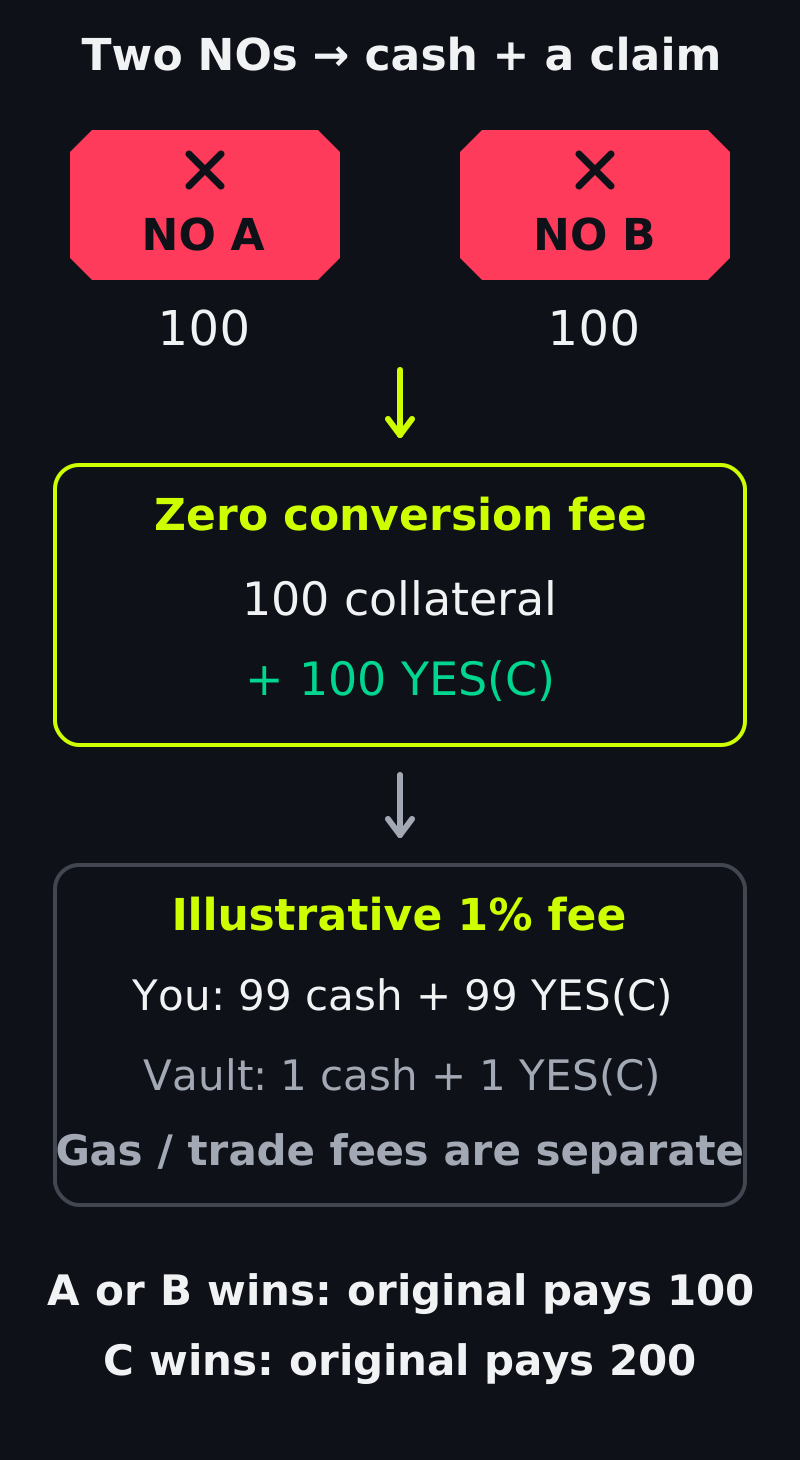
A two-NO conversion releases part of an existing entitlement as cash. A configured fee reduces both returned collateral and YES tokens.
Selecting all three NOs returns 200 collateral and no YES tokens, before fees: in every valid state exactly two NOs win. Selecting just A returns the other two YES legs and no collateral. These are different applications of the same identity, not separate reward programs.
The public CTF conversion example can deduct a configured fee from both output types. At an illustrative 100 basis points, or 1%, converting 100 NO(A) and 100 NO(B) gives 99 collateral plus 99 YES(C) to the caller and 1 collateral plus 1 YES(C) to the fee recipient. These are hypothetical parameters, not a Kuest fee quote.
At token precision, the contract first computes the per-leg fee by rounding down amount × feeBips / 10,000 in integer base units. It subtracts that fee from each returned YES amount and multiplies the net amount by K−1 for collateral. Conversion fees, trading fees and gas are separate costs. Released collateral was already part of the input basket’s entitlement; its arrival is not evidence of profit.
WCOL accounts for the transformation
The public adapter’s WrappedCollateral source illustrates WCOL, an accounting token around underlying collateral. In that design, the wrapper participates in the CTF inventory transformation. Explaining that public example does not establish the asset or supported conversion route of a particular Kuest deployment.
The new splits also create NO tokens. Both those NOs and the caller’s selected NOs are transferred to the designated discard address, where they must never be redeemed. This is an ERC-1155 transfer, not a burn that reduces token supply. The exclusion of those claims is part of the accounting. WCOL minting adds no underlying money; the mechanism relies on the linked payout structure and the collateral already held.
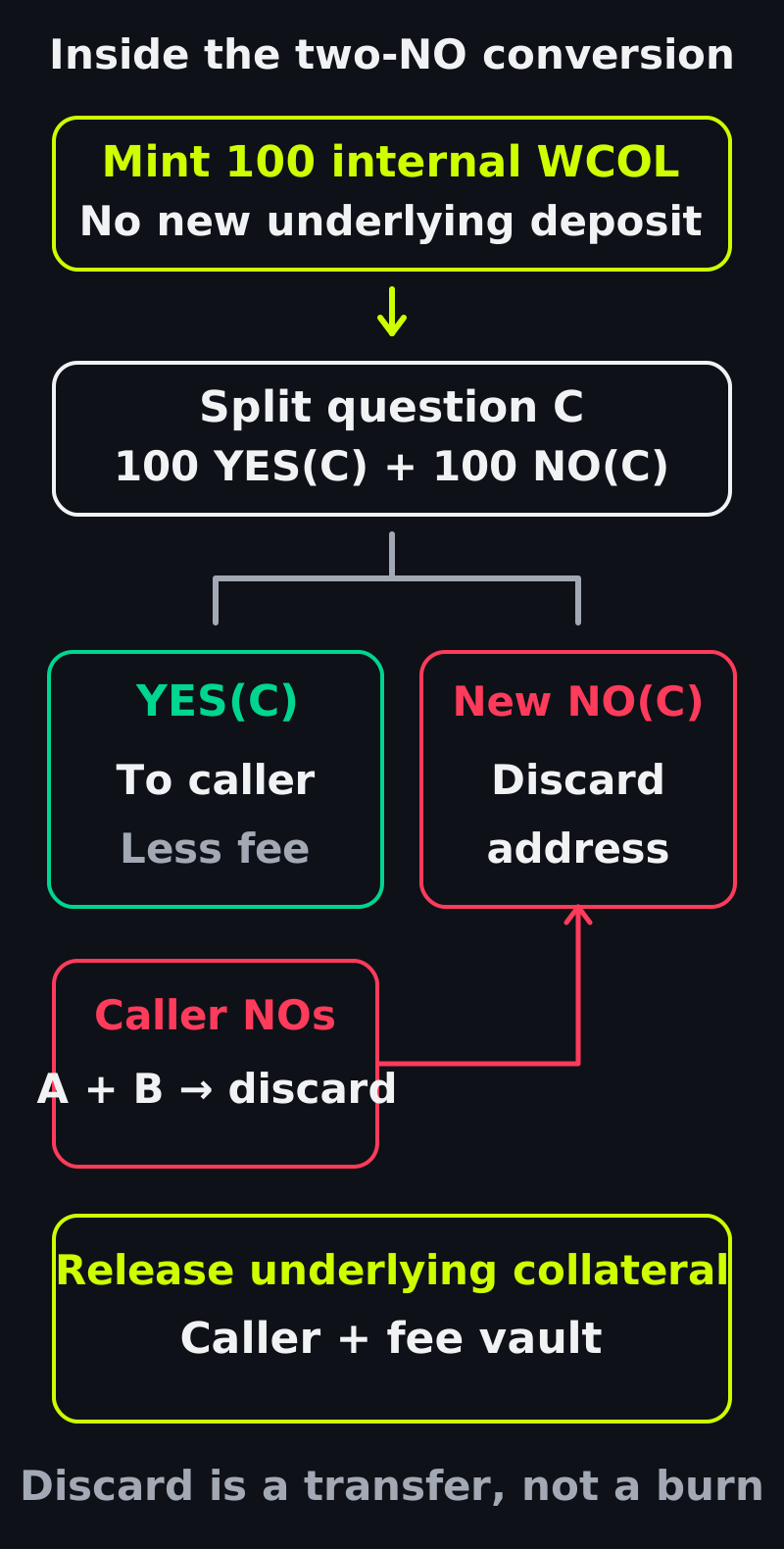
WCOL supports internal accounting. Newly minted WCOL does not add underlying collateral, and discarded NO claims must stay out of redemption.
A conversion transaction is atomic: if a required transfer or other step reverts, its state changes roll back. Buying the input positions beforehand is a separate trade. Atomic conversion does not guarantee their acquisition price, the safety of inconsistent rules or a profitable exit.
OTHER is an outcome; UNKNOWN is a resolution answer
A catch-all OTHER can make a candidate list exhaustive: if the actual winner is neither A nor B, OTHER wins under the stated rules. Then NO(A) corresponds to YES(B) plus YES(OTHER), before fees. OTHER still needs precise treatment of replacements, joint winners and no-result events; its label alone does not settle those cases.
Polymarket’s augmented NegRisk documentation describes named outcomes, placeholders that can receive names later, and an explicit Other. It advises trading named outcomes, avoiding unnamed placeholders and avoiding Other directly because its definition changes as placeholders are clarified. A visible candidate list can therefore omit positions relevant to conversion. Check the complete contract question set and the applicable definitions, not just the cards on screen.
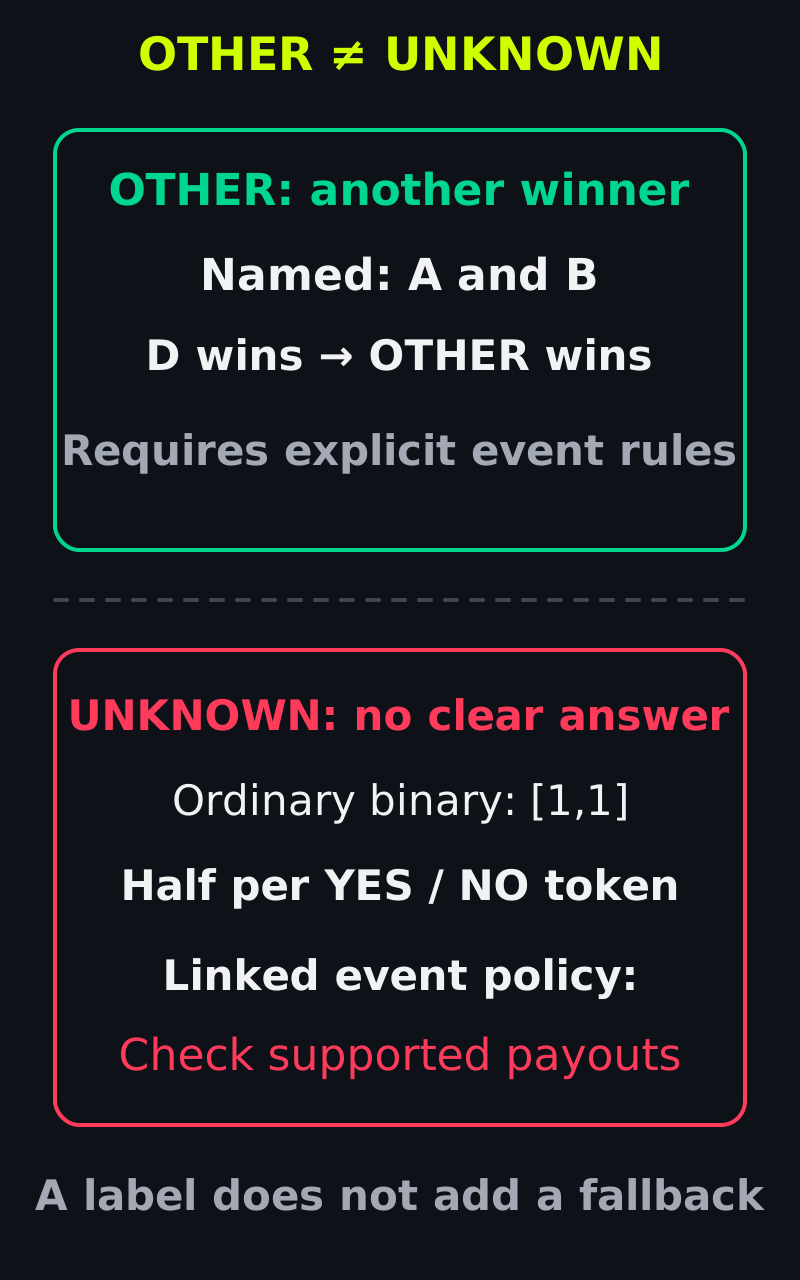
An additional outcome and an unavailable answer solve different problems. Check the selected event’s supported payout rules.
UNKNOWN is different: it can be an oracle’s unavailable-or-indeterminate answer. In an ordinary binary model, [1,1] pays half per YES and NO. A linked event must be checked against its own public payout and recovery rules; do not assume that the same array is supported or that it authorizes cancelling the whole event.
Implementation details that change the answer
Three checks before converting
Select questions, not a binary side. In this adapter, an event mask of
0b011selects NOs for question indices 0 and 1—A and B in our example. That is different from the per-question CTF partition values 1 for YES and 2 for NO. Conversion uses the registered question count.Use the correct identity. This NegRiskIdLib stores the question index in the last byte of the event’s question ID. That convention belongs to this family. Its position-ID derivation uses WCOL, even when the interface displays an underlying stablecoin amount.
Approve the contract doing the work. Trading uses the configured ordinary or NegRisk exchange; conversion needs the NegRisk adapter’s permission to transfer the caller’s CTF positions. Splitting through that adapter needs underlying-collateral allowance to it. An approval for one address does not grant permission to another. Inspect the published permissions for each selected contract; a trading approval is not proof that conversion is authorized.
What a Kuest operator must verify
Kuest’s public market-creation guide describes supported market formats. Start with the full outcome set and a documented resolution policy, then establish the actual deployed contracts, collateral, conversion availability, fees and required permissions. A grouped event page is not sufficient evidence that the conversion identity applies.
The conversion arithmetic above is a public CTF example under explicit assumptions. Before offering the corresponding inventory action on a Kuest site, compare it with the selected market’s published contract and interface. A familiar function name or version label supplies no compatibility guarantee.
Launch your own prediction market with Kuest around an outcome set your audience can understand: name every possible winner, explain exceptional results and disclose actual costs. The next article follows where those assets live and who can move them through wallets, approvals and upgrade authority.