

A temperature can be known while a market remains unresolved. Someone still has to select the evidence, submit an authorized answer and get the payout recorded. A dispute, paused adapter or failed transaction can interrupt that path. Even a recorded result does not mean every holder has received collateral.
This seventh article in How Polymarket and Kuest work follows that path using our verifiable weather rules. The central question is practical: which address can make this particular position pay, under which procedure?
The source supplies evidence; the oracle supplies authority
Our fictional market asks whether Observatory A’s noon UTC observation for City B on Date C is at least 30.0°C. Its rules select station B-01, the official CSV and revisions available by 13:00 UTC, with no extra rounding. A valid 30.1 means YES; missing evidence follows the separately specified unavailable-data policy.
The observatory publishes data. A proposer submits an answer based on it. A disputer challenges that answer where the selected system permits challenges. An oracle provides the answer accepted by the contract, often through an adapter that translates it into outcome payouts. These roles can involve different people and contracts; the exchange’s last traded price decides none of them.
In Kuest’s inspected Conditional Tokens implementation, a condition is identified by a hash of the oracle address, question ID and outcome count. When reportPayouts runs, it recomputes that identity using the caller as the oracle. An unrelated wallet reporting the same question computes a different condition; it cannot overwrite this one’s payout. A successful report requires a prepared condition and an unset payout denominator.
The oracle or adapter recorded for the condition is the authority that the ledger recognizes. A matching headline under another oracle or question identifier is not the same conditional claim. Read those public identifiers before comparing results.
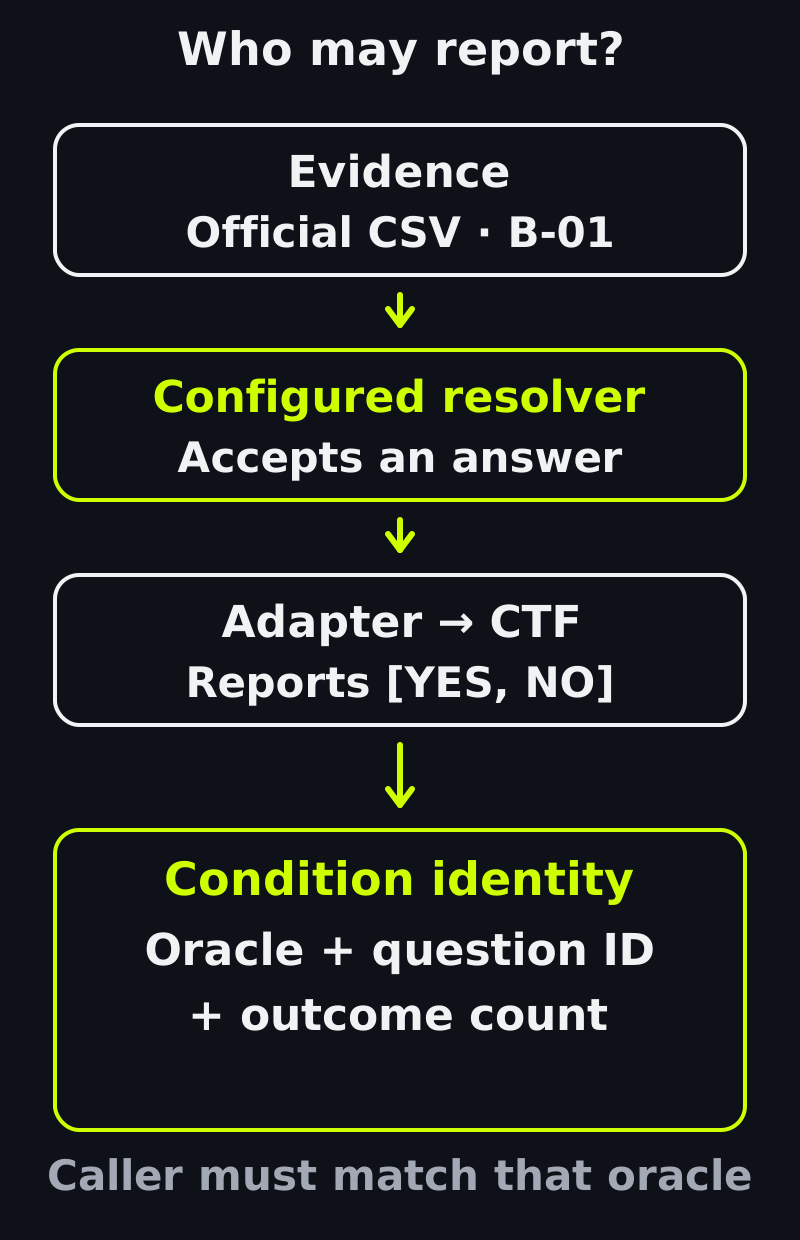
The CSV establishes evidence. The configured contracts establish who can turn it into a payout record.
A fixed oracle identity does not freeze human interpretation, whitelist membership or every administrative power behind that address. Nor does preparing a condition prove that an operator has listed it for trading. Contract identity, resolution authority and catalog admission require separate checks.
UMA adds a challenge process
UMA’s optimistic oracle model starts with a bonded proposal: the proposer risks collateral on an answer. During its liveness period, a disputer can post a counter-bond. An unchallenged answer can settle after that period; a contested request can reach the Data Verification Mechanism, or DVM, where UMA stakers vote. Economic incentives support review, but do not make the source unambiguous or ensure someone notices an error.
Polymarket’s current resolution documentation, checked on 30 October 2026, describes a two-hour challenge window for its UMA markets, a second proposal round after a first challenge, and escalation after another challenge. These are documented product flows, not universal parameters for every UMA integration. The same documentation describes Chainlink TWAP up-down markets: compare the final time-weighted price with the opening reference, with equality resolving Up. That route does not use UMA’s proposal-and-dispute process.
Kuest’s public resolution documentation describes creator-approved proposers for direct-resolution markets. Identify the selected market’s actual result authority and review or dispute rights; do not transfer UMA’s challenge procedure to a different route.
Consider a hypothetical optimistic request with a two-hour liveness period. At 13:10, an eligible proposer reports NO using the original 29.9°C CSV. A reviewer finds an official correction to 30.1 published at 12:50, inside our cutoff, and challenges before 15:10. The evidence supports YES under the rules; the challenge starts the configured dispute procedure. It does not instantly pay YES holders. A correction published at 13:05 would be outside those same rules.
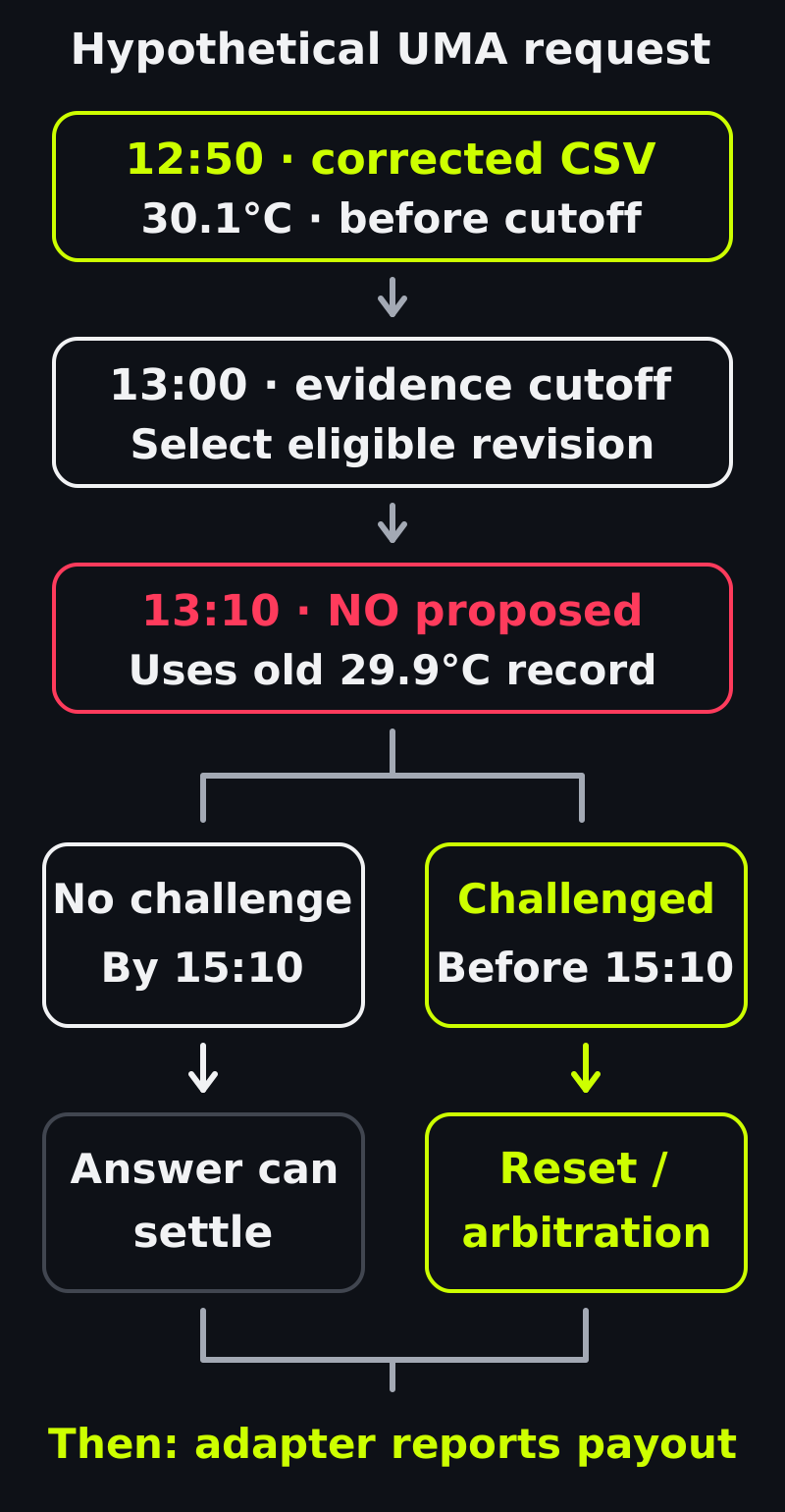
The cutoff selects eligible evidence. The challenge window permits review. Finalization still needs the selected procedure and a successful transaction.
The active request and its documented procedure matter more than an isolated old proposal event. Check applicable bond and challenge timing in public records. A challenge begins a process; it does not itself establish a final payout.
A resolution procedure must ultimately produce the payout accepted by the position ledger. For an ordinary binary model, YES can be represented by [1,0], NO by [0,1], and a supported UNKNOWN by [1,1]. The last pays half a unit per token rather than refunding the purchase price. A NegRisk route needs its own compatible mapping.
Administrative recovery is part of the trust model
The public Polymarket CTF adapter illustrates administrative pause, reset, flag and manual-resolution powers. Its published safety period is specific to that implementation. Review the actual deployed authority and timing rather than attributing an upstream example to Kuest or every market.
Recovery powers can address a broken callback or stalled process, but they also place trust in administrators. Identify their addresses, role controls and any proxy upgrade authority. A metadata edit or clarification is another distinct action: the original rules and attributed updates help determine meaning, while the resolver and adapter determine reporting authority. An on-chain timestamp alone cannot legitimize a changed threshold.
Direct resolution has a different responsibility model
Kuest’s public DRO guide describes an approved wallet for the creator submitting the official outcome directly onchain. It separately describes bonded community reports as an engagement signal rather than a vote that can override the approved proposer. The operator must disclose those responsibilities before participants trade.
An operator must disclose who can finalize the selected market and what review or dispute process actually exists. A direct submission must not be advertised as having an UMA challenge window merely because an unrelated market uses UMA. Preserve the source evidence and identify who handles an erroneous or delayed result.
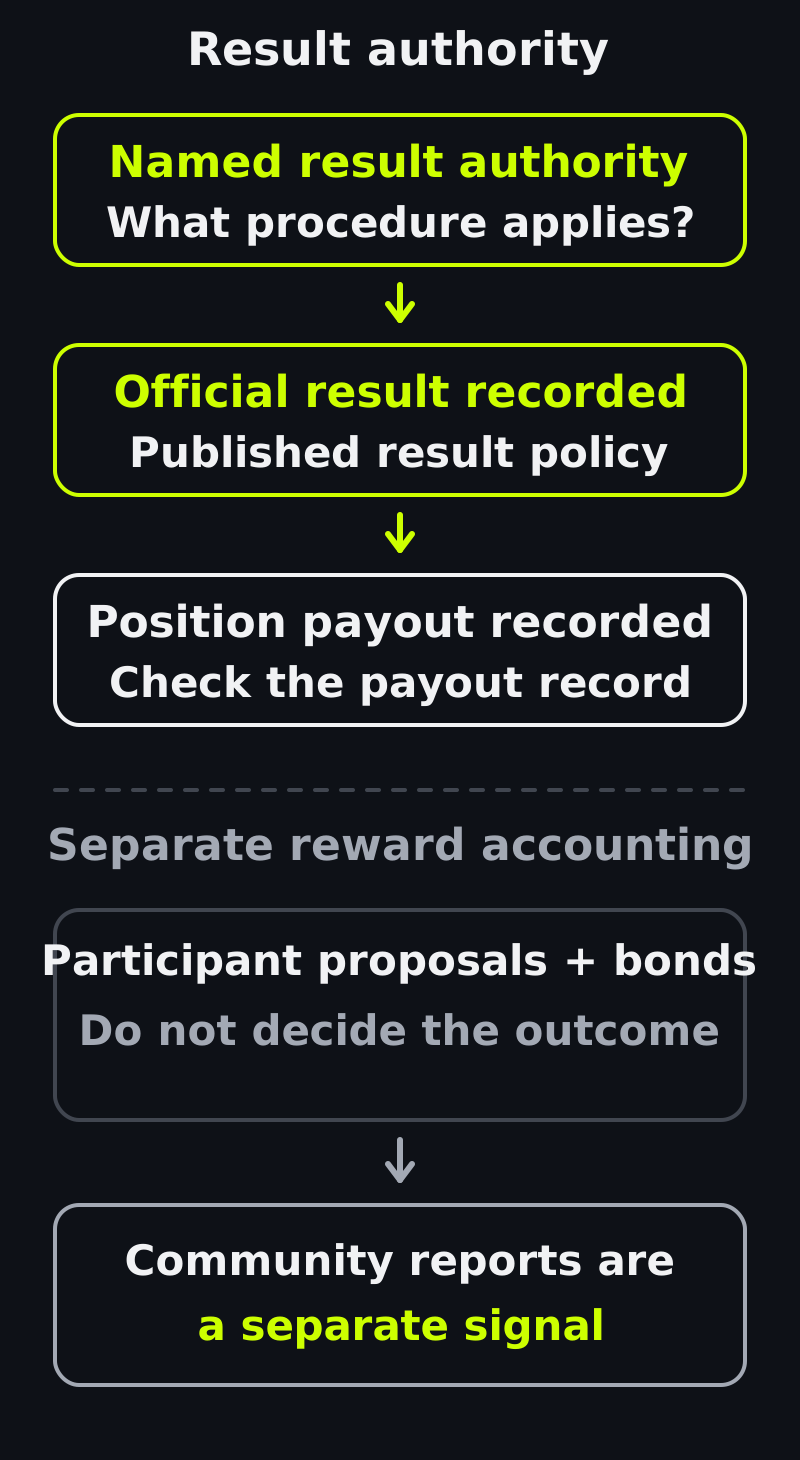
Identify the official result authority. Community participation does not automatically give a report authority over the payout.
Result reporting, any reward accounting and a holder’s redemption are separate obligations. The participant needs to know which record establishes the claim and which transaction actually delivers collateral; an incentive label alone answers neither question.
A mirror needs its own local resolution
A mirrored market has local positions and a separately identified source. Compare their public rules, outcome identities and payout records. A similar title is insufficient evidence that two markets correspond, and a resolved source does not itself establish the state of a different local contract.
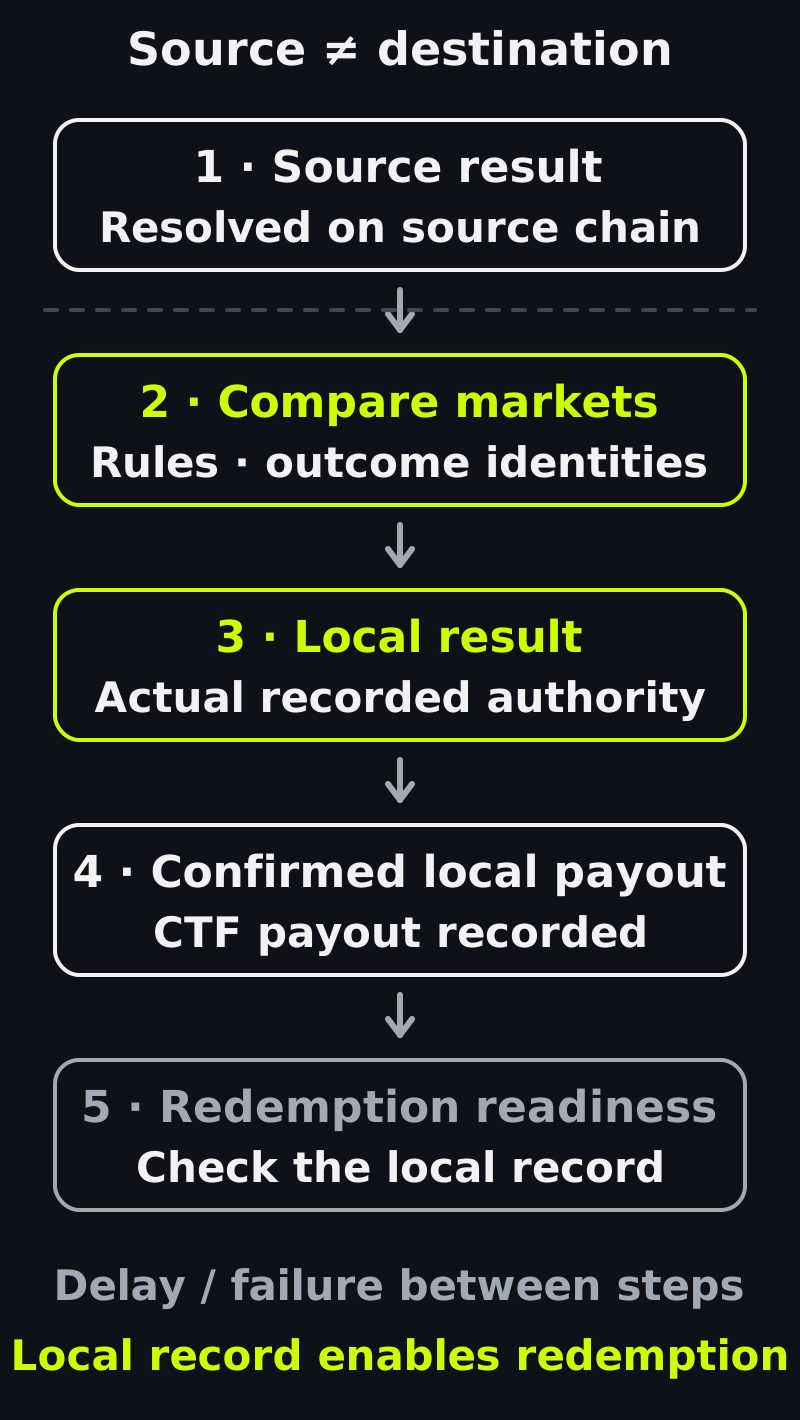
Source resolution, local resolution and redemption readiness are separate observations; do not infer one from another.
Source finalization does not transfer collateral between venues or redeem local tokens. Different rules, mappings or accepted payouts can leave apparently related positions with different entitlements. Check the local payout record and supported redemption route instead of assuming cross-venue finality or a shared dispute guarantee.
Diagnose the checkpoint that actually failed
If the source is unavailable or the rules conflict, preserve the evidence and apply the specified fallback or clarification process. If a proposal is premature or wrong on an optimistic route, an eligible disputer needs the active request, required bond and remaining challenge time. On a direct route, contacting the responsible authority does not create an on-chain dispute right.
If the adapter is paused or flagged, inspect its state and the responsible administrator’s next action. If a transaction reverts, inspect the receipt and reason; the attempted call is not a payout record. If the chain shows a resolved condition while the interface still says pending, investigate indexing. None of these statuses alone authorizes an automatic refund. Reward synchronization is yet another checkpoint, separate from holder redemption.
Resolved means payable; redeemed means paid
CTF resolution stores payout numerators and their denominator; it does not visit every wallet. Redemption is a later operation that burns selected position balances and releases their collateral entitlement. A wallet or automation may submit it, but the successful payout report alone proves no such transfer.
Suppose a holder owns 40 YES and 10 NO. Under a YES result, [1,0], their entitlement is 40 collateral units. Under this ordinary adapter’s UNKNOWN result, [1,1], it is 25. Before redemption, those remain token balances with a claim; afterward, the redeemed balances are burned and collateral is transferred. Purchase costs affect profit, not the payout ratio.
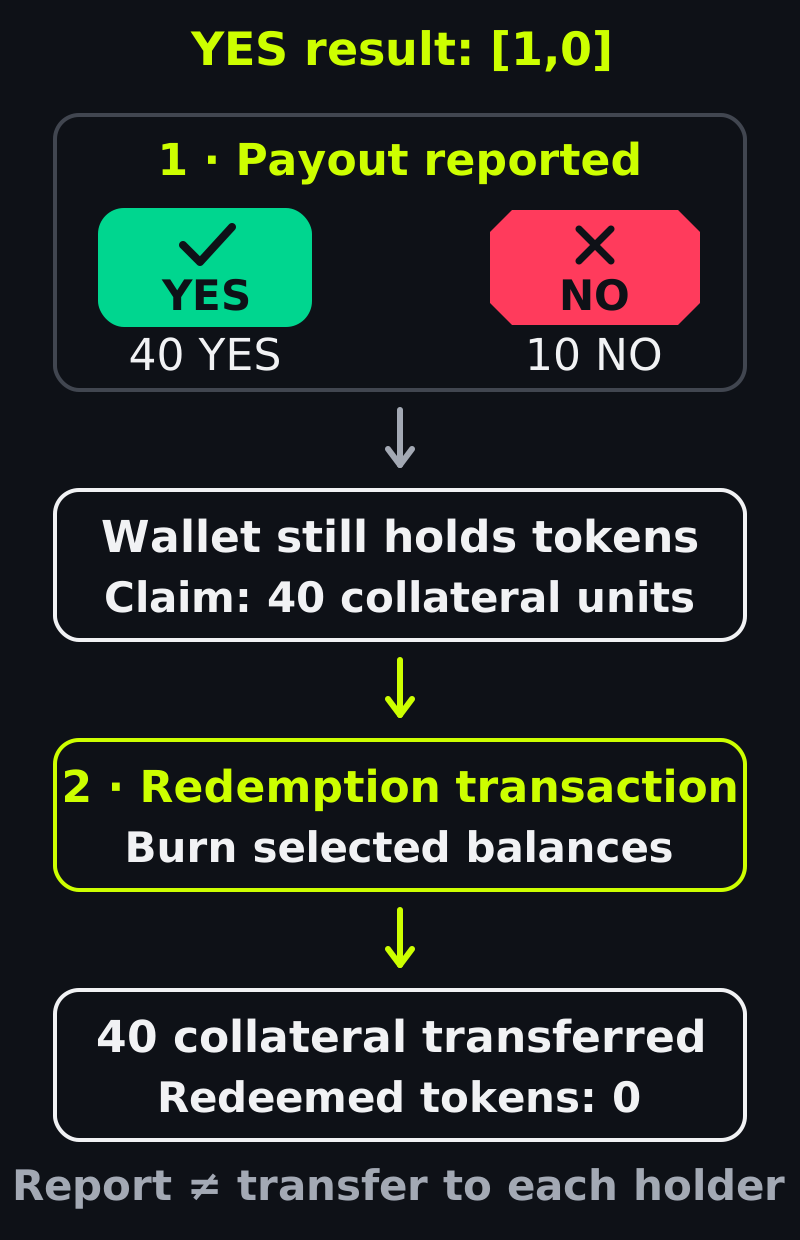
A payout record establishes the ratio. A redemption transaction changes the holder’s token and collateral balances.
For a Kuest operator, the public resolution documentation makes the responsibility concrete: identify the person or authority that may answer, disclose actual challenge rights, retain evidence and assign support for delayed results. Check the selected market’s public contract records and current documented procedure before offering it; a general article cannot promise a completion time.
Launch your own prediction market with Kuest with a resolution policy your audience can inspect: the evidence source, authorized result authority, dispute or review procedure, supported fallback and person responsible for stalled transactions. The next article applies these foundations to linked outcomes and NegRisk, where one question’s result must also respect the event’s structure.