

“Your funds stay in your wallet” leaves three questions unanswered: which address holds them, who can authorize movement, and who can change the rules that address executes? A useful custody explanation answers all three.
This ninth article in How Polymarket and Kuest work follows the assets behind a trading balance, then separates signatures, approvals, recovery and upgrades. It builds on the system map and signed-order settlement.
Start with the asset-holding address
An externally owned account, or EOA, uses a private key to authorize actions. A smart-contract wallet has its own address and authorization code; the owner signing for it can be a different address. Seeing the owner’s address in a connected-wallet menu does not locate the trading funds.
Polymarket’s wallet documentation, accessed 30 October 2026, describes Deposit Wallets as the default for account wallets deployed from 4 May 2026, alongside legacy Proxy and Safe wallets. Identify the actual wallet type before copying a signing example. Those account-generation labels do not identify the position protocol or collateral token.
For a simple Kuest CTF example, ignore fees: a wallet begins with 100 collateral units and buys 100 YES at 0.60. After settlement, it has 40 collateral and 100 YES. The collateral token contract records its cash balance; the Conditional Tokens contract records its position balance. The website displays those records—it is not itself the asset ledger.
The seller receives the 60 paid. Separately, outstanding CTF positions depend on the collateral backing their condition, created through splitting. A purchase does not put another 60 into that reserve. If YES resolves to a full-unit payout, redeeming 100 YES returns 100 collateral; if YES loses, it returns zero. Our buyer ends with 140 or 40 collateral before costs.
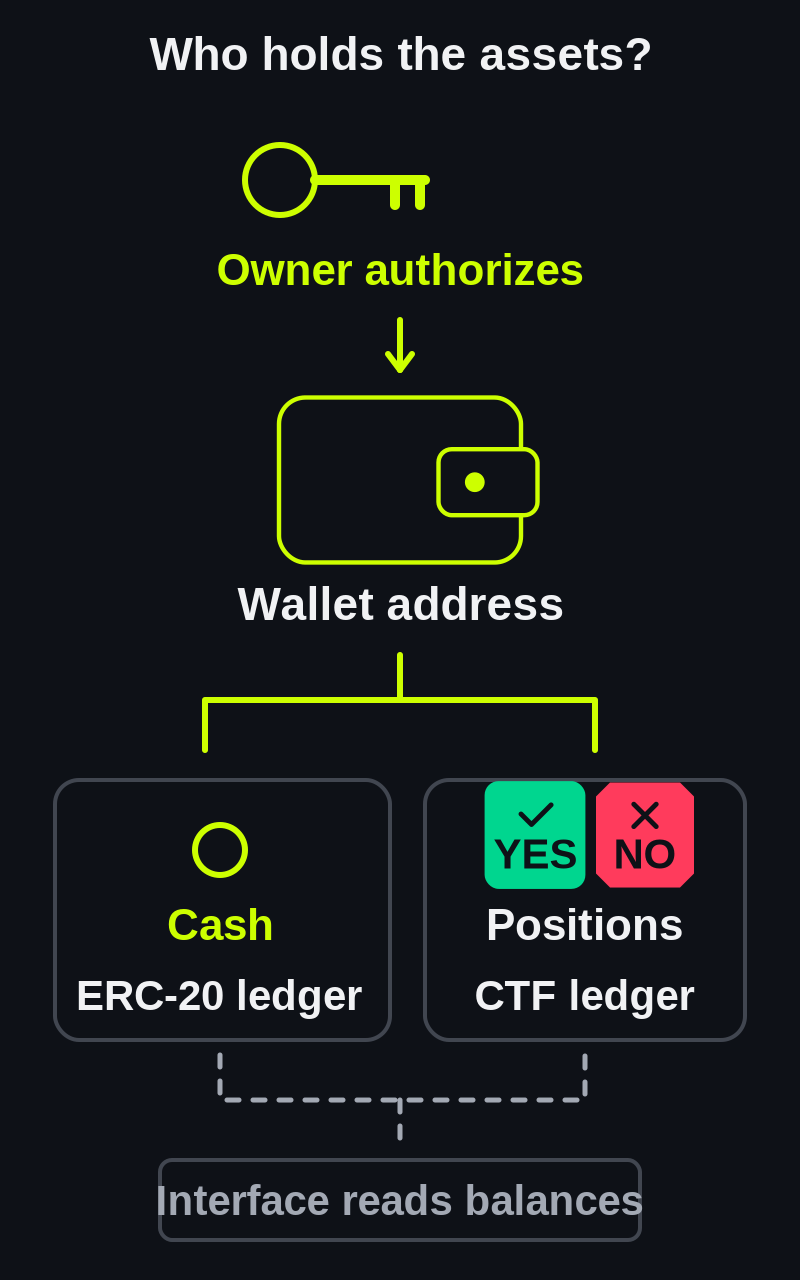
The wallet address holds the claims. Token contracts maintain the balances; a website balance is a view of them.
The NegRisk route adds an adapter and wrapped-collateral accounting. Current Polymarket also documents a separate Protocol V2 position system. Trace the selected route’s actual assets and redemption path rather than treating every “dollar” or YES label as the same token.
Six identities, six different jobs
The owner signer authorizes wallet actions. The wallet address holds assets. An authorized session signer can exercise delegated rights. An API credential authenticates service requests. A relayer operator submits transactions. A contract administrator changes whatever configuration its role permits. One organization can operate several of these, but their powers still come from different checks.
In Polymarket CTF Exchange V2’s signature code, the EOA branch checks that maker and signer match. Its legacy Proxy and Safe branches check an ECDSA signature plus a factory-derived wallet address. They do not ask an arbitrary Safe to validate a multisig threshold. The separate POLY_1271 branch requires maker and signer to be the contract address and calls contract signature validation.
ERC-1271 standardizes a contract signature-validation interface, not the policy behind it. Supported account types and signing methods must be checked in the current public integration documentation for the chosen venue.
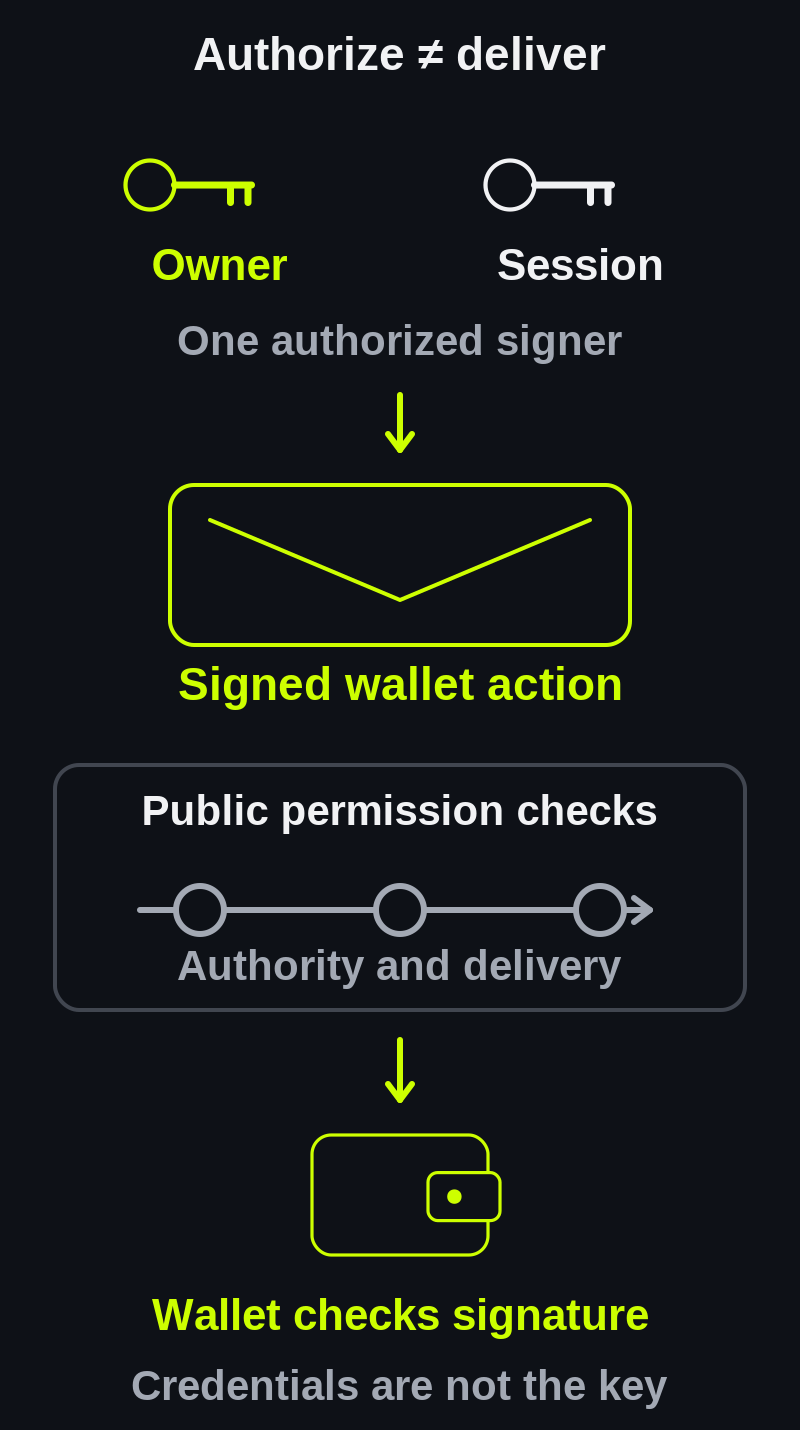
A signature authorizes defined contents; transaction delivery and confirmation are separate requirements.
What a Kuest wallet batch actually authorizes
Kuest’s factory deploys deterministic beacon-proxy wallets and initializes their owners. Here the address derivation uses the factory, beacon and wallet ID; the owner is initialized separately. A predicted address alone does not prove the wallet is deployed or identify its current owner.
Authorized factory operators forward signed batches to the wallet’s execute(). It checks a nonempty call list, the intended wallet, the next nonce, the deadline and a valid signature before making the calls. A failed call reverts the batch. The nonce prevents replay of that successful batch; it is not an exchange-order cancellation nonce.
The wallet’s session authorization expires at a specified time. A session-signed batch cannot call the wallet itself or its beacon, preventing those routes to owner-only configuration. However, this inspected implementation does not impose per-asset spending caps or per-market limits. Time-limited authority can still be broad authority.
Transaction sponsorship and wallet authorization are different responsibilities. Use the supported public account flow and inspect the permission actually being granted. Do not infer a per-asset spending cap from a service’s availability or the use of a session signer.
An approval is broader than one order
An ERC-20 allowance lets a named spender transfer up to an authorized amount under that token’s rules. ERC-1155 setApprovalForAll gives an operator transfer authority across the holder’s positions in that token contract. It is not limited to the market currently visible on screen.
The exchange still checks signed trade terms; an approval does not itself specify a purchase price. Conversely, revoking a token approval does not erase a signed order. Separate the order’s validity, the spender’s permission and the funds available when settlement executes.
| Intended operation | Permission to inspect |
|---|---|
| Trade standard positions | Collateral allowance and CTF operator approval to the ordinary exchange |
| Trade NegRisk positions | Trading permissions to the distinct NegRisk exchange |
| Split positions | Collateral allowance to CTF for the standard route, or to the NegRisk adapter for its route |
| NegRisk merge, conversion or redemption | CTF operator approval to the NegRisk adapter |
| Optional automatic redemption | CTF operator approval to the configured auto-redeem contract |
The public CTF guide explains holder inventory operations. Standard CTF merge and redemption do not require approving an unrelated exchange. An approval granted to address A also grants nothing to address B, even if both share a brand name.
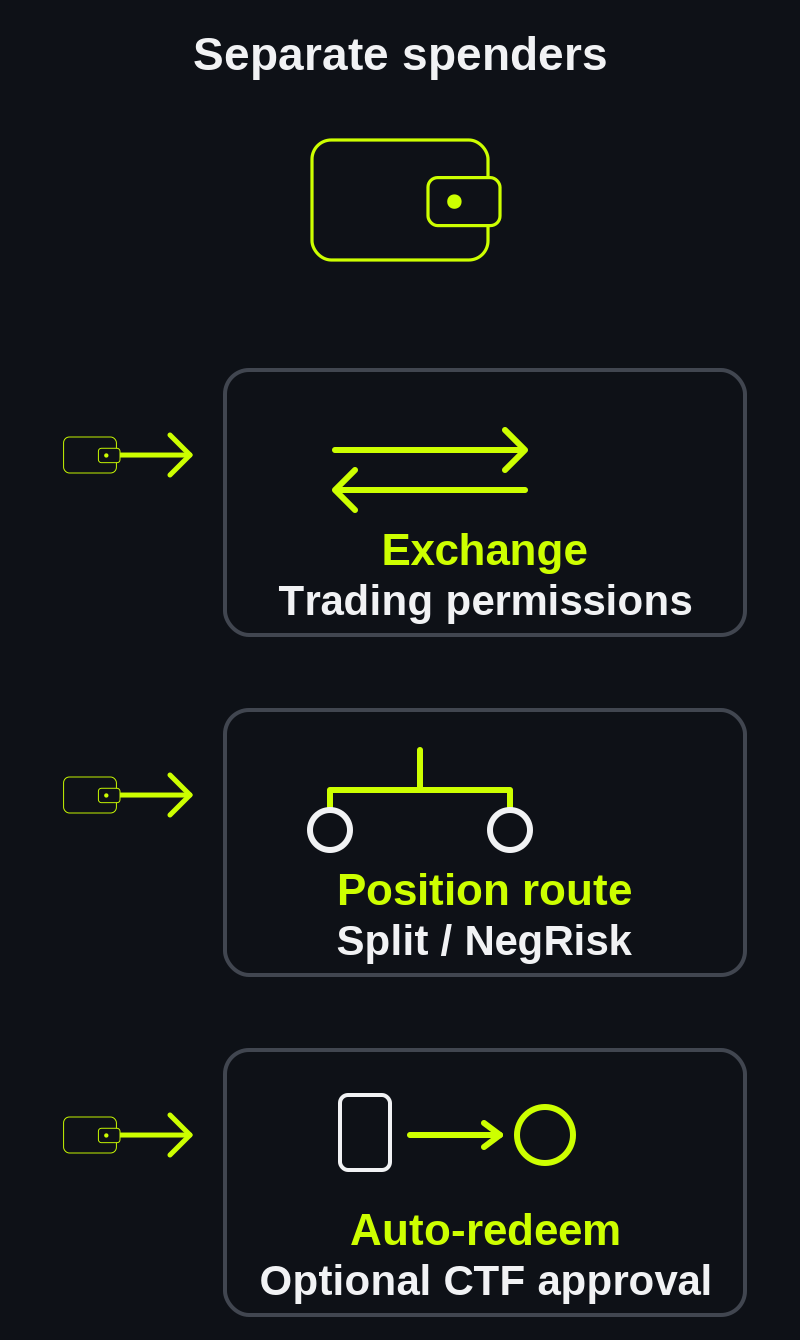
Read the asset, spender address and scope of each approval. ERC-1155 operator approval covers more than one selected position.
An optional redemption helper introduces another contract and permission boundary. Before approving it, identify its published source, who may invoke it and where collateral must be delivered. A convenience feature does not make a broad token approval narrow.
Recovery has two clocks
In this Deposit Wallet, owner-called pause() records a timestamp. Its direct owner emergency entry points—for withdrawals, approval/session revocations and opt-out—require the current time to be strictly later than that timestamp plus the factory’s configured delay. Those calls bypass factory submission under the inspected implementation; the factory admin can change the delay within the contract’s bounds.
Wallet pause is not a trading kill switch here. Neither execute() nor isValidSignature() checks that paused timestamp. Existing authorizations and approvals therefore need their own treatment; naming a function “pause” does not establish that it disables them.
The public upstream CTF Exchange V2 pause example uses a configured block delay before an account restriction takes effect. This illustrates a separate clock from a wallet’s emergency waiting period; it does not establish Kuest’s live exchange behavior or parameter values.
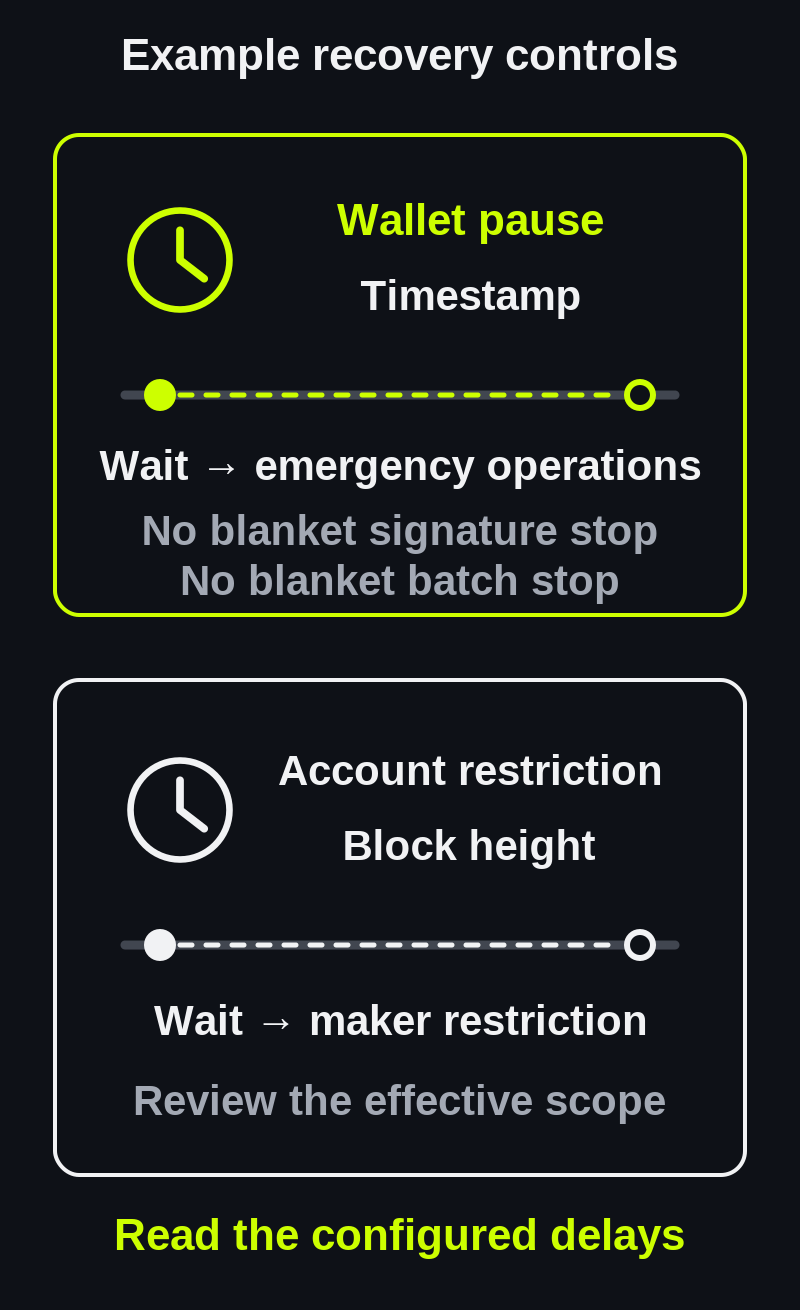
Recovery controls can have different clocks and scopes. This comparison is not a statement of every deployment’s parameters.
Preapproval creates another boundary. The public upstream Exchange V2 source illustrates operator preapproval of an order hash. Preapproval, effective token permissions, supported cancellation and account restrictions need separate checks; changing a signer does not automatically prove every prior authorization is unusable.
The matching operator chooses which matches to submit, within the contract’s signature, price and fill checks. Exchange admins can manage operators, pause trading and configure fee parameters. User-held assets therefore coexist with service availability, submission policy and administrative dependencies.
The address can stay while its logic changes
A proxy can keep one user-facing address while executing a different implementation. ERC-1967 defines standard implementation and beacon storage conventions. Inspect the proxy’s current target, published source and upgrade authority rather than treating an unchanged address as unchanged code.
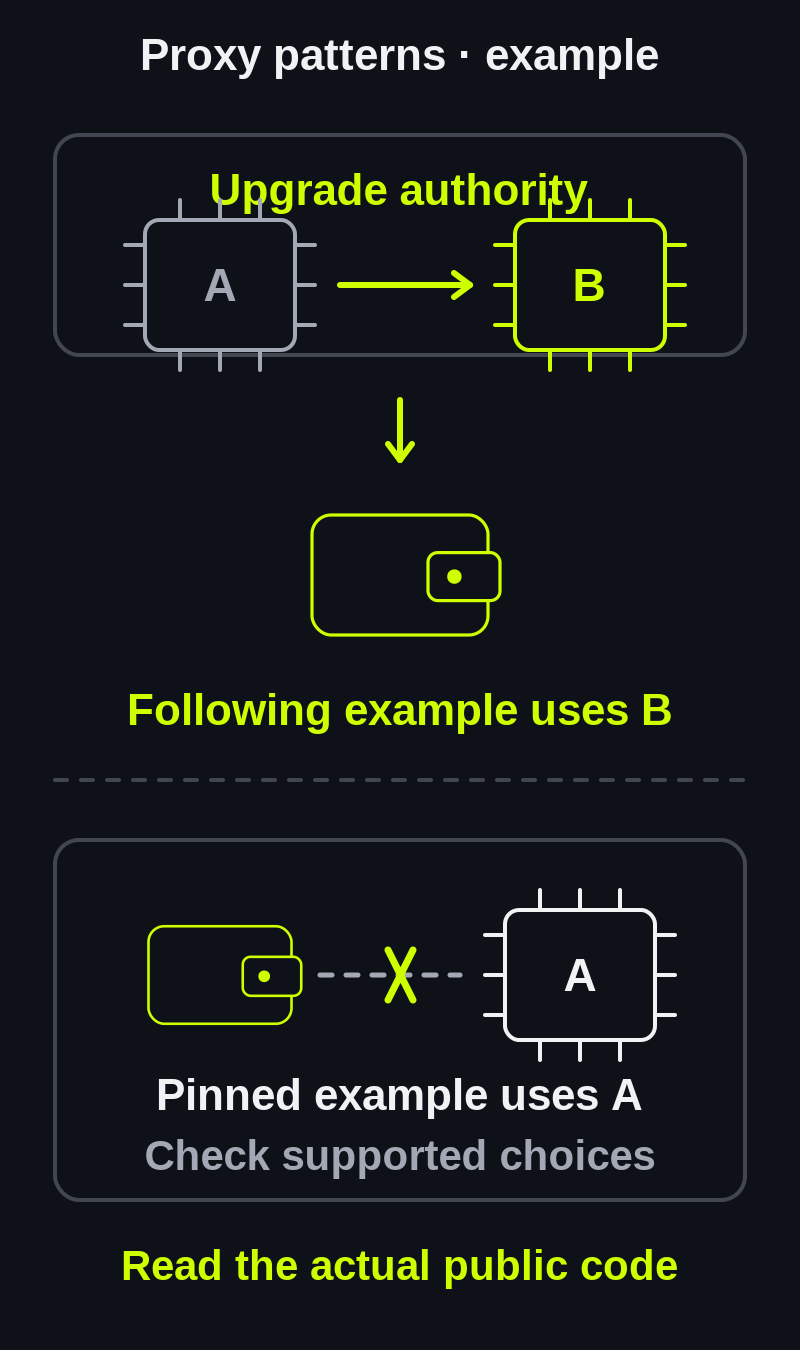
Following and pinning are conceptual patterns. Confirm which choices the actual deployed public code supports.
A beacon-based design can have wallets following a shared implementation and, where expressly supported, a separate pinning or opt-out mechanism. The figure is a conceptual comparison of those patterns, not a claim that every wallet supports both. Confirm the actual deployed code and supported recovery instructions before describing a particular account as pinned, immutable or upgrade-protected.
Name the failure before describing the protection
“Non-custodial” can describe user-authorized asset movement while leaving operational and upgrade trust in place. A useful review asks which component can move funds, alter that authorization, decide payout or interrupt access.
| Component compromised or unavailable | Boundary affected |
|---|---|
| Owner key | Wallet authorization and owner recovery powers; losing the key also threatens access |
| Authorized session signer | Delegated signatures until expiry or effective revocation; inspect actual scope |
| Application server or API credentials | Authenticated service actions and request integrity, within service permissions and remaining signature checks |
| Factory or beacon upgrade authority | Future execution or wallet logic under the applicable upgrade path |
| Resolution authority | Which positions pay; see oracles and disputes |
| Metadata gateway | Availability of the referenced rules; unavailable content is not automatically a changed on-chain commitment |
| Relayer, RPC or indexer | Submission or visibility; stale data does not itself transfer funds, but can mislead decisions |
An application may need authenticated service credentials to support its documented account flow. Encryption at rest does not by itself establish what an active application can access. For participants, disclose the actual permissions and recovery route; API credentials and an owner’s private key are different kinds of authorization.
A website administrator is not automatically an exchange operator or contract owner. Likewise, a treasury described as a Safe needs its actual owners and threshold checked. Treasury control, reward-contract custody and a participant’s wallet ownership are separate questions.
What an operator should be able to explain
The Kuest wallet examples above refer to the publicly verified wallet implementation and factory implementation. At Polygon block 96459545, the public factory proxy 0x2CcdC6C5dDcd895aFcCD259F291de9b618A5cA6c pointed to that factory logic and its beacon returned that default wallet logic. This identifies the reviewed implementation, not every historical account or future upgrade.
Before calling a deployment reviewed, identify the actual asset-holding wallet, factory, beacon, effective implementation and relevant token permissions at a recorded block. The linked implementations have public verified source; the beacon page inspected for this review did not expose verified source. Its internal behavior is therefore not described here. Obtain documented recovery support for the actual wallet instead of assuming it from another component.
An upstream audit covers its named version and scope. Reviewing Kuest’s changes, reproducing a build, matching deployed bytecode, resolving proxy implementations and checking current roles each answer an additional question. An explorer’s verified-source badge alone does not establish an audit or eliminate privileged powers.
Launch your own prediction market with Kuest with a clear account-access explanation: identify where users’ assets live, disclose each permission and upgrade authority, and rehearse the supported recovery path. Those decisions belong alongside market rules and the liquidity plan.