
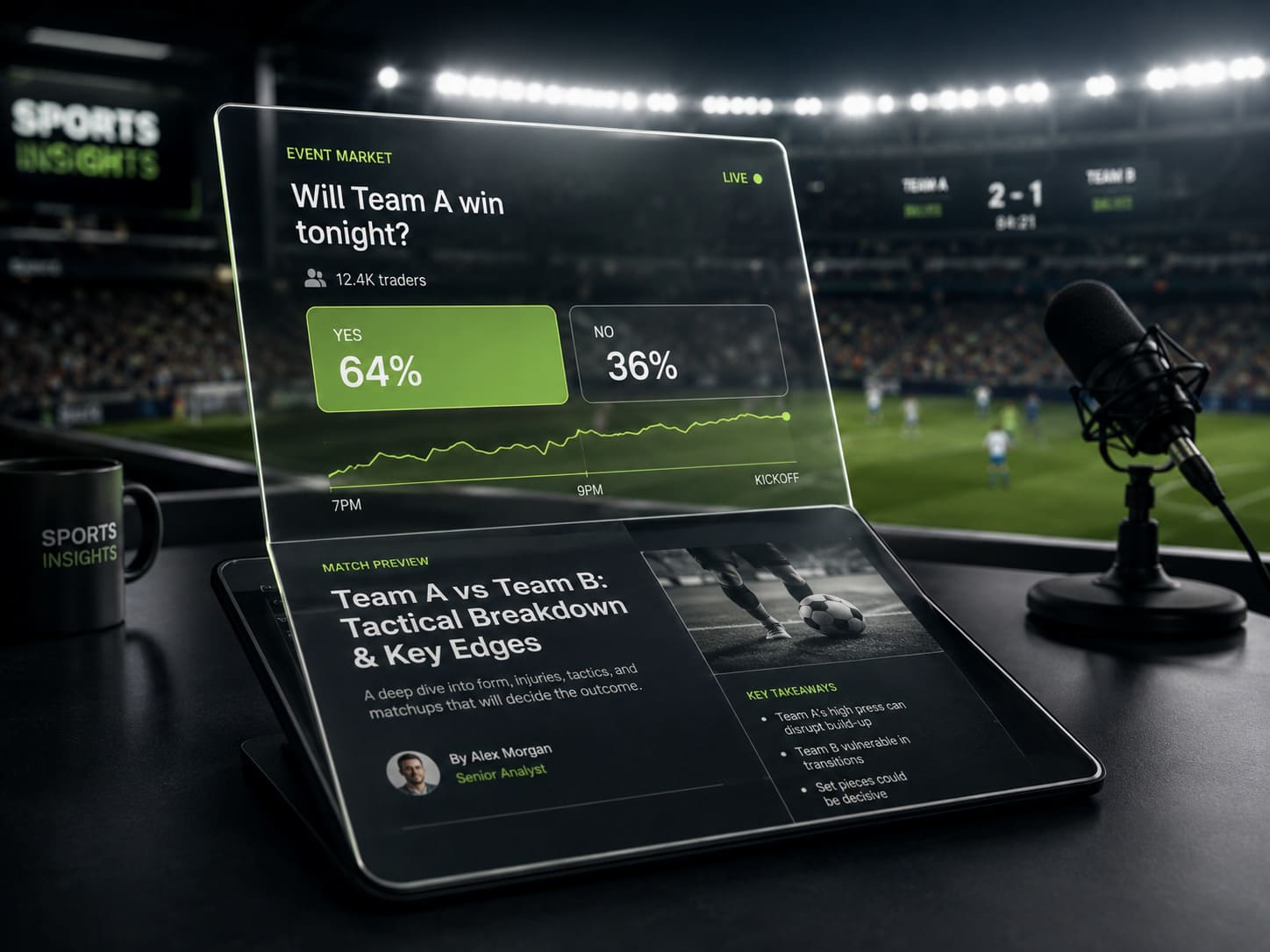
Your sports audience already predicts outcomes every day. A prediction-market layer can let your site monetize that conviction through trading activity without asking you to become a sportsbook overnight.
You publish match previews, injury reports, transfer news, power rankings, fantasy analysis, betting-adjacent content, or live commentary.
Your readers already ask:
Will the favorite win this weekend?
Will this club qualify for Europe?
Will the driver finish on the podium?
Will the rookie win the award?
Will the team reach the final?
The discussion creates attention.
The attention creates pageviews, newsletter opens, podcast downloads, social replies, and sponsor inventory.
But the most commercial action often happens somewhere else. A reader leaves your article, opens a sportsbook or betting exchange, and turns the prediction into a wager on another company’s product.
That is a meaningful gap for sports publishers and media operators.
The usual alternatives are familiar: sell more banners, add another sponsor package, build a subscription tier, or send qualified traffic to a sportsbook through an affiliate deal.
Those models can work. They also make the operator dependent on impressions, recurring access, or somebody else’s conversion funnel.
There is another layer to test:
operate a branded sports prediction market platform where the questions your audience already debates become event markets and the operator earns a fee when users trade.
This is not a shortcut around gambling law.
It is a different infrastructure and regulatory conversation from launching a sportsbook, and that difference is exactly why sports media operators are paying attention.
Sports media already has the audience and the monetization problem
Sports publishers do not usually struggle to create interest.
They struggle to capture enough value from the interest they create.
A breaking-news story can attract a large audience for a few minutes.
A match preview can generate search traffic for several days.
A newsletter can become a habit.
A podcast can build trust over months.
But the commercial layer is often disconnected from the editorial layer.
The sports-media business already uses a mix of revenue models. Better Collective’s 2025 annual report separates publishing revenue into revenue share, CPA, subscription, sponsorships and CPM, which is a useful picture of the existing stack for sports content businesses. The annual report also describes publishing as revenue generated through an owned-and-operated sports media network and partnerships.
The Athletic offers a different example. Its path to profitability has included subscription-bundle distribution, paid advertising, sponsorships, and partnerships around sports lifestyle topics. Axios’ reporting shows how a sports media product can combine subscription and advertising economics while expanding into audio, video, and commercial partnerships.
The pattern is consistent:
sports media is already a product business, not just an advertising business.
The next product does not need to be a sportsbook.
It can be a market attached to the editorial relationship you already own.
Why launching a sportsbook is a heavy first step
A sportsbook is not just a sports website with odds on it.
It is a regulated gambling operation with a specific risk, compliance, payments, player-protection, and trading model.
Depending on the jurisdiction, the operator may need to manage licensing, responsible-gambling controls, age and identity verification, geolocation, KYC and AML processes, technical testing, suspicious-activity reporting, tax obligations, customer-fund rules, advertising restrictions, and ongoing regulatory reporting.
The UK Gambling Commission provides a concrete example of the operational burden. It says a remote application can take up to 16 weeks depending on business complexity, and its remote betting licence pages list application fees, annual fees, technical requirements, and continuing compliance obligations. The remote-sector guidance explains the application process, while the remote general betting licence page shows that fees vary by activity and gross gambling yield.
That is one regulator and one market. It is not a universal cost estimate.
In the United States, the structure is different again. Legal sports betting is built through state and tribal frameworks, with market-specific licenses, taxes, restrictions, and integrity requirements. The American Gaming Association’s State of the States 2025 report shows how initial license fees, renewal fees, tax rates, mobile availability, and collegiate restrictions vary by state.
For a sports publisher, the strategic problem is simple:
you may want to monetize sports conviction long before you want to become a full gambling operator.
| Launching a sportsbook | Adding a prediction-market layer |
|---|---|
| Requires a gambling or betting framework in each target market | Uses an event-contract or other applicable framework that must be assessed for each market |
| The operator manages betting liability, pricing, and settlement exposure | A venue can be structured around exchange-style trading and defined contracts |
| Customer funds, KYC, AML, age, location, and responsible-gaming controls are central | User eligibility, identity, funds, risk, and responsible-trading controls still matter |
| Requires sportsbook odds, trading, risk, payments, and player-support operations | Requires market creation, order matching, liquidity, resolution, data, and support operations |
| Revenue often comes from sportsbook margin or revenue share | Revenue can come from a configured fee on trading activity |
| The operator is directly entering the wagering category | The media brand can test a market product beside its editorial product |
The second column is not a claim that regulation disappears.
It is a different product decision with a different legal analysis.
What a sports prediction market platform actually does
A prediction market asks users to trade on the outcome of a defined event.
A market could ask:
Will Club A win the 2026 league championship?
Will the match end with more than 2.5 goals?
Will Team B qualify for the knockout stage?
Will Driver C finish on the podium in the next race?
Users buy or sell positions based on their view. The market price expresses the crowd’s current probability before considering the spread and execution details.
The CFTC describes event contracts as products designed to help people forecast, plan, hedge, or harness perceptions of future events. Its overview explains that prices reflect traders’ perceived probability, order books can show real-time bids and asks, and customers may trade in and out before settlement. Read the CFTC’s overview of prediction markets and event contracts for the regulated-market model.
For sports media, the important product boundary is:
your article creates context; the market creates an action layer.
The article can explain the teams, form, injuries, schedule, tactics, and historical patterns.
The market can let an eligible user express a view by taking a position.
The result is a product loop that feels native to sports content:
preview → debate → market → new information → price movement → recap
That loop can operate beside your existing site, newsletter, podcast, community, or app.
The revenue stack for sports publishers
A prediction market should not be presented as a replacement for every existing revenue stream.
It is a new layer attached to a behavior that existing content already creates.
| Revenue model | What the audience does | What the operator earns from | Main limitation |
|---|---|---|---|
| Display advertising | Reads, watches, or listens | Impressions and advertiser demand | Revenue is tied to inventory and attention, not conviction |
| Sponsorship | Associates with a show, newsletter, team, or editorial franchise | Campaign or placement fees | Often episodic and dependent on sponsor budgets |
| Subscription | Pays for access, analysis, tools, or community | Recurring membership revenue | Requires a continuing premium benefit |
| Sportsbook affiliate | Clicks, registers, deposits, or bets with a third party | CPA, revenue share, or hybrid commission | The third party owns the transaction and customer experience |
| Data or premium tools | Uses projections, stats, fantasy tools, or alerts | Subscription or licensing revenue | Requires differentiated data or product depth |
| Prediction market | Trades a position on a defined sports question | Fee attached to trading activity | Requires clear rules, liquidity, resolution, and compliance design |
These models can coexist.
A match preview can carry a sponsor, link to a paid analysis product, include an affiliate disclosure, and point to a branded market for an eligible audience.
The market adds a new economic equation:
Operator fee revenue = trading volume × operator fee
Illustrative monthly volumes look like this:
| Monthly trading volume | At 0.5% | At 1.0% | At 1.5% |
|---|---|---|---|
| $25,000 | $125 | $250 | $375 |
| $100,000 | $500 | $1,000 | $1,500 |
| $500,000 | $2,500 | $5,000 | $7,500 |
| $2,000,000 | $10,000 | $20,000 | $30,000 |
These are illustrations, not a forecast or a recommended rate.
Actual economics depend on audience size, activation, repeat trading, market quality, liquidity, user geography, costs, applicable taxes, fee sensitivity, and the operator’s legal structure.
Our guide to prediction-market fee models covers starting rates, spreads, trader tolerance, and the difference between headline volume and net revenue.
Why sports are a strong category for prediction markets
Sports have three properties that make them unusually legible to a market product.
The outcomes are time-bound
A match has a start time and an end time.
A tournament has a bracket.
A season has a schedule and a final table.
That makes it easier to define when trading closes and when the result can be resolved.
The audience already forms opinions
Sports fans do not need to be taught to predict.
They already argue about lineups, tactics, transfers, form, coaching, injuries, weather, travel, and momentum.
The product challenge is not creating a reason to care.
It is selecting questions that can be expressed as clear, fair, and observable contracts.
The content cadence is naturally recurring
There is always another match, race, round, transfer window, draft, award, or season milestone.
That gives a media operator a repeatable publishing rhythm:
Monday preview → market launch → midweek update → match-day conversation → resolution → recap
The market becomes more useful when it is embedded in this cadence rather than launched as a separate destination that fans must remember to visit.
What sports markets should you create first?
The first market should be easy to explain in an article, easy to resolve from a trusted source, and relevant to the audience you already have.
Match and event outcomes
- Who wins the next match?
- Will the match go to overtime?
- Will the race finish under a specified weather condition?
- Will a team advance to the next round?
- Will a tournament finish with a specified champion?
These are easy to understand, but they still need rules for postponed matches, abandoned games, overtime, shootouts, replayed fixtures, and official corrections.
Season and tournament futures
- Will a club win the league?
- Will a team finish in the top four?
- Will a driver win the championship?
- Will a nation reach the final?
- Will a player win a season award?
Season markets can create longer-lived positions and give the audience a reason to return between match days.
Team and league milestones
- Will a team reach a defined number of wins?
- Will a club score more than a defined number of goals this month?
- Will a league set a record attendance figure?
- Will a team qualify for a competition?
- Will a franchise announce a new coach before a deadline?
These markets work well for specialist publishers because they can connect to the stories the audience is already following.
Media and fan-culture questions
- Will a transfer be completed before the window closes?
- Will an award ceremony name a specific winner?
- Will a sports documentary reach a defined audience milestone?
- Will a team announce a partnership before a given date?
- Will a fan vote produce a specified result?
These expand the market inventory beyond the final score while keeping the questions close to the editorial product.
What to avoid at launch
Avoid markets that settle on a single athlete’s private condition, an officiating action, an injury, an alleged disciplinary incident, or information that a small group can influence.
The CFTC’s March 2026 sports event-contract advisory specifically highlights heightened manipulation or price-distortion concerns for contracts involving injuries, unsportsmanlike conduct, physical altercations, or the action of a single person or small group, such as officiating actions. It also says sports-related contracts based on the aggregate performance of multiple participants over an extended period may be more consistent with the relevant market-integrity principle. Read CFTC Staff Letter 26-08 before designing a sports market catalog.
The practical rule is simple:
start with broad outcomes that are hard for one person to manipulate.
A sportsbook alternative no gambling license is not a legal category
The phrase sportsbook alternative no gambling license captures a real operator desire: monetize sports demand without spending years building a sportsbook licensing and risk operation.
But it is not a legal category.
The question is not whether a product uses the words “prediction market” or “event contract.” The question is how the product is structured, who operates it, what users are doing, where they are located, what they trade, how settlement works, and which regulator has authority.
There are at least three different layers to separate.
1. A sportsbook or betting intermediary
The product offers betting facilities on sports events. Depending on the market, it may take the other side, manage a book, operate an exchange, or facilitate bets between customers.
This is the category where gambling licensing, responsible-gaming requirements, age controls, geolocation, customer funds, and betting advertising rules are likely to be central.
2. A regulated event-contract venue
The product offers contracts that may fall under a derivatives or event-contract framework. In the United States, the CFTC describes federally regulated prediction markets, designated contract markets, intermediaries, order books, contract terms, and market-integrity obligations.
That does not mean every prediction-market interface is automatically covered by the same framework. A media operator may not be a registered exchange, broker, or intermediary. The infrastructure provider, entity structure, user relationship, and distribution model all matter.
3. A media and distribution layer
The publisher writes the preview, embeds the market link, distributes the recap, and owns the audience relationship.
That role does not grant permission to offer or advertise a regulated product to everyone everywhere.
It does, however, create a useful operating boundary: the sports media company can own content, brand, audience, and demand while a specialized infrastructure provider handles the market layer under an appropriate legal and compliance model.
That is the middle ground worth evaluating.
Sports leagues and data providers make integrity part of the product
Sports media operators sometimes think of integrity as a league problem that begins after launch.
It begins when the first contract is designed.
The market needs a trusted source, a fair close time, a resolution rule, and controls around participants who may possess non-public information.
This is becoming more visible as leagues engage directly with the prediction-market category. In March 2026, MLB announced Polymarket as its official prediction-market exchange partner and described an integrity framework with Polymarket and the CFTC. The agreement includes official league data, restrictions on markets that present integrity risks, and information-sharing commitments. See MLB’s official announcement.
The implication for a media operator is not that you need to negotiate an MLB partnership before publishing a market.
The implication is that sports data and integrity are product inputs, not decorative extras.
Ask:
- Is the data source official, licensed, or otherwise reliable?
- Does the source publish a timestamp and correction policy?
- Can the market be resolved without editorial interpretation?
- Are league, team, player, official, and insider restrictions documented?
- Does the provider monitor unusual trading or manipulation signals?
- What happens if the official source changes, disappears, or corrects the result?
- Can the operator pause a market before settlement?
If the answer to these questions is vague, the market is not ready for a homepage promotion.
Write the rulebook before the preview
Sports media teams are good at headlines.
Prediction-market operators need to be equally good at contract specifications.
Every market brief should answer:
- What exactly is the event?
- What counts as the final result?
- Does overtime, extra time, a shootout, or a replay count?
- When does trading close?
- Which official source determines the outcome?
- What happens if the match is postponed or abandoned?
- What happens if the league changes an official result later?
- Who proposes and reviews the resolution?
- How long can a resolution be challenged?
- What happens if the event is canceled or never occurs?
Polymarket’s resolution documentation is a useful reference for thinking about source selection, end dates, edge cases, proposal, and challenge processes.
For operators using Kuest, the Create Market API documentation covers market metadata and registration, while the DRO Resolution API documentation covers the resolution workflow.
A headline such as “Will Team A win?” is not a complete market specification.
The full specification must say whether the answer is based on regulation time, extra time, penalties, an official replay, or the league’s final record.
The rule should be visible before a user trades.
How the sports-media product loop works
The operator’s job is to connect editorial moments to market moments without turning every article into a sales page.
1. Publish the context
Write the preview your audience already expects.
Explain form, lineups, tactics, injuries, schedule, weather, data, and uncertainty.
Do not turn the editorial into a disguised instruction to trade a particular side.
2. Publish one clear market
Link a contract whose question, deadline, source, and edge cases are visible.
One good market near the top of the article is better than a catalog of unrelated markets at the bottom.
3. Let the market become the discussion object
Readers can debate the probability rather than only debate the writer.
The displayed price gives the conversation a moving reference point.
4. Return the market to the content cycle
As lineups are announced, weather changes, or the match progresses, the market can move.
The newsletter, live blog, podcast, or social account can explain what changed without promising an outcome.
5. Resolve and recap
Once the official result is available, resolve the market through the defined process and publish a recap.
That closes the loop and gives the audience a reason to return for the next event.
The operator’s first launch plan
Phase 1: Audit the existing sports audience
Review the last 60 days of:
- Match previews and recaps.
- Newsletter clicks and replies.
- Podcast questions and listener messages.
- Social posts with the highest discussion rate.
- Polls and community threads.
- Search queries and pages with repeat traffic.
Look for questions that are recurring, disputed, time-bound, observable, and specific to your audience.
The best first market is usually hidden in an existing content pattern.
Phase 2: Pick one sport and one cadence
Do not launch football, basketball, tennis, motorsport, cricket, esports, and awards markets at once.
Choose one vertical where your editorial team already has credibility.
Then choose a cadence:
- One market per match day.
- Three to five markets per week around a league.
- One season-future market plus weekly event markets.
- One market per race, round, or tournament stage.
Consistency matters more than catalog size.
Phase 3: Launch with five to ten broad markets
Use a small first catalog:
- Two match or event outcomes.
- One tournament or season market.
- One team or league milestone.
- One market connected to the editorial story of the week.
Avoid niche player props, referee calls, injury markets, and questions that depend on a private source.
The goal is to learn whether your audience wants to trade, not to make the interface look full.
Phase 4: Seed the market in the editorial workflow
Place the market where the audience already has context:
- Inside the match preview.
- In the newsletter section covering the event.
- In the podcast show notes.
- In the live-blog header or recap.
- In the community channel where fans debate.
Add a short explanation of what the price means and link to the full market rules.
Phase 5: Add the market to the recurring format
Make it part of the product, not a one-time experiment.
Examples:
- “Market of the weekend” in the newsletter.
- A probability segment in the podcast.
- A daily market board during a tournament.
- A Monday recap of resolved markets.
- A weekly article comparing market movement with expert predictions.
The format creates habit without forcing every reader to trade.
Phase 6: Measure activation and trust
Track:
- Article readers who view the market.
- Market viewers who become eligible first-time traders.
- First traders who return.
- Average volume per active trader.
- Spread, depth, and slippage.
- Resolution time after official results.
- Disputes and support contacts.
- Markets that attract views but no trades.
- Which sports, formats, and writers produce repeat activity.
The first launch succeeds when you learn which editorial formats create useful market activity.
What to ask a prediction-market infrastructure provider
Sports media operators should not evaluate providers only by demo quality.
Ask operational and legal questions before committing your brand.
Regulatory and entity model
- Which entity operates the market venue?
- In which jurisdictions is the service available?
- Who determines user eligibility and restricted locations?
- Who handles KYC, AML, sanctions, age, and responsible-trading controls?
- Is the provider a registered exchange, broker, intermediary, technology provider, or another type of service?
- What responsibilities remain with the media operator?
Market integrity and sports data
- Where do results and live data come from?
- Are official league or governing-body sources supported?
- How are insider restrictions and suspicious trading handled?
- Can the operator exclude markets involving individual athletes or officials?
- What is the correction, postponement, and abandoned-event policy?
Trading and liquidity
- Is the price backed by a live order book?
- Who provides bids and asks at launch?
- Is liquidity shared across operator venues?
- Can users place limit orders?
- How are spreads, slippage, pauses, and cancellations displayed?
- What happens during high-volatility moments?
Brand and ownership
- Can the market use the publisher’s domain and visual identity?
- Who owns the audience relationship and first-party data?
- Can the operator choose categories and publishing cadence?
- Are the fee schedule and attribution visible?
- Can the operator export activity and revenue data?
Operations and support
- Who answers user support questions?
- Who proposes resolutions and handles challenges?
- What incident-response process exists for a live sports event?
- Can the operator pause a market quickly?
- What notices, disclosures, and terms must appear next to the market?
If a provider answers only the product questions and avoids the entity, user, integrity, and resolution questions, keep evaluating.
How Kuest fits a sports media operator
Kuest is designed for operators who already have an audience and want to add a branded prediction-market layer without building an exchange stack from scratch.
Your sports publication remains yours.
Your editorial team chooses the questions, categories, cadence, and voice.
Your brand and custom domain can become the market surface.
Kuest provides the underlying prediction-market infrastructure, including matching, settlement, resolution workflows, shared liquidity, and operator controls.
The Kuest protocol overview explains the infrastructure model. The owner architecture documentation describes the boundary between the operator deployment and Kuest services. The guided launch documentation covers the route from configuration to a branded venue, and the custom-domain guide helps make the market feel like part of your sports product.
For programmatic publishing, use the Create Market API documentation. For settlement operations, use the DRO Resolution API documentation. For fee attribution and operator economics, review the Affiliate & Fees documentation.
Our guide to shared liquidity for prediction markets explains why a media operator should not need to build a market-making desk before testing the first market. Our build-vs-license analysis covers the cost and timeline tradeoff of owning the full exchange stack.
The simple model is:
Your sports media brand = audience, context, trust, and distribution
Kuest = market infrastructure, liquidity, matching, and settlement rails
Your operator fee = the revenue layer attached to trading activity
Kuest does not turn an ambiguous sports product into a compliant one by itself. It gives the operator an infrastructure layer that can be evaluated with counsel against the target market, user, and distribution model.
The opportunity is not to become a sportsbook overnight
The strongest sports-media use case is usually narrower than “launch our own betting product.”
It is:
turn the questions our audience already discusses into a branded, measurable, repeatable market experience.
That lets the operator test:
- Whether fans will take positions, not just click headlines.
- Which sports and editorial formats create repeat activity.
- Whether a fee-per-trade model complements sponsorship and affiliate revenue.
- Whether the audience trusts the market rules and resolution process.
- Whether the infrastructure can support the operator before the team takes on deeper regulatory and operational responsibilities.
The product can begin with a small catalog, one sport, broad outcomes, and an optional action layer.
The brand does not need to promise betting advice.
The writer does not need to tell readers what to trade.
The market does not need to replace the content.
It needs to make the content’s strongest recurring predictions actionable in a controlled, transparent way.
FAQ: Sports Media Prediction Markets and Sportsbook Alternatives
What is a sports prediction market platform?
A sports prediction market platform lets eligible users trade positions on defined sports outcomes. A media operator can publish the market alongside previews, newsletters, podcasts, or community discussions while an infrastructure provider handles the exchange, liquidity, settlement, and resolution layers.
Is a prediction market the same as a sportsbook?
No. A sportsbook is a betting product with its own licensing, risk, pricing, payments, and responsible-gambling requirements. A prediction market may use event contracts and an exchange-style order book, but its legal treatment depends on its exact structure, operator, users, collateral, jurisdictions, and distribution. Do not assume the label determines the law.
Can a sports media site launch a sportsbook alternative with no gambling license?
The phrase sportsbook alternative no gambling license describes a business goal, not a guaranteed legal outcome. Some prediction-market structures may be available through a regulated infrastructure provider under an applicable event-contract or derivatives framework. The media operator still needs counsel to determine whether it is offering, arranging, marketing, or distributing a regulated product in each target jurisdiction.
Why would a sports publisher choose a prediction market instead of sportsbook affiliate links?
Affiliate links monetize referrals into another company’s funnel. A branded prediction market can keep the market surface, audience relationship, question selection, and operator fee closer to the publisher’s own product. Affiliate and prediction-market revenue can coexist; they monetize different actions.
How does a sports prediction market make money?
The operator configures a fee on trading activity. The basic equation is trading volume multiplied by the operator fee. Actual revenue depends on activation, repeat trading, market quality, liquidity, user geography, costs, and the applicable legal and business structure.
What sports markets should a media site launch first?
Start with broad, time-bound outcomes that are easy to explain and resolve: match winners, tournament advancement, season futures, team milestones, or championship outcomes. Avoid individual injuries, officiating decisions, private information, and markets that a single person or small group could manipulate.
Do sports markets need official league data?
Not every market needs an official feed, but the operator needs a reliable, pre-defined source and a clear correction policy. Official league or governing-body data can improve settlement confidence and integrity, especially for markets where timing or corrections matter.
How should a sports market handle overtime or postponed matches?
The rule should say before trading starts whether regulation time, extra time, penalties, replays, postponements, abandoned matches, or official corrections count. If a reasonable moderator could interpret the same event in two ways, the market is not ready to publish.
Does the media operator need to provide liquidity?
Not necessarily. A provider may offer shared liquidity or managed market-making support, but the operator should understand who supplies bids and asks, how spreads are shown, and what happens when a market moves quickly. An empty order book is a trust problem, not just a trading problem.
Does the media operator need to build a sports trading engine?
No. A managed infrastructure provider can supply matching, settlement, liquidity, resolution workflows, and operator controls. The media operator should focus on audience distribution, market selection, editorial context, support, and the legal responsibilities that remain with its entity.
Can a publisher promote markets inside articles and newsletters?
It may be possible, but promotion is not permission. The publisher needs to understand advertising, financial-promotion, gambling, consumer-protection, platform, and jurisdictional rules before distributing market links. Use clear disclosures and avoid presenting a market as guaranteed income or a recommendation to take a particular side.
How is a sports prediction market resolved?
The market should define the outcome, trading close, source, edge cases, proposer, review process, and challenge window before launch. The operator or provider then follows that process when the official result becomes available.
Is a sports prediction market a lower-risk regulatory option?
It may be a different and potentially lighter infrastructure path for some operators, but that is not a universal conclusion. Sports markets are receiving active regulatory and league scrutiny, particularly around integrity and manipulation. Treat the prediction market as a separate legal product that still requires jurisdiction-specific analysis.
What should a sports publisher measure during the first launch?
Measure article-to-market views, first-trade conversion, repeat trading, volume per active trader, spread, depth, slippage, resolution time, disputes, support contacts, and activity by sport and editorial format. The goal is to learn which content creates trusted repeat market activity.