
If you search for “how to create a market on Polymarket,” the answer depends on what you want to own. Regular users can suggest a question to Polymarket, but they cannot open it themselves. If you want your own questions, brand, audience and trading-fee revenue, Kuest lets you launch a prediction-market platform.
As of September 2026, Polymarket markets are created by its markets team with input from users and the community. You can propose a question, but Polymarket decides which proposals become tradable markets.
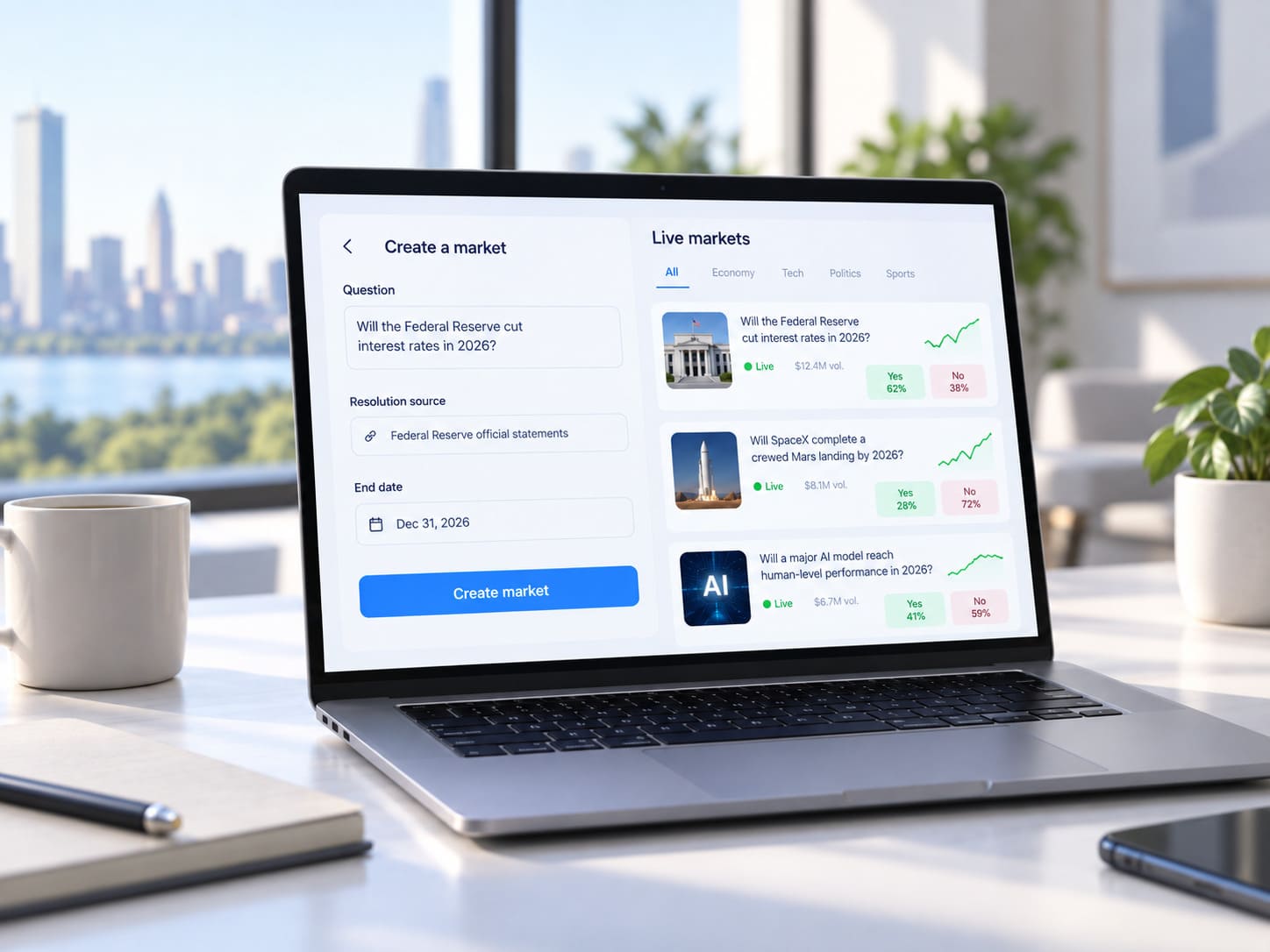
The cover is a conceptual illustration of an operator configuring a venue; it is not an official Polymarket interface.
This distinction matters for creators, communities, media businesses, entrepreneurs and prospective operators. If you want one question listed, submit a clear proposal. If you want to choose the catalogue, build an audience around it and earn from trading activity, own the destination where that activity happens.
Can you create a market on Polymarket?
No—not directly. Polymarket uses a curated market-creation model. There is no public “Create Market” flow where a regular trader writes a question and immediately opens it for trading.
Users can still contribute ideas. Polymarket asks for a title, a resolution source and evidence that traders want the market. Its markets team reviews the proposal and decides whether to create it.
The practical choice looks like this:
| Goal | What you do | Who controls the venue | What you receive |
|---|---|---|---|
| Get one question listed on Polymarket | Submit a well-specified proposal | Polymarket markets team | A chance for the market to be listed; no listing guarantee |
| Operate a branded prediction market | Choose your audience, questions, brand, fees and distribution | You, with Kuest handling the infrastructure | Custom markets, your domain, shared liquidity options and trading-fee revenue |
How to submit a market idea to Polymarket
Polymarket’s current guidance asks for three things:
- A clear market title. State exactly what traders are forecasting.
- A resolution source. Name the official page, dataset, exchange or authority that will determine the outcome.
- Evidence of demand. Show why a real audience would trade the question.
The Help Center recommends proposing ideas publicly on X by tagging @Polymarket. A proposal is an input to the markets team, not a market you publish yourself, so there is no guarantee it will be created.
Does proposing a market make you money?
No. Suggesting a question does not make you the operator of the resulting market, and Polymarket’s public proposal guidance does not promise an automatic trading-fee share to the person whose question is listed.
If you want to earn from trading activity, you need to own the destination. That is the bridge from submitting your best questions to someone else’s platform to launching a platform with your brand, your markets, your audience and your fees.
How to write a question that can actually resolve
A strong prediction-market question is unambiguous when money is at risk. Polymarket’s resolution documentation explains that the title describes the event, while the rules define the source, deadline and edge cases.
Compare these two versions:
Vague question
Will Bitcoin moon this year?
“Moon” has no objective threshold, so traders can interpret it in different ways.
Better question
Will Bitcoin trade at or above $150,000 before December 31, 2026?
A production-ready version should also name the price index or exchange, observation window and timezone.
Use five checks before you submit a question:
1. Define one event
Ask traders to price one measurable outcome. Split combined ideas into separate markets when they represent separate decisions.
2. Set a real deadline
Give the market a firm end date so it can close even when the answer is no.
3. Choose an authoritative source
Use an official authority, named dataset or specified exchange that reviewers and traders can check.
4. Resolve edge cases in advance
State what counts before trading starts: for example, whether a beta release, announcement or intraday price counts.
5. Test demand, not only validity
The best proposals combine uncertainty, disagreement, a clear resolution and an audience that cares.
Examples for focused communities
Turn an opinion into a measurable event:
- Crypto: Will Solana trade above $300 before December 31, 2026? Name the exchange or index.
- AI: Will OpenAI publicly release a new flagship GPT model before December 31, 2026? Define “publicly release.”
- Sports: Will Arsenal win the 2026–27 Premier League? Use the league’s official final table.
- Creator economy: Will Creator X’s public Instagram account display at least 10 million followers before 23:59 UTC on December 31, 2026? Define how the count will be checked.
Each question is narrow enough to resolve and specific enough for a community to decide whether it wants to trade it.
When you want to own the market
Instead of submitting your best questions to someone else’s platform, Kuest lets you launch the platform yourself: your brand, your markets, your audience and fees from trading activity. You choose the focus and the questions; Kuest handles the infrastructure so you can launch without code or a server.
| Question | Submit to Polymarket | Operate with Kuest |
|---|---|---|
| Who chooses the catalogue? | Polymarket’s markets team | You |
| Where does the audience trade? | Polymarket | Your brand and custom domain |
| Can you publish niche questions? | Only if Polymarket accepts them | Yes, create markets for your audience |
| How do fees work? | No automatic proposer fee is promised | Choose a configurable 0.5%–3% trading fee paid directly to your operator wallet |
| How do you start with liquidity? | Use Polymarket’s existing venue | Mirror active Polymarket markets and start with shared liquidity |
How to launch a Polymarket-style venue with Kuest
Step 1: Choose your audience
Start with a community you understand: a creator audience, newsletter, media brand, local community or focused topic. Your edge is knowing which questions people already discuss.
Step 2: Create your questions
Turn that knowledge into clear, resolvable markets. Define the event, source, deadline and edge cases before you invite people to trade.
Step 3: Choose your trading fee
Set a configurable trading fee of 0.5%–3% per trade, paid directly to your operator wallet. Choose the rate that fits your audience and business model, then make it clear to traders.
Step 4: Optionally mirror established Polymarket markets
Add active Polymarket markets when they help your audience. Shared liquidity gives a new venue a useful starting point instead of an empty order book, while your custom questions give people a reason to stay.
Step 5: Add your brand and launch
Choose your logo, colors, language and custom domain. Kuest handles the infrastructure, so you can launch free, with no code, in approximately 15 minutes.
Frequently asked questions
Can anyone create a market on Polymarket?
No. Regular users can suggest questions, but Polymarket’s markets team decides which proposals become markets.
How do I suggest a market to Polymarket?
Share a clear title, resolution source and evidence of demand. Polymarket’s Help Center recommends posting the idea on X and tagging @Polymarket.
How do you create a question on Polymarket?
You can propose it, but you cannot publish it directly as a regular user. Polymarket decides whether to create the market.
What makes a good Polymarket question?
Use one measurable event, a firm deadline, an authoritative source and clear rules for edge cases. Show why traders will care.
Can I earn fees for suggesting a Polymarket market?
Polymarket’s public proposal guidance does not promise an automatic fee share for the person who suggests a listed question.
Can I create my own prediction market instead?
Yes. Kuest lets you launch a branded venue with custom questions, configurable trading fees, optional Polymarket mirrors and shared liquidity, without code or a server.
How much does it cost to start with Kuest?
Kuest is free to launch, with usage-based costs as your venue scales. See the launch page for the current path.
You found the question. Now own the market.
If you came here looking for a button that lets you publish your own question on Polymarket, that button does not currently exist for regular users.
If your goal is to build a market business, choose the questions, put them under your brand, set your fee and give your audience a place to return. Launch your own prediction market with Kuest—free, no code and live in approximately 15 minutes.