
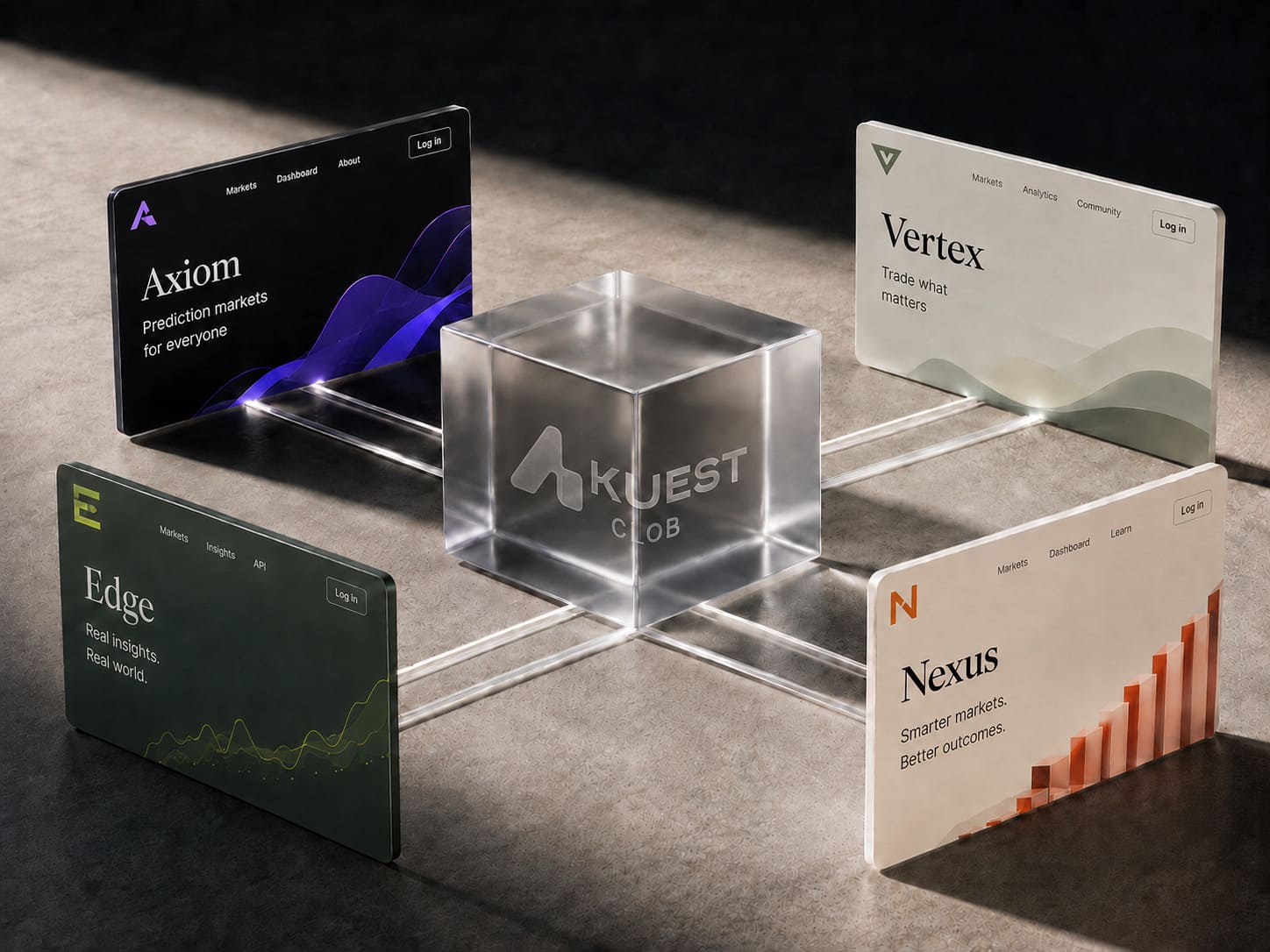
If you already know you want to operate a prediction-market business, the question is not whether prediction markets are interesting. It is which parts of the stack you should own — and which parts you should buy as SaaS.
You have the audience, distribution channel, product thesis or trading business.
You know the market you want to serve.
You have probably looked at Polymarket and thought:
“I want this kind of product, under my brand, for my users.”
That is a business decision.
It is also an infrastructure decision.
A Polymarket-style venue is not just a frontend with a question, a YES button and a probability chart. It is a live trading system with an order book, market data, wallets, settlement, resolution, liquidity, operational controls and a compliance perimeter.
The fastest way to launch in 2026 is usually not to assemble every component yourself.
It is to use prediction market SaaS: a managed, multi-tenant infrastructure layer that lets you operate a branded venue while a specialist provider runs the difficult parts underneath.
The operator owns the customer relationship, market strategy, brand, distribution and fee economics.
The infrastructure provider supplies the rails.
That is what a white label prediction market should mean in practice.
What is prediction market SaaS?
Prediction market SaaS is software and infrastructure that lets a business launch and operate an event-trading venue without building the complete stack internally.
The provider may supply some or all of the following:
- A branded trading frontend and custom domain.
- Market creation, templates, categories and lifecycle controls.
- A central limit order book and order-matching infrastructure.
- Wallets, balances, positions, deposits and withdrawals.
- Market data, charts, order updates and webhooks.
- Resolution, settlement, payout and dispute workflows.
- Liquidity through shared order flow, market makers or external venues.
- Operator analytics, permissions, monitoring and support.
- KYC, eligibility, geofencing and other compliance integrations.
The exact product varies by provider. Some vendors offer only an API or a widget. Others offer a complete white-label venue. Those are very different products.
The important distinction is whether you are buying a trading product or merely buying access to someone else’s markets.
| Model | What the user sees | What the operator controls | Best fit |
|---|---|---|---|
| Affiliate / referral | A third-party venue | Traffic and promotion | Testing demand without operating a product |
| Market-data API | Your own frontend | Experience and distribution | Teams with their own trading and settlement stack |
| Embedded widget | A market inside your existing app | Placement and surrounding UX | Adding a narrow prediction surface |
| White-label SaaS | A complete venue under your brand | Brand, markets, fees, audience and operations | Operators that want to launch a real business quickly |
| Build in-house | A fully custom venue | Everything | Teams whose moat is exchange infrastructure itself |
If you are searching for a white label prediction market, the target product is usually the fourth row: a complete venue that is yours commercially and visually, without making you responsible for every low-level system on day one.
What does it mean to white-label your own Polymarket?
It does not mean copying Polymarket’s name, interface or contracts.
It means offering the same broad class of product primitives — tradable event contracts, probability-priced outcomes, order-book execution and settlement — through your own business.
Your users should experience:
- Your domain.
- Your logo, colors and typography.
- Your market categories and editorial voice.
- Your onboarding and account experience.
- Your market selection and featured events.
- Your fee model and customer support.
- Your terms, eligibility rules and geographic availability.
The provider should make the underlying systems available without turning its brand into the product’s main identity.
Polymarket’s public documentation is useful because it makes the underlying primitives concrete. It describes a central limit order book in which prices emerge from supply and demand, with off-chain matching and on-chain settlement. Its developer documentation also exposes market-data feeds, order updates and trading APIs.
That is the standard you should use when evaluating a SaaS provider. Do not ask only whether it has a “prediction market UI.” Ask whether it can support the complete lifecycle of a tradable event contract.
The six layers underneath a Polymarket-style venue
1. Market creation and lifecycle
Someone has to create the contract before anyone can trade it.
The market layer defines the question, outcomes, opening time, closing time, payout, resolution source, edge cases and status transitions.
A serious operator needs more than a form that publishes a sentence. You need reusable market templates, approval workflows, the ability to pause or cancel a market, versioned rules and a record of what changed and when.
Start with a binary market if that is what your audience understands best:
Will the European Central Bank cut rates at its September meeting?
Then make the rules explicit:
- Which meeting counts?
- What source determines the outcome?
- What happens if the meeting is postponed?
- When does trading close?
- When can the market be resolved?
The market question is the headline.
The resolution rules are the product.
If you want to automate market creation instead of relying only on an admin dashboard, Kuest’s Create Market API documentation covers the metadata, authorization and registration flow for creating events and markets.
2. Trading and the order book
Prediction markets are trading venues, not static polls.
A central limit order book, or CLOB, lets users post bids and asks. The spread between those orders is part of the user experience. When the book is thin, a trader pays more slippage and has less confidence that the displayed probability is actionable.
Your provider should explain:
- Whether matching is centralised, decentralised or hybrid.
- Whether matching happens off-chain and settlement on-chain.
- Which order types are supported.
- How partial fills and cancellations work.
- How market and user state updates reach the frontend.
- What happens during an engine restart or chain outage.
Polymarket’s documentation describes a hybrid CLOB model: compatible orders are matched off-chain and the matched trade settles through smart contracts. Kalshi’s current developer documentation similarly exposes REST, WebSocket and FIX interfaces for event-contract market data and trade execution.
You do not need to reproduce either venue’s implementation. You do need to understand whether your SaaS provider has the same operational depth.
3. Resolution and settlement
The market is not finished when the trade executes.
It is finished when the outcome is determined, positions are settled and winning users can receive their payout.
Resolution can be handled through an oracle, a trusted administrator, a designated source, a dispute process or a combination of these models.
Polymarket’s public resolution documentation is a useful example of the complexity: markets have predefined resolution rules and use an optimistic oracle flow in which outcomes can be proposed and disputed. A dispute can escalate into a further review and voting process.
For your venue, ask:
- Who is allowed to propose an outcome?
- What evidence is accepted?
- How long can a proposal be challenged?
- Who handles ambiguous or unavailable source data?
- Can a market be voided or resolved 50/50?
- How are payouts reconciled and reported?
If a provider cannot answer these questions clearly, it is not offering a production-ready prediction market SaaS product. It is offering a trading screen with a settlement problem waiting for you later.
For a deeper explanation of this layer, see our guide to prediction-market resolution and settlement. Kuest operators can also review the DRO Resolution API documentation for the operator-facing resolution flow.
4. Liquidity and market making
Liquidity is the cold-start problem every new venue inherits.
You can bring traders to a market, but that does not automatically create executable prices. If the first user arrives to an empty book, the venue feels unfinished. If the spread is too wide, the trader may never come back.
Prediction market SaaS can address this in several ways:
- Shared liquidity: your venue participates in a broader order-flow network.
- Professional market makers: approved liquidity providers quote your markets under defined terms.
- External routing: orders or prices connect to another venue where permitted.
- Operator-funded liquidity: you subsidise depth for a launch campaign.
- Hybrid liquidity: different market categories use different sources.
Do not accept “instant liquidity” as a feature description without asking what it means economically and operationally.
Ask for the actual answer:
- Is liquidity shared across tenants?
- Is it a live order book or only a reference price?
- Who quotes proprietary markets?
- Who bears inventory and adverse-selection risk?
- What spreads and depth can be expected during a normal launch?
- What happens when a market moves quickly?
The best white-label prediction market provider treats liquidity as infrastructure, not as a marketing promise.
Our guide to shared liquidity for prediction markets covers why this matters when a new venue is trying to avoid an empty order book.
5. Wallets, identity and money movement
The trading experience depends on what happens before and after the order.
Users need an account, a balance, a way to fund it, a position view, transaction history and a reliable withdrawal or redemption flow. Crypto-native operators may need wallet connection and on-chain custody flows. Other operators may need fiat payments, internal ledgers, bank rails or a regulated intermediary.
This is one of the most important places to separate a demo from a business.
Ask whether the provider supports:
- Custodial, non-custodial or hybrid accounts.
- Fiat, stablecoin or other collateral models.
- KYC, AML and age-verification providers.
- Geographic eligibility and blocking rules.
- Account limits, responsible-trading controls and fraud monitoring.
- Reconciliation between the trading engine, wallet and reporting layer.
You do not want to discover after launch that “white-label” meant only the homepage while your team still has to build the account and money-movement system.
6. The operator control plane
The operator needs to run the venue every day.
That means more than viewing total volume.
Your console should help you create markets, curate the catalog, review user activity, configure fees, manage permissions, monitor liquidity, investigate incidents, resolve issues and export the data your finance and compliance teams need.
The operator control plane is where SaaS creates leverage. If every market change requires a ticket to the vendor, you have outsourced engineering but not gained operating speed.
White-label prediction market SaaS is not the same as a re-skinned app
The phrase “white-label” is used loosely. Before signing, define what you expect to own.
| Capability | Thin re-skin | Production white-label SaaS |
|---|---|---|
| Custom domain | Sometimes | Included and supported in production |
| Visual identity | Logo and colors | Full theme, navigation, copy and UX surface |
| Market catalog | Vendor-controlled | Operator-curated or jointly managed |
| Fees | Fixed or unclear | Configurable operator economics |
| Liquidity | User-supplied | Shared, routed or contracted liquidity model |
| Resolution | Manual vendor process | Documented rules, workflow and audit trail |
| Data access | Limited dashboard | APIs, webhooks, exports and analytics |
| User relationship | Shared with vendor | Operator owns the customer experience |
| Operations | Vendor ticket queue | Operator controls with vendor support |
The difference matters because your moat is rarely the color palette.
Your advantage is the combination of distribution, market selection, trust, user experience and proprietary behavioral data. A white-label provider should give you enough control to build that advantage rather than flattening every operator into the same generic marketplace.
How to choose a prediction market SaaS provider
Use this scorecard when you compare vendors.
Product ownership
Can users tell that they are on your venue? Do you control the domain, product copy, market taxonomy, onboarding and support surface? Does the provider reserve the right to place its branding in the critical user flows?
Market flexibility
Can you create your own questions, or are you limited to an imported catalog? Can you configure binary, multi-outcome or scalar markets? Can you set deadlines and resolution sources per market?
Liquidity quality
Request a real description of the liquidity model, including depth, spreads, market-maker obligations, inventory risk and launch support. A shared order book can solve the cold start, but it does not make every niche market liquid automatically.
Resolution reliability
Read the resolution policy before reading the pricing page. Confirm how source changes, ambiguous outcomes, disputes, cancellations and payout reconciliation are handled.
API and integration surface
If the venue is going to be part of your existing product, check for REST APIs, WebSockets, webhooks, single sign-on, CRM events, analytics exports and permissioned operator actions.
Commercial model
Understand every line: setup fees, monthly minimums, per-trade charges, payment processing, liquidity incentives, support tiers, custom development and revenue share. Your headline operator fee is not your net margin.
Security and continuity
Ask where contracts are deployed, who controls upgrade keys, how secrets are managed, how incidents are communicated, what the SLA covers and how you can export your data if the relationship ends.
Compliance boundaries
Be precise about what the vendor provides and what remains your responsibility. KYC tooling is not a license. Geofencing is not a legal opinion. A compliance integration is not the same as a compliant operating model.
The economics of a white-label prediction market
The basic operator revenue equation is simple:
Gross operator fees = trading volume × operator fee
At a 1% operator fee, the illustration looks like this:
| Monthly trading volume | Gross operator fees at 1% |
|---|---|
| $100,000 | $1,000 |
| $1,000,000 | $10,000 |
| $10,000,000 | $100,000 |
These are examples, not a forecast.
Your actual economics depend on activation, repeat trading, market quality, liquidity, fee sensitivity, jurisdiction, payment costs, infrastructure fees, market-maker incentives, customer support and taxes.
The operator fee is still strategically important because it lets you monetize activity rather than only impressions or subscriptions. It also makes market quality part of the growth model: a tighter, more reliable market can drive more repeat volume than a larger but inactive catalog.
The right pricing question is not:
“What is the highest fee I can charge?”
It is:
“What fee leaves enough value for traders, liquidity providers and the operator to keep the market active?”
Build vs. license: which one fits your business?
The build-vs-license analysis breaks down the cost and timeline of owning the entire stack. The short version is that building a production-grade venue means owning contracts, audits, matching, resolution, wallets, compliance, liquidity, security and operations at the same time.
Build makes sense when:
- The venue itself is your strategic moat.
- You need a novel contract design that existing providers cannot support.
- You have the capital and specialist team for a multi-year infrastructure program.
- Regulatory, sovereign or institutional requirements mean you cannot rely on an external operator.
License prediction market infrastructure when:
- Your moat is distribution, a vertical audience, a brand or a financial product.
- You want to validate a market before committing millions to engineering.
- Your initial contracts fit standard binary, multi-outcome or scalar models.
- Time to market matters because the event window is already open.
- You would rather spend your team on acquisition, market strategy and retention.
| Decision | Build in-house | License prediction market SaaS |
|---|---|---|
| Primary asset | Exchange infrastructure | Audience, product and distribution |
| Time to first market | Many months | Days or weeks, depending on scope |
| Liquidity at launch | Operator must source it | Shared, routed or managed options may exist |
| Customization | Maximum | Configurable within the provider architecture |
| Maintenance | Owned by the operator | Shared with the infrastructure provider |
| Best first milestone | Production exchange | Validated venue and repeat trading behavior |
For most operators, the license decision is not an admission that technology is unimportant. It is a decision to focus ownership on the layer where the business can actually differentiate.
A practical launch plan for 2026
You do not need 1,000 markets to launch. You need a narrow product that behaves correctly under real user activity.
Phase 1: Define the business boundary
Write down who the operator is, which users you will serve, where those users are located, what markets you will offer, what collateral they will use and what your first revenue line will be.
This is where legal and compliance counsel belongs. It is much easier to change the initial scope on paper than after you have acquired users into an unsuitable product.
Phase 2: Select one vertical and a repeatable market cadence
Choose one category where you can publish high-quality questions repeatedly:
- Macro and economic releases.
- Crypto and protocol milestones.
- Sports competitions.
- Technology launches and company events.
- Entertainment, culture or community events.
Start with ten to twenty markets that share an audience. A smaller catalog with clear rules and a reliable publishing rhythm is more useful than a large catalog full of stale questions.
Phase 3: Configure the venue
Set the brand, domain, market templates, fee model, user eligibility, resolution sources, liquidity model and operator permissions. Kuest operators can follow the guided launch documentation and the custom-domain guide for those deployment steps. Connect the API or identity layer only where it improves the product experience.
Your first technical acceptance test should include:
- A user can discover a market and understand the rules.
- A user can fund an account and place an order.
- A partial fill and cancellation behave correctly.
- The probability and order book update in real time.
- The market can be paused, resolved and settled.
- The operator can reconcile volume, fees and payouts.
Phase 4: Run a closed beta
Invite a small group of users who already understand your vertical. Watch where they hesitate. Do not measure only signups.
Measure:
- Market-view-to-trade conversion.
- First-deposit-to-first-trade conversion.
- Average order size and repeat trades.
- Spread, depth and slippage.
- Time from event outcome to resolution.
- Support tickets per active trader.
The beta is for finding operational failures while the audience is still small enough to help you.
Phase 5: Launch around an event, not around a software release
Your public launch should have a reason to exist now.
Anchor it to a major economic release, match week, product announcement, election milestone or industry event. Publish the analysis, explain the market rules and give users a reason to return as the probability changes.
The goal is not one viral market.
The goal is a repeatable loop:
new event → new market → new trades → new information → repeat users
Compliance is not solved by white-labeling
Prediction markets can sit across different legal categories depending on the contract, operator, users, collateral, jurisdiction and distribution model.
In the United States, the CFTC explains that event contracts are often structured as swaps and that regulated prediction markets operate under a derivatives framework. The agency has continued to publish prediction-market guidance and proposed-rulemaking materials during 2026, which is a useful reminder that the regulatory environment is active rather than settled.
Before launch, determine with qualified counsel:
- Whether your product is an event-contract venue, a betting product, a derivatives product or another regulated activity.
- Which entity is the operator of record.
- Which jurisdictions and users can access the venue.
- Which KYC, AML, sanctions, age and responsible-trading controls apply.
- What market categories are restricted or require additional review.
- Who has the authority to resolve, suspend or cancel a market.
A provider can reduce the engineering burden. It cannot make your business decisions for you.
Read the CFTC’s explanation of prediction markets and event contracts, the agency’s March 2026 prediction-markets rulemaking announcement, and any jurisdiction-specific guidance that applies to your launch.
How Kuest fits the prediction market SaaS model
Kuest is built for operators that want their own prediction-market venue rather than another consumer destination.
The operator controls the brand, domain, market surface, audience and fee strategy. Kuest provides the underlying prediction-market infrastructure, including Polymarket-derived smart-contract architecture, matching infrastructure, settlement infrastructure and shared liquidity across operator deployments.
That separation lets an operator focus on the parts that compound:
- Choosing a market vertical.
- Publishing better questions.
- Acquiring and retaining traders.
- Building a trusted brand.
- Improving the trading experience.
- Learning from market and user behavior.
The Kuest protocol overview explains the infrastructure model. The Kuest owner architecture docs describe what the operator deployment owns and which services Kuest provides, while the launch flow is designed for configuring a venue rather than starting a multi-year exchange build.
Kuest is not a promise that every operator should launch in every jurisdiction or with every market type. It is a way to make the infrastructure decision proportional to the business you are actually building.
The operator advantage is not the code
In 2026, the hard question is no longer whether a team can build a prediction-market frontend.
Many teams can.
The hard question is whether the venue has reliable liquidity, clear resolution, trustworthy operations, compliant access and a reason for traders to return.
That is why the best prediction market SaaS is more than a collection of components.
It compresses the distance between your business idea and a functioning market:
brand → market → trade → settlement → repeat usage
You still need a differentiated audience, market strategy and operating discipline.
You do not need to spend the first year proving that you can run an order book.
FAQ: Prediction Market SaaS
What is prediction market SaaS?
Prediction market SaaS is managed software and infrastructure for launching and operating a branded event-trading venue. Depending on the provider, it can include the frontend, order book, market data, wallets, liquidity, resolution, settlement, APIs, analytics and operator controls.
What is a white-label prediction market?
A white-label prediction market is a venue powered by third-party infrastructure but presented under the operator’s own brand and domain. The operator controls the market strategy, audience, product surface and commercial model while the provider runs the underlying systems.
Can I build my own Polymarket?
You can build a Polymarket-style venue, but you should not copy Polymarket’s brand or assume that a frontend is the complete product. A real venue needs order execution, liquidity, wallet flows, resolution, settlement, monitoring and a clear regulatory model. White-label SaaS lets you launch comparable product primitives without owning every layer from the start.
Is a white-label platform just a re-skinned website?
It should not be. Ask whether you control the domain, market catalog, fees, user experience, data, resolution workflows and operator permissions. If you only receive a themed frontend over a vendor-controlled catalog, you have a re-skin or widget, not a complete white-label business.
Do I need to provide liquidity?
Not always, but you need to understand the liquidity model. A provider may offer shared order flow, market-making relationships, external routing or launch support. Proprietary markets may still require dedicated liquidity because no external order book exists for them.
Can I set my own trading fee?
Many white-label models let the operator configure a fee, but the exact range, revenue share, infrastructure charge and liquidity costs depend on the provider and deployment. Kuest owners can review the Affiliate & Fees documentation for the fee and attribution model. Model your net economics rather than comparing headline fee percentages.
How long does it take to launch?
A standard white-label deployment can be configured in days or weeks, while a custom regulated or deeply integrated deployment can take longer. The timeline depends on market scope, jurisdictions, identity and payments, custom UX, liquidity and the provider’s onboarding process.
Does prediction market SaaS solve compliance?
No. It can provide controls and integrations that support a compliance program, but the operator still needs to determine the applicable legal structure, markets, jurisdictions, user eligibility and obligations with qualified counsel.
Should I use a Polymarket API instead?
Use an external API when you want to build your own product surface and are prepared to own the remaining layers. Choose white-label SaaS when you want a complete operator venue with trading, settlement, liquidity and operations already connected.
When should I build instead of license?
Build when exchange infrastructure is your moat, you need contract primitives no provider supports, or you have institutional reasons to own the full stack. License when your advantage is distribution, market selection, brand, vertical expertise or time to market.