
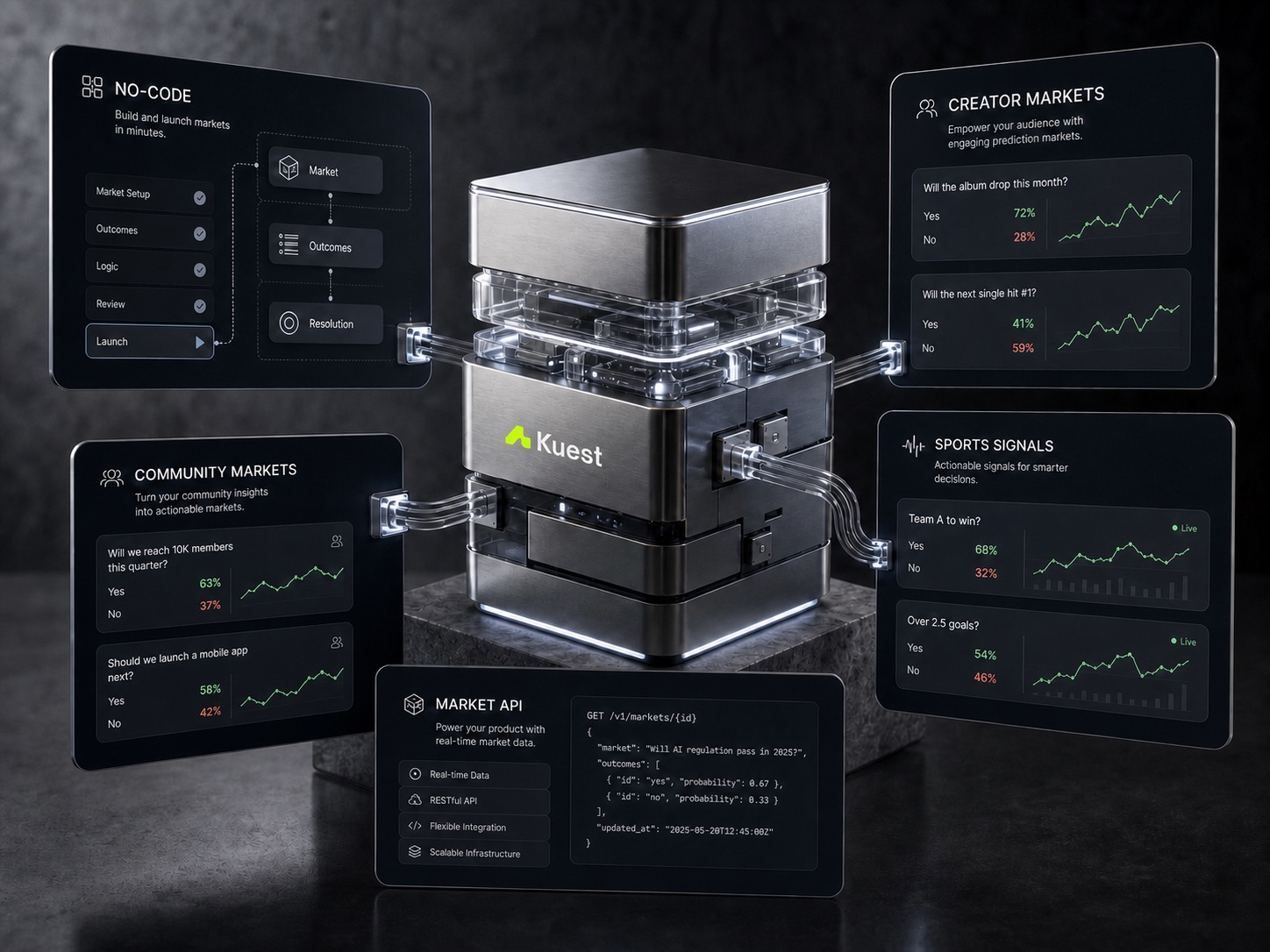
You do not need to become a Solidity engineer to build a useful crypto business. You do need a real customer, a clear market design and infrastructure that can survive real activity.
The list of crypto business ideas is full of ambitious products: tokens, NFT communities, decentralized applications, on-chain loyalty programs, creator economies and new financial markets.
The hard part is rarely coming up with another idea.
The hard part is turning one into a product people can use without spending the first year recruiting engineers, learning smart contracts, wiring wallets and solving settlement problems that have nothing to do with your insight.
That is where a no-code blockchain business can make sense.
For a founder with distribution, expertise or a strong community, no-code infrastructure can turn a business thesis into a working Web3 product without building every protocol layer from scratch. A prediction market is one of the clearest examples because the product is easy to explain, naturally repeatable and capable of creating a revenue layer around an existing audience.
You choose the niche.
You publish the questions.
Your audience trades on outcomes that matter to them.
The platform handles the complex infrastructure underneath.
This is not a promise that every crypto idea can be launched with a drag-and-drop builder. It is a practical guide to choosing a business model, validating demand and using managed prediction-market infrastructure to launch crypto business without developer overhead becoming the project.
What is a no-code blockchain business?
A no-code blockchain business is a customer-facing product built with managed services, templates, visual configuration and APIs instead of a large in-house blockchain engineering team.
The founder still owns the business decisions:
- Who the product is for.
- What problem the product solves.
- Why blockchain improves the experience.
- How users discover and trust it.
- What users pay for.
- Which actions the business will and will not support.
The infrastructure provider supplies some of the technical building blocks:
- Smart-contract or ledger infrastructure.
- Wallet and account flows.
- Transaction and balance management.
- Market or asset creation tools.
- Data APIs and webhooks.
- On-chain settlement or custody integrations.
- Hosting, monitoring and operational controls.
The phrase “no-code” describes how you operate the product. It does not mean the product has no code, no security model and no technical dependencies. A smart contract is still a program deployed on a blockchain, and a decentralized application combines a contract with a user-facing interface. Ethereum’s documentation and dapp overview make that distinction clear.
The useful question is not:
“Can I build this without ever seeing code?”
It is:
“Which technical layers are differentiated by my business, and which layers should I buy as infrastructure?”
Why prediction markets are a strong no-code business model
Prediction markets turn beliefs about future events into tradable positions.
A market might ask:
Will the central bank cut rates at its next meeting?
Will a new game reach one million players this year?
Will a creator launch the product they announced?
Will a protocol release its next upgrade before October?
Users buy and sell outcome contracts. The market price can act as a continuously updated estimate of the probability of an event, subject to liquidity, information quality and the market’s rules.
The CFTC’s explanation of prediction markets and event contracts describes common yes-or-no event contracts and the way market prices can aggregate information about future outcomes. The commercial opportunity for a founder is not to copy a general-purpose venue. It is to create a trusted market around a specific audience and information loop.
Prediction markets work well as a no-code business idea because they have several properties that are difficult to get from a generic token launch:
- A clear user action: users make a forecast by trading a position.
- A repeatable content format: every event can become a new market.
- A built-in reason to return: prices move as information changes.
- A measurable revenue event: trading volume can support a fee model.
- A strong niche advantage: expertise and distribution can matter more than protocol novelty.
You do not need to convince users that a new token will appreciate. You need to give them a question they care about, rules they understand, a market they can trade and a resolution process they trust.
No-code blockchain business ideas worth evaluating
Prediction markets are the focus of this guide, but a good founder should compare them with other Web3 business models before choosing a direction.
| Business idea | What the customer gets | Primary growth loop | Main operational risk |
|---|---|---|---|
| Niche prediction market | Tradable forecasts about a vertical they follow | New event leads to new markets and repeat trading | Liquidity, resolution and market integrity |
| Creator or community market | A branded way to turn group knowledge into forecasts | Conversation creates questions and questions create trades | Moderation, ambiguous questions and user trust |
| On-chain membership or loyalty | Portable access, rewards or status | More members create more utility for the network | Low retention if the token is the only benefit |
| Crypto data or intelligence product | Research, alerts or dashboards based on on-chain activity | Insight improves acquisition and subscription retention | Data quality and willingness to pay |
| B2B forecasting workflow | A structured way for teams to price uncertainty | More decisions create more internal forecasts | Privacy, permissions and enterprise adoption |
The right business is the one where you already have an unfair advantage.
That advantage might be a newsletter, a community, a media brand, access to a professional audience, a research workflow or expertise in a category that general-purpose platforms overlook.
1. A vertical prediction market
Build a market for one audience instead of trying to cover the entire world.
Examples include:
- Crypto protocol upgrades and ecosystem milestones.
- Technology launches, funding and adoption thresholds.
- Creator and entertainment events.
- Macro, economics and business indicators.
- Sports media and fan engagement.
- Industry-specific forecasts for professionals.
The narrower the category, the more important your editorial quality becomes. Your users should recognize why your market exists and why your team is better placed to curate it than a general-purpose venue.
2. A community prediction layer
If you already run a Discord, Telegram group, membership site or private network, a prediction market can make the community’s collective knowledge visible and tradable.
The market should complement the conversation, not replace it. A community manager can publish a question, discuss the evidence, let members trade and then bring the result back into the group after resolution.
That creates a loop between content and action:
discussion → market → new information → discussion
3. A creator or media market
Creators can turn recurring predictions into a product instead of leaving them as posts that disappear in a feed.
A creator might publish markets around:
- Release dates.
- Chart or box-office milestones.
- Product launches.
- Technology adoption.
- Community goals.
The creator’s value is the context and distribution. The prediction-market platform supplies the trading, market lifecycle and settlement rails.
4. A premium research and forecasting product
Research businesses can use a market as both a product and a signal layer. Subscribers may receive analysis, while the broader market shows how participants price the event over time.
This model can combine:
- Paid research.
- Sponsored market series.
- Data access.
- Market commentary.
- Trading fees where permitted by the operating model.
The important distinction is that the market is not a decorative chart attached to a report. It needs clear rules, active participants and a resolution process that makes the output useful after the event.
5. A B2B forecasting workspace
Not every prediction market needs to be public.
An enterprise or professional product could let a team forecast delivery dates, demand, operational milestones or external events. In that context, the commercial value may come from better decisions and workflow integration rather than public trading fees.
This can be a good starting point for founders who have access to a specific industry and want to validate forecasting behavior before opening a consumer venue.
Why a prediction market beats a token-first launch for many founders
Tokens are often treated as the default answer to a crypto business idea. But a token does not create demand by itself. It creates an asset that needs utility, liquidity, distribution, trust and a reason to keep holding it.
A prediction market starts with a more concrete user job:
“I have a view about this event, and I want to express it in a market.”
That gives you a product loop before you decide whether any token belongs in the business.
| Token-first launch | Prediction-market launch |
|---|---|
| Start with an asset | Start with a question |
| Need to invent utility | Users already understand the event |
| Liquidity is often speculative | Liquidity supports a specific market |
| Value depends on token adoption | Value can come from repeat trading and information |
| Narrative can outrun the product | The product is tested by actual activity |
This does not make prediction markets automatically safer or easier. Event trading can involve financial, gambling, consumer-protection and payments considerations. It does mean the customer interaction is more legible than “buy this token and wait for utility later.”
What you still need to own without hiring developers
The most common mistake in no-code planning is treating infrastructure as the entire business.
You still need to own the layers that create differentiation:
The audience and distribution
Who will arrive on launch day? Why will they trust your market more than a general-purpose platform? Which existing channel can bring the first 100 active users?
An audience is not a vanity metric. A prediction market without participants is an empty order book, regardless of how polished the interface looks.
The market thesis
What will you list, and what will you refuse to list? Which events are frequent enough to support a repeatable publishing cadence? What expertise makes your market questions better?
The best starting category is usually not “everything people might predict.” It is a narrow set of events where you can consistently write clear questions and explain why they matter.
The resolution policy
Every question needs a finish line. Define the source, cutoff time, interpretation of edge cases and payout process before the market opens.
The Kuest resolution API documentation describes the operator-facing resolution flow. The principle is simple even when the implementation is not: users should know how an outcome will be determined before they risk capital or reputation on a position.
The trust and compliance model
Users need to know who operates the venue, what assets are supported, which countries are eligible, what happens to their funds and who can intervene if a market is paused or disputed.
No-code reduces your engineering workload. It does not transfer responsibility for the promises your business makes.
The infrastructure behind a no-code prediction market
A prediction market is a compact product surface over several operational systems.
1. Market creation
You need a way to define the question, outcomes, close time, resolution source, market status and payout rules. Templates help you create markets consistently without asking a developer to write a new contract or configure a new backend workflow for every event.
Kuest’s Create Market API documentation covers the metadata and registration flow for creating events and markets programmatically.
2. Trading and order matching
The market needs an execution model. A central limit order book lets users post bids and asks, while other approaches may use automated pricing or an external venue.
Ask your provider:
- How are orders matched?
- Are partial fills and cancellations supported?
- How does the interface receive live updates?
- What happens during an outage or chain congestion?
- Can users see the spread and available depth?
The Polymarket documentation on prices and the order book is a useful reference for the concepts involved. You do not need the same implementation, but you do need to understand the system you are putting your brand on.
3. Liquidity
Liquidity is the difference between a market that looks active and one where users can actually trade at reasonable prices.
It can come from:
- Shared liquidity across operator deployments.
- Professional market makers.
- External routing where permitted.
- Operator-funded launch incentives.
- A combination of these models.
Polymarket’s market-maker documentation describes market makers as traders who continuously post bid and ask orders. That is the basic concept to clarify with any platform provider: who provides the quotes, who carries inventory risk and what depth can a new market realistically expect?
Kuest’s guide to shared liquidity from day one explains why a new operator should treat liquidity as a launch requirement, not a feature to add later.
4. Resolution and settlement
An outcome must be determined, accepted, recorded and paid out. If the source is ambiguous or unavailable, the venue needs a documented procedure.
Read the provider’s resolution policy before you evaluate the theme editor. Confirm:
- Who can propose a result.
- Which sources count as evidence.
- How long a result can be disputed.
- Whether a market can be voided or cancelled.
- How users are notified.
- How payouts and reporting are reconciled.
5. Accounts, wallets and payments
Users may need email or social sign-in, wallet connection, a custodial balance, stablecoin funding, fiat payment rails or a regulated intermediary. Your provider may support some or all of those flows.
Do not assume that “blockchain-based” tells you how the user experience works. Decide whether your audience needs a crypto-native wallet journey or an account experience that hides most of the chain complexity.
6. Operator controls and data
You need a console for creating markets, managing categories, setting fees, reviewing activity, pausing events, resolving outcomes and exporting data.
You may also need:
- REST APIs.
- WebSockets or real-time feeds.
- Webhooks.
- Single sign-on.
- Custom domains.
- Analytics exports.
- Role-based permissions.
- Incident notifications.
The Kuest architecture documentation explains the separation between an operator deployment and the managed services underneath it.
No-code does not mean no technical diligence
Tools such as OpenZeppelin Contracts Wizard can generate smart-contract code from configurable components, and platforms such as thirdweb simplify contract deployment across supported EVM networks.
Those tools are useful examples of how technical barriers are falling. They are not proof that a production financial or event-trading product is ready to launch without engineering review.
Before you choose a provider, ask:
- Which contracts and services are already deployed?
- Has the contract architecture been audited or independently reviewed?
- Who controls upgrade keys and emergency permissions?
- What happens if an RPC provider or blockchain is unavailable?
- How are balances reconciled?
- Can you export users, markets, trades and fee data?
- What is the incident-response process?
- What happens if you need to migrate away?
If a no-code platform cannot answer those questions, it is optimized for a demo rather than a business.
How to choose a no-code prediction-market platform
Compare platforms by the business you want to operate, not by the number of blockchains in a feature list.
1. Can you launch under your own brand?
You should control the domain, logo, colors, copy, market categories and user-facing experience. A widget inside somebody else’s product can be useful, but it is not the same as owning a venue.
Kuest’s custom-domain documentation covers the deployment detail that makes the product feel like your business rather than an embedded demo.
2. Can you create your own markets?
Check whether you can publish your own questions, define resolution sources and schedule a market cadence. If you can only display a vendor-controlled catalog, your differentiation is limited to distribution.
3. Is the liquidity model explicit?
Ask whether liquidity is shared, sourced from a market maker, routed from another venue or funded by you. Ask about spreads, depth, inventory risk and what happens when the market moves sharply.
“Liquidity included” is not a sufficient answer.
4. Is resolution operationally clear?
Read the edge-case policy. A prediction market is a trust product, and ambiguous settlement can damage the brand you spent months building.
5. Can you control economics?
Understand setup costs, monthly minimums, per-trade fees, payment costs, liquidity incentives and revenue share. Kuest operators can review the Affiliate and Fees documentation when modeling attribution and operator economics.
6. Can the product grow with your audience?
Check permissions, analytics, APIs, webhooks, rate limits, support response and data portability. The first launch may be small, but your provider should not force a full migration when you move from a few hundred users to a real operating business.
| Option | What you own | What you still need to solve | Best first milestone |
|---|---|---|---|
| No-code builder | Configuration and basic user experience | Custom trading, liquidity, settlement and edge cases | A prototype or simple validation flow |
| Embedded prediction widget | Distribution and surrounding content | Limited control over catalog, economics and user relationship | Prove that your audience will interact with markets |
| White-label prediction-market SaaS | Brand, market strategy, audience and fee model | Demand, market quality, compliance and operations | Launch a functioning venue with repeat trading |
| Custom protocol build | Every layer of the stack | Engineering, audits, security, liquidity and maintenance | Own infrastructure as the long-term moat |
For most non-technical founders, the third option is the practical middle ground. It removes the need to hire developers before the business has evidence, while leaving enough control to build a differentiated operator brand.
Our guide to build versus license for prediction markets covers the trade-off in more detail.
The economics of launching a prediction market
The simplest operator revenue model is:
Gross fees = trading volume × operator fee
An illustrative monthly scenario at a 1% operator fee looks like this:
| Monthly trading volume | Gross operator fees at 1% |
|---|---|
| $25,000 | $250 |
| $100,000 | $1,000 |
| $500,000 | $5,000 |
| $2,000,000 | $20,000 |
These are examples, not forecasts. Your net economics depend on platform costs, liquidity incentives, payment processing, custody, support, taxes, user acquisition and applicable regulation.
The revenue model becomes more interesting when the market is attached to an existing business:
- A media company adds fee revenue to analysis and sponsorship.
- A community operator turns discussion into measurable activity.
- A creator adds a repeatable product to an audience they already own.
- A research business sells market data and commentary.
- An industry platform creates a paid forecasting workflow.
Read our guide to prediction-market fee models before setting a headline fee. The goal is not to charge the most. It is to leave enough value for users and liquidity providers that the market stays active.
A 30-day launch plan for a non-technical founder
You do not need a hundred categories and a thousand markets to learn whether the idea works. You need one audience, one market family and enough activity to observe user behavior.
Week 1: Choose the audience and the job
Write a one-sentence answer to each question:
- Who is the first user?
- Which recurring events do they already discuss?
- Why would they use a market instead of a poll or comment thread?
- What existing channel will bring the first participants?
- What does a successful first month look like?
If you cannot answer these without mentioning the blockchain, the business idea may be infrastructure-led rather than customer-led.
Week 2: Design ten markets
Create a small catalog of questions with:
- A precise outcome.
- A measurable resolution source.
- A known close time.
- A reasonable time to resolution.
- Enough audience interest to attract more than one trader.
Avoid questions that depend on subjective judgment, private information or a source that can disappear. The market rules should be easy to understand before a user sees the chart.
Week 3: Configure the venue
Set up the brand, domain, market templates, categories, fee model, eligibility rules, liquidity approach and resolution permissions. The Kuest launch documentation provides the operator flow for configuring a prediction-market venue.
Run a complete internal journey:
- Discover a market.
- Read the rules.
- Create or connect an account.
- Fund the account.
- Place, cancel and fill an order.
- See the position and trade history.
- Resolve the market.
- Reconcile the payout and fee data.
Week 4: Run a closed beta
Invite people who already understand your subject area. Watch where they hesitate and where they misunderstand the market.
Measure:
- Market view to first trade.
- First deposit to first trade.
- Repeat trades per active user.
- Spread, depth and slippage.
- Time from event outcome to resolution.
- Support questions per active trader.
- Volume by market and acquisition source.
Do not optimize for registrations alone. A prediction market becomes a business when users return to trade on the next relevant event.
Compliance: no-code does not create a shortcut
Prediction markets can be treated differently depending on the contract, collateral, users, operator, jurisdiction, distribution and intended use.
In the United States, the CFTC explains that event contracts are often structured as swaps and that regulated prediction markets operate within a derivatives framework. Other jurisdictions may apply different rules, including gambling, financial-services, consumer-protection, payments or promotional requirements.
Do not market a prediction-market platform as “license-free” simply because the infrastructure is managed or blockchain-based.
Before you launch, get qualified advice on:
- Which entity operates the market.
- Which users and jurisdictions are eligible.
- Whether your contracts are financial products, gaming products or another category.
- KYC, AML, sanctions, age and responsible-trading controls.
- Custody, payments and withdrawal obligations.
- Restricted event categories.
- Advertising, affiliate and creator disclosures.
- Market suspension, dispute and complaint procedures.
The CFTC prediction-market overview is a useful starting point for understanding regulated event contracts, not a legal opinion for your business. Your provider can supply controls and infrastructure. It cannot decide which legal model applies to your launch.
How Kuest fits the no-code blockchain business model
Kuest is designed for founders and operators who want to launch a prediction-market business around their own audience, brand or category.
You bring:
- The audience.
- The market thesis.
- The editorial and operating team.
- The distribution channel.
- The commercial model.
Kuest provides the prediction-market infrastructure underneath, including market creation, trading, settlement, operator controls and a shared-liquidity model across deployments.
That lets a non-technical founder spend the first month on the business rather than assembling an exchange stack:
audience → market questions → trades → resolution → repeat usage
The Kuest protocol overview explains the infrastructure model. The owner architecture documentation describes the boundary between the operator experience and the managed platform services.
If you are evaluating whether to launch crypto business without developer overhead, the useful question is not whether you can avoid every technical person forever. It is whether you can validate the business before committing to a permanent engineering organization.
The real no-code advantage is focus
The best no-code blockchain businesses are not shortcuts around product quality.
They are businesses that know where their advantage lives.
If your advantage is a community, a vertical audience, a research workflow, a creator brand or a distribution channel, owning every contract and matching engine may be a distraction during validation.
A prediction market gives you a concrete way to test the thesis:
- Can you attract the first traders?
- Can you write questions people understand?
- Can you create enough event cadence for users to return?
- Can you keep markets liquid enough to be useful?
- Can you resolve them without disputes damaging trust?
- Can trading activity support a sustainable revenue layer?
If the answer is yes, you have evidence for deeper investment. If the answer is no, you have learned that the problem is not solved by hiring more developers.
The business comes first.
The blockchain is the infrastructure choice that helps the business deliver the experience.
FAQ: No-Code Blockchain Business Ideas
Can I start a blockchain business without coding?
Yes, if you use managed infrastructure and choose a business model that does not require custom protocol development on day one. You still need product, distribution, operations, security diligence and legal advice. No-code removes much of the initial engineering work; it does not remove the work of running a real business.
What is the best no-code blockchain business idea?
There is no universal best idea. For a founder with a niche audience, a prediction market can be a strong option because it creates repeatable event-based products and a possible fee layer. Other founders may be better suited to data, membership, loyalty or B2B forecasting products.
Can I launch a prediction market without hiring developers?
Yes, a white-label prediction-market SaaS platform can provide the market, trading, liquidity, resolution, settlement and operator layers needed for an initial venue. You should still have access to technical review when evaluating contracts, integrations, security, data portability and operational incidents.
Is a prediction market a crypto business?
It can be. A market may use blockchain-based contracts, wallets or settlement, while the customer experience can feel similar to a modern Web2 trading product. Whether the model is appropriate for your business depends on users, collateral, market design, jurisdiction and the infrastructure provider.
Do I need a token to launch a prediction market?
No. A market can start with event contracts, supported collateral and a fee model. Adding a token creates additional product, liquidity, disclosure and regulatory questions, so it should solve a real user or business problem rather than serve as a default launch requirement.
What prediction-market niche should I choose?
Choose a category with recurring events, an audience you can reach, questions you can resolve objectively and enough information flow to make prices interesting. Crypto, technology, creators, sports media, macro and professional forecasting are possible starting points, but distribution and expertise matter more than the category label.
How do prediction markets make money?
The most direct model is a fee on trading volume. A business can also monetize sponsorships, premium research, market data, memberships, integrations or enterprise access. Review the full cost of liquidity, infrastructure, payments, support and compliance before treating gross fees as revenue.
Does no-code mean the platform is decentralized?
No. No-code describes how the product is configured and operated. A platform may use smart contracts, centralized matching, custodial accounts, managed APIs or a hybrid architecture. Ask which parts are on-chain, which are managed off-chain and who controls the critical permissions.
Can I run a prediction market without a license?
Do not assume that. Legal treatment varies by jurisdiction and product structure. Blockchain infrastructure and white-label software do not create a universal exemption. Get qualified advice before deciding which users, markets and payment flows your business can support.
Should I build custom infrastructure later?
Possibly. Start with managed infrastructure when your advantage is distribution, market selection, brand or vertical expertise. Consider a custom build when exchange infrastructure itself becomes the moat, your requirements exceed the provider’s model or ownership is necessary for institutional, security or regulatory reasons.