

A market can exist before anyone is willing to trade it. Creating its question and outcome tokens does not create a buyer at 0.59, a seller at 0.61, or enough size for the next customer. Those require funded orders from participants willing to take the other side.
This tenth article in How Polymarket and Kuest work follows that capital: how a quote becomes useful execution, how fills change a market maker’s exposure, and how an operator can specify the service it needs. All prices and quantities below are hypothetical, expressed in collateral units; they are not live quotes.
Who connects to whom on Kuest?
A market maker repeatedly offers to buy and sell, choosing prices and sizes while managing the resulting positions. Other traders also supply liquidity when they leave resting orders. A dedicated maker is therefore not a technical prerequisite for creating a market; it is one way to organize dependable execution.
On a compatible Kuest deployment, the operator runs the branded interface and develops its audience. Traders enter through that interface. The interface connects their orders to Kuest’s configured CLOB; market makers connect their quoting systems to that trading infrastructure. Matching and contract settlement are separate steps, as the order lifecycle explains.
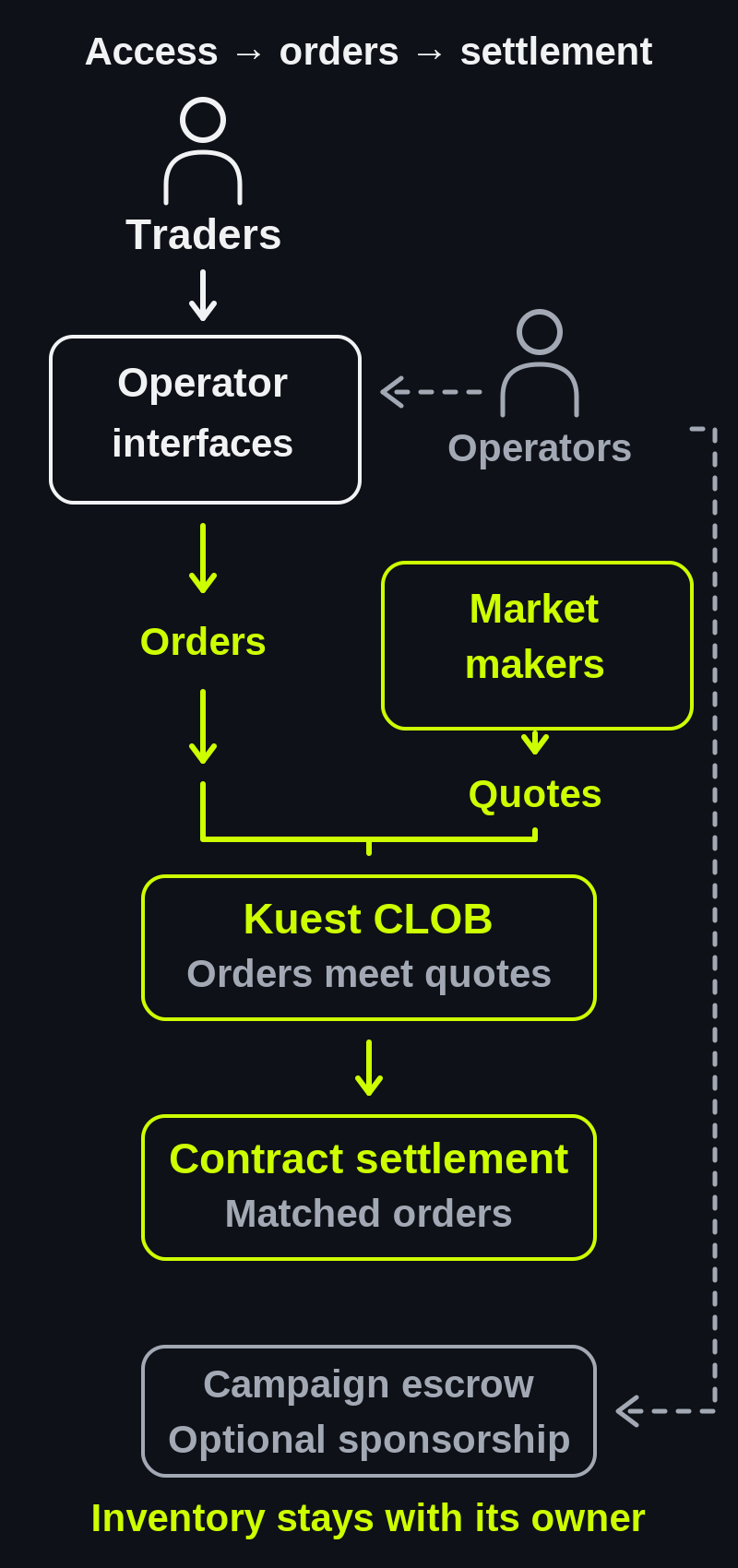
User access, order submission, settlement and optional sponsorship are different relationships.
Operators using the same network, backend and market assets can expose a common book. A maker’s order can then meet flow from several branded interfaces without duplicating its inventory at each domain. The opportunity is more reachable demand per integration, conditional on those operators attracting actual traders. Two interfaces showing the same order do not double its depth. See the system map for these boundaries.
The operator still owns audience development, market selection, rule disclosures and its liquidity requirements. The maker owns pricing, capital, inventory, cancellation and any hedge. Kuest supplies the connected trading and campaign mechanisms described here; neither software nor sponsorship guarantees a counterparty at every price.
Measure the trade, not the volume badge
The spread is best ask minus best bid. At 0.59 / 0.61 it is 0.02 collateral per share, and the midpoint is 0.60. A midpoint describes two quotes; it does not establish fair value or the price available for a large order.
Consider two YES books with the same 0.59 best bid. Book A offers 50 shares at 0.61 and another 150 at 0.66. Book B offers 200 at 0.61. Both have the same spread, but buying 200 costs 129.50 in A and 122 in B, before fees. A’s size-weighted execution price is 0.6475; B’s is 0.61. That is 7.50 more collateral for the same claim.
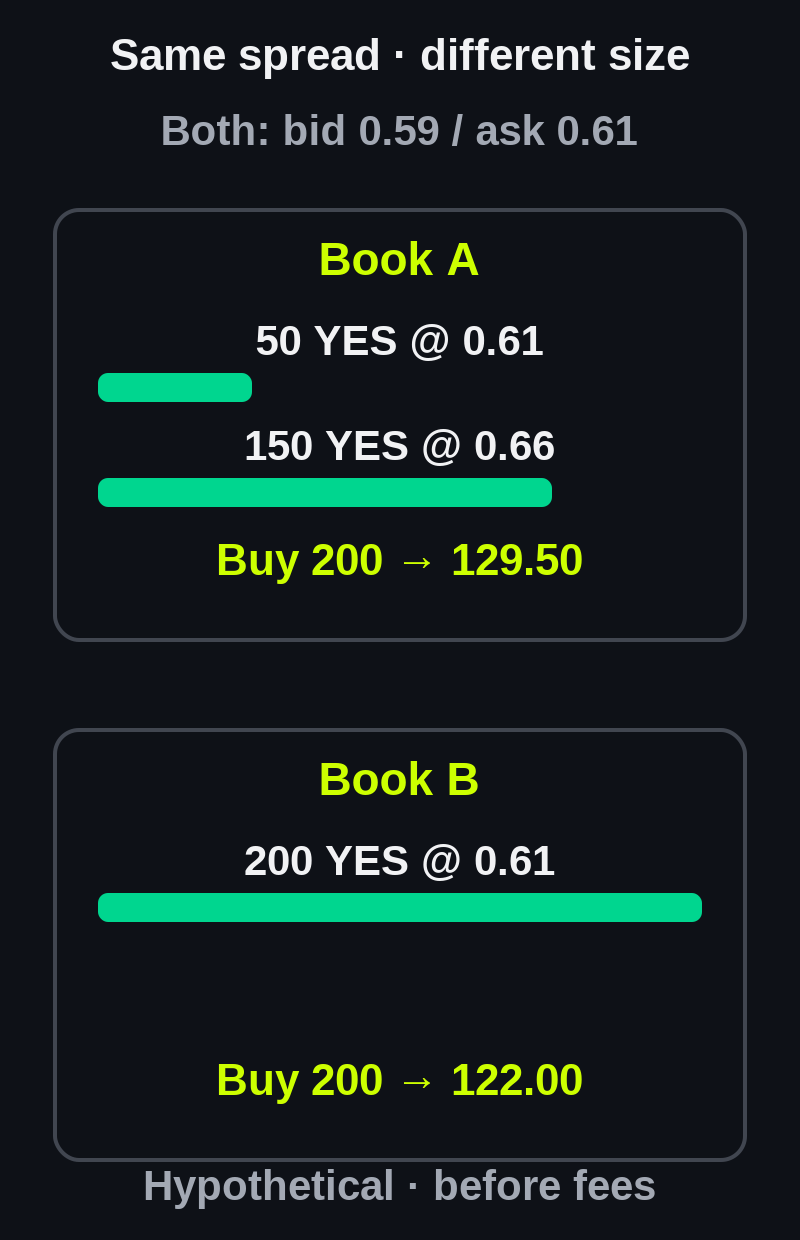
Compare the same order size at the same observation time. Displayed orders can change before execution.
Depth within a band measures available size near a stated reference. Using midpoint 0.60 and an ask ceiling of 0.62, A has only 50 shares; B has 200. Specify whether depth means shares or collateral notional, and measure both buy and sell sides. Historical traded volume measures completed activity, so yesterday’s volume cannot establish today’s exit capacity.
Quote uptime is the fraction of an agreed service window satisfying the specified conditions. If 570 of 600 equally spaced samples have both sides, the required spread and depth, sampled compliance is 95%. That does not prove continuous availability between samples. Define timestamp freshness, sampling frequency, exclusions and treatment of outages before paying against this metric.
A filled quote changes the portfolio
Start with 200 collateral. In an ordinary Kuest binary CTF market, split 100 into 100 YES and 100 NO, retaining 100 cash. Ignoring costs, the complete set still pays 100 whichever ordinary binary outcome wins. The maker can offer YES for sale because it actually holds YES; it also needs cash for bids.
Quote 100 YES at bid 0.59 and ask 0.61. If a customer buys all 100 YES, the maker receives 61 and now holds 161 cash plus 100 NO. Its final portfolio pays 161 if YES wins or 261 if NO wins, compared with the original 200. Selling the YES created exposure to NO; receiving cash did not finish a profitable round trip.
If the maker later buys 100 YES back at 0.59, it spends 59, holds 102 cash plus the complete set, and can merge that set for 100. Ending cash is 202: a 2-unit gross gain before all costs. But after news raises YES’s executable ask to 0.80, buying it back costs 80 instead. Merging then leaves 181, a 19-unit loss. The original 0.02 spread promised neither second fill.
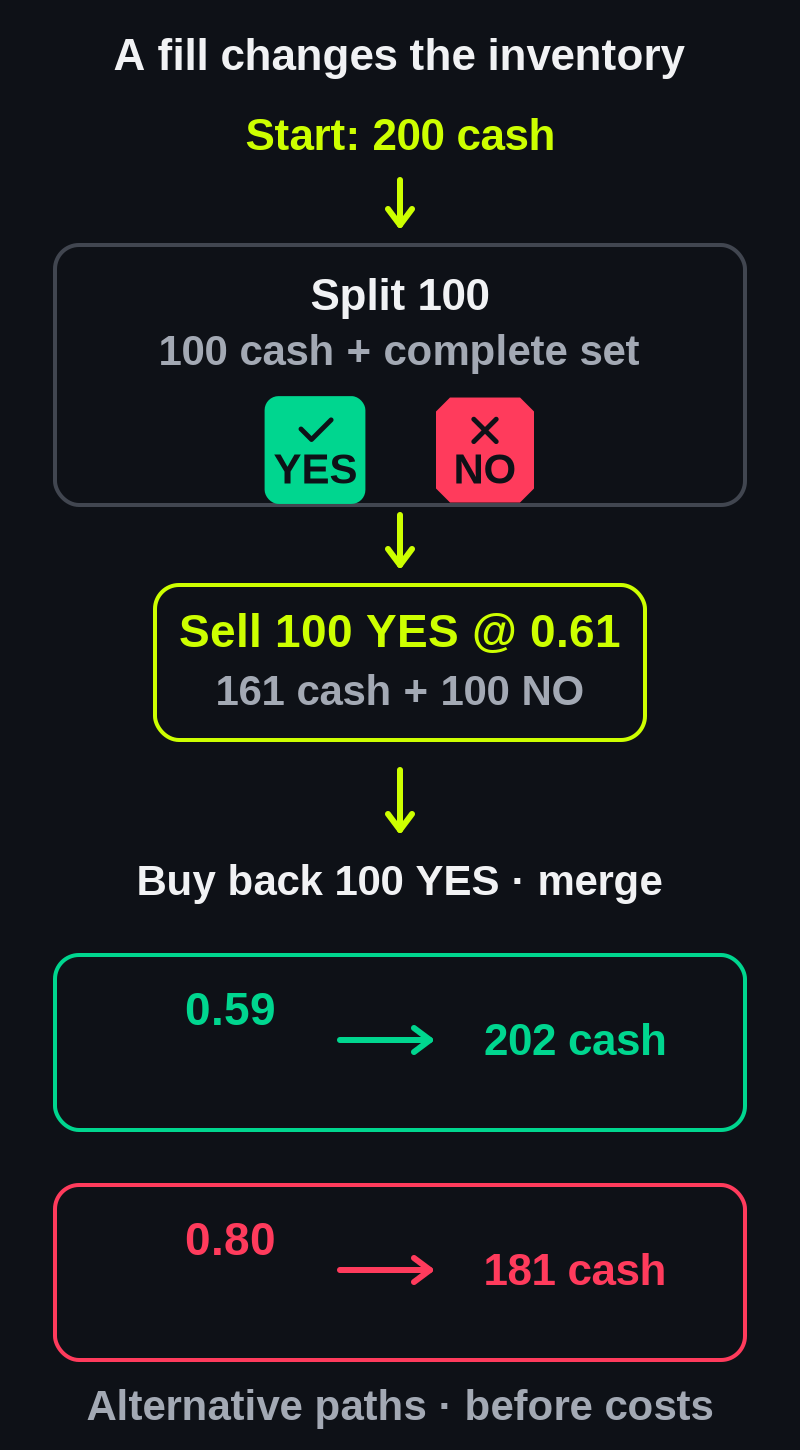
Adverse selection occurs when a counterparty trades against a quote that has become unfavorable to its maker—for example, buying YES at 0.61 after learning information supporting a much higher value. Inventory skew responds to accumulated exposure: after selling YES, a maker might raise its YES bid, reduce further YES sales or lower its NO ask to encourage rebalancing. Size and loss limits can instead require pulling orders.
Splitting prepares sale inventory and merging releases matched pairs, but neither creates extra capital. Outstanding bids, pending fills, existing positions and a separate hedge all consume a budget. Reconcile balances and order states before reusing that budget; cancellation requested after a fill cannot undo the trade.
An empty book needs a pricing decision
Without both bid and ask there is no executable two-sided midpoint. A last trade or external reference can still help a maker estimate value, but neither is an offer to sell the desired size. With neither direct nor complementary executable interest, a buy cannot fill. Depending on its order type, it cancels or waits for future interest.
An operator and maker must agree how initial quotes will be priced when there is no useful local midpoint. A model, an external venue or a manually reviewed estimate can supply a reference, but the maker still chooses prices, funds the orders and accepts inventory risk. A fallback number does not establish an event probability.
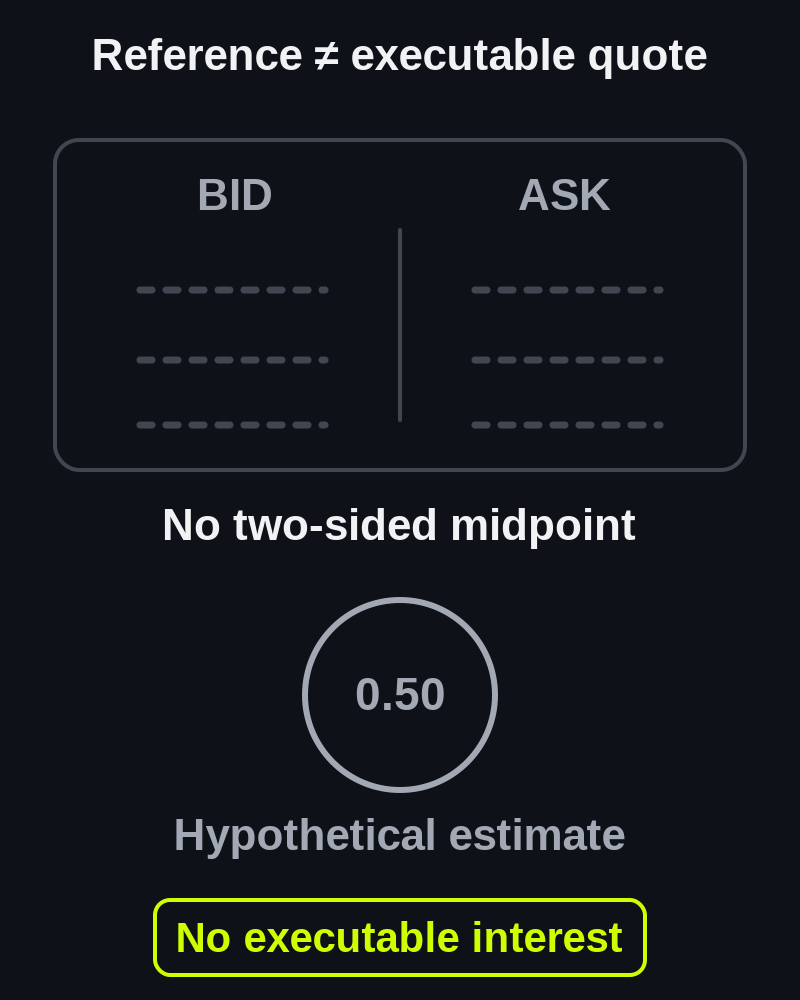
A maker’s operating plan should define acceptable input freshness, maximum inventory and loss exposure, funding limits and when to withdraw quotes. These are service requirements to agree and measure, not a description of a proprietary quoting implementation.
A Polymarket hedge is another trade
A maker can use an equivalent Polymarket outcome to reduce Kuest exposure when the payoff mapping, access and executable depth permit it. This is an opportunity for desks already operating across venues: reuse pricing and risk infrastructure while serving Kuest operators. The two venues retain separate books, assets, permissions and balances.
After the earlier sale of 100 Kuest YES for 61, buying 100 equivalent Polymarket YES for 59 would replace the sold exposure economically. Together with the retained Kuest NO, the combined portfolio would pay 100 if the venues agree; including the remaining cash gives the same 202 gross ending value. Those external YES cannot be sold as local Kuest YES without a separately supported asset route. This is a cross-venue portfolio, not replenished local sell inventory.
Alternatively, assume the maker already owns 100 Kuest YES bought for 60 and buys 100 Polymarket NO for 42. If both contracts resolve consistently and the winning claim pays one comparable unit, combined payout is 100 whether YES or NO wins. Total cost is 102, so the hedge locks a 2-unit loss before costs under those assumptions. It reduces directionality; it does not turn a losing entry into profit.
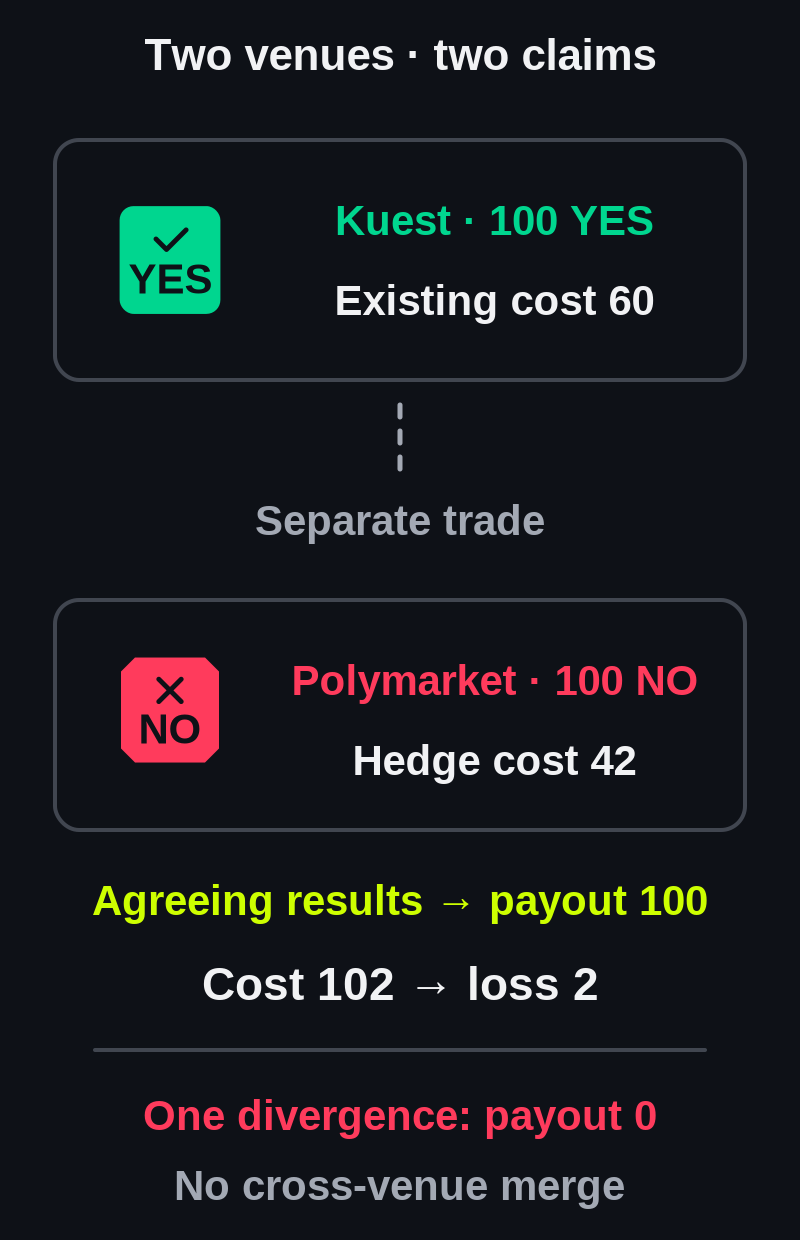
Cross-venue positions cannot be merged as one local complete set. The hedge relies on both settlement paths.
Compare exact wording, outcome mapping, timestamps, cancellation treatment, result authority and collateral—not just headlines. If Kuest resolves NO while Polymarket resolves YES, both positions in this example lose. Fees, spread, conversion costs and different payout times change the economics even when results agree. Current Polymarket position documentation also distinguishes CTF from Protocol V2; confirm the selected asset and supported operations.
If only 40 external NO fill, the remaining 60 Kuest YES stay directional. Separate FOK orders or a batch request do not make cross-venue fills atomic. Set a maximum unhedged quantity and a response to failed or expensive hedges before accepting customer flow. Our existing cross-venue guide develops that workflow; Article 13 compares strategies and cross-venue payoff scenarios (Coming soon).
Specify what the operator is buying
Separate four budgets: trading inventory, operating expenses, campaign compensation and conditional incentives. A refundable bond is additional committed capital, not revenue. Builder fees paid for routed orders, maker rebates paid under an eligible program and sponsored rewards compensate different activities; none implies that every maker receives all three. Polymarket’s market-making documentation, accessed 30 October 2026, likewise separates resting-liquidity rewards from rebates on eligible executed maker activity.
A useful mandate names the network and condition IDs; inventory owner and funding; maximum spread and depth bands per side; service hours and compliance measurement; approved news/outage responses; loss and hedge-cost allocation; cancellation and handover duties; compensation, bond, review and dispute terms. “Provide 10,000 liquidity” leaves currency, distance, duration and responsibility unanswered.
Kuest’s public market-making guide describes sponsoring a liquidity campaign. Confirm the network, admission requirements, available makers and campaign terms before committing funds. The public market-maker page, checked on 30 October 2026, displayed Polygon Amoy and “No matching opportunities”; a setup screen is not evidence of immediately available mainnet capacity.
The publicly verified MarketMakerEscrow implementation records campaign scope and terms commitments, handles the sponsor’s service funding and any required maker bond, and defines payment and dispute powers. Polygon’s escrow proxy pointed to that implementation at block 96459545. Retain the actual agreed terms; a hash alone does not explain the service being bought. Trading inventory remains a separate allocation.
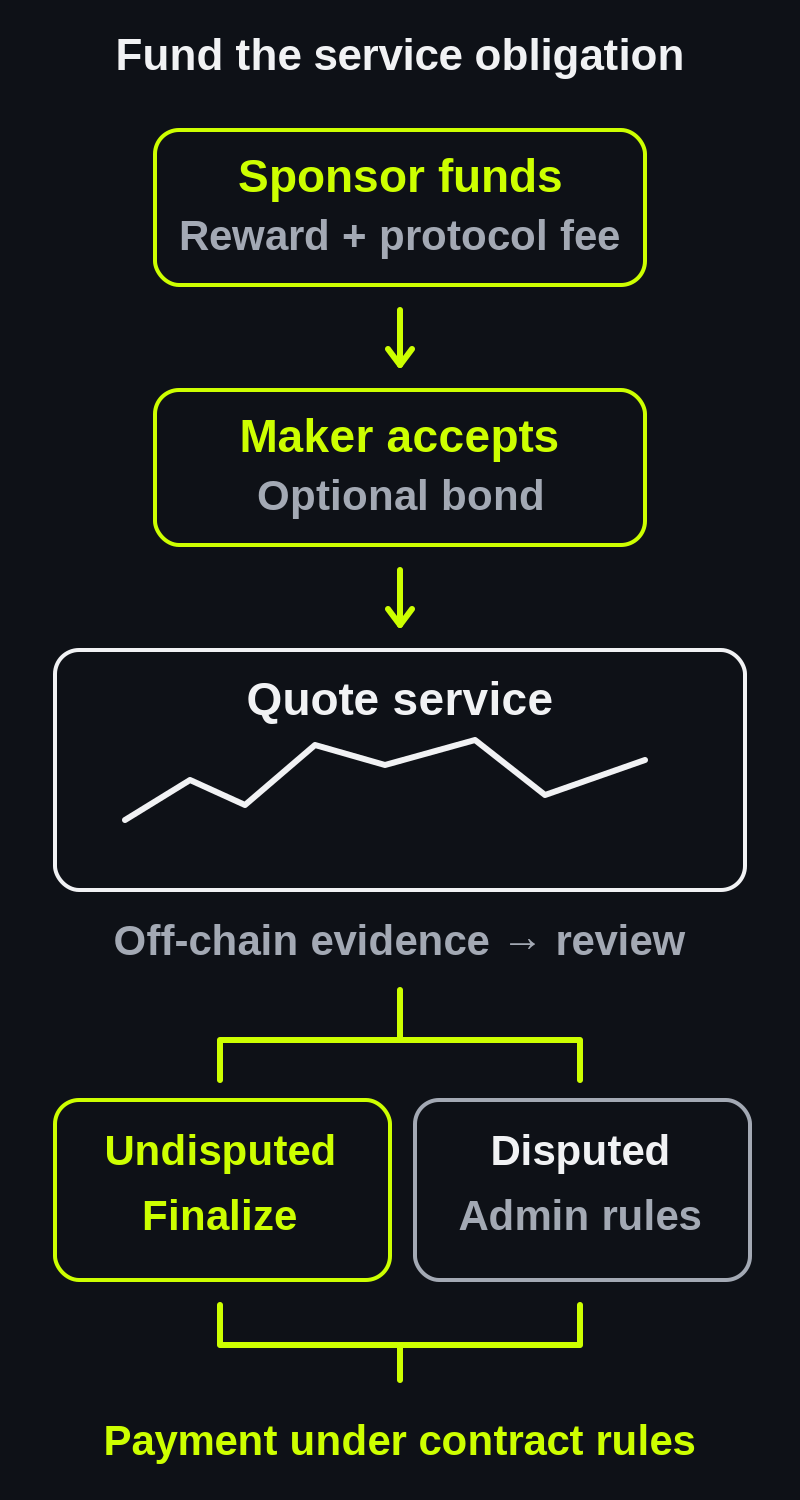
Escrow coordinates committed payments. Quote measurements and dispute adjudication remain explicit dependencies.
The contract does not measure spread, depth or uptime. After service, an undisputed campaign can finalize at its claimable time, crediting reward and bond to the payout account’s withdrawals; a supported direct claim also exists. A sponsor dispute opened within the allowed window instead requires an admin decision allocating reward and bond within deposited amounts. Owner-controlled upgrades and those adjudication powers belong in the permissions review.
Our guides to finding market-making opportunities and evaluating liquidity mandates cover desk selection and commercial screening. Use this article’s execution calculations to turn those conversations into measurable requirements; Article 14 will assemble the broader operator checklist.
Launch your own prediction market with Kuest with a liquidity brief alongside your market rules: specify the trade size users need, the spread and depth you will measure, who funds inventory, and who responds when risk limits stop quoting. Market makers can bring their quoting and hedge stack to that defined demand; operators can buy a clear service instead of assuming liquidity appears at launch.