
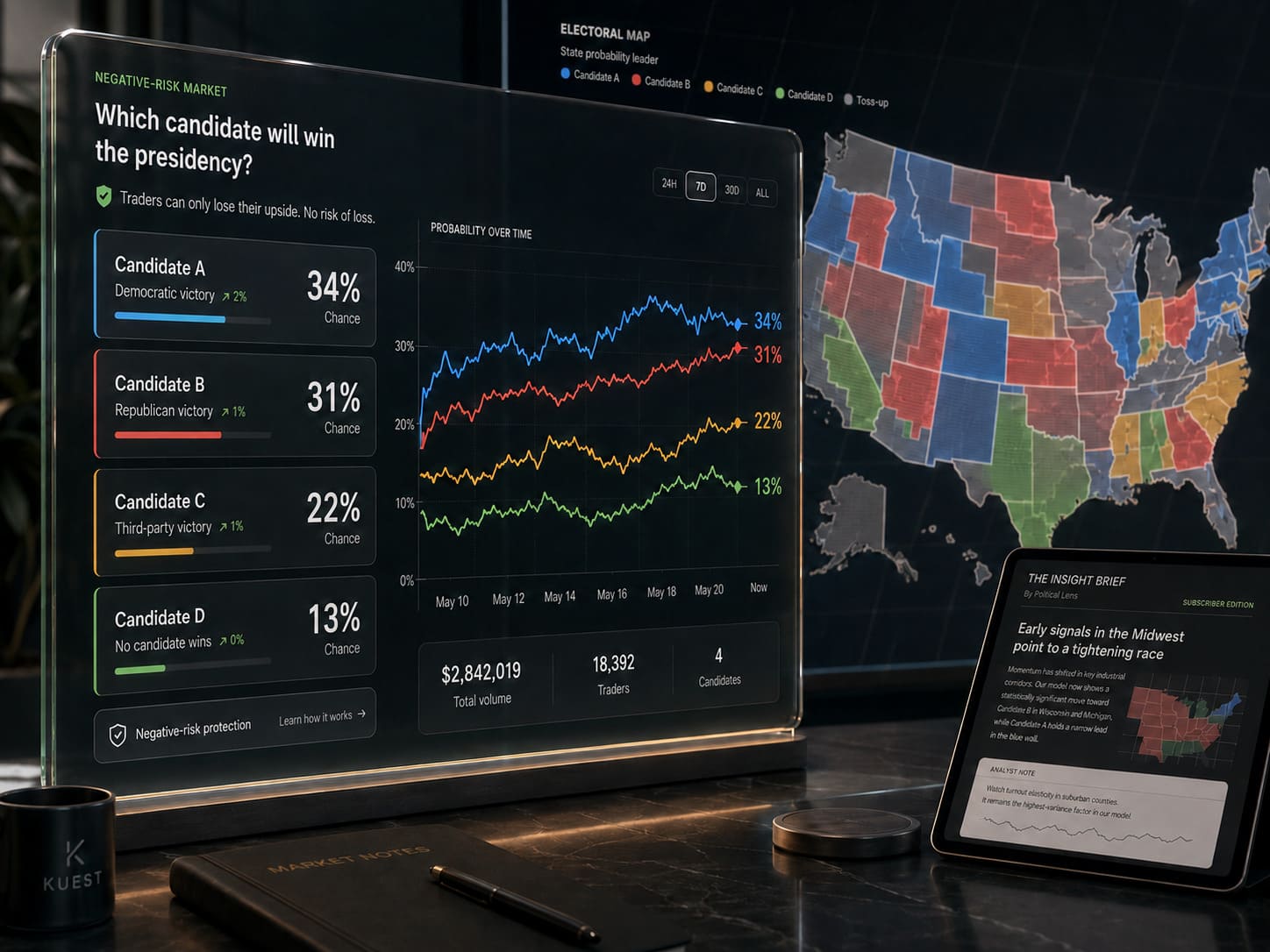
Election-year traffic is valuable because political audiences return every day. A prediction-market layer can turn that recurring attention into a branded product, as long as the market is presented as a transparent signal rather than a substitute for reporting, polling, or civic judgment.
You publish a newsletter about elections, campaigns, public policy, Congress, parties, polling, or political power.
You may be an independent pundit with a paid subscriber base, a political journalist with a daily briefing, a campaign-adjacent analyst, a media company with several language editions, or an expert whose audience follows every race call.
Your readers already ask:
Will this candidate win the nomination?
Which party will control the chamber after the election?
Will the referendum pass?
Will the coalition survive the confidence vote?
Will turnout exceed the official threshold?
The questions create attention.
The attention creates newsletter opens, subscriptions, podcast downloads, social replies, live-blog sessions, sponsorship inventory, and demand for your interpretation.
But the most commercial action may happen elsewhere. A reader leaves your newsletter, searches for a market on another platform, and turns the question you framed into a trade on someone else’s product.
That is the opportunity for political newsletters and pundits:
operate a branded election prediction market where the questions your audience already debates become clearly specified event markets and your business earns a configured fee when eligible users trade.
This is not a way to make an election more certain.
It is not a replacement for polling, reporting, or editorial accountability.
It is a product layer that can make a political audience’s uncertainty visible, measurable, and recurring during the months when interest is already at its highest.
Political newsletters already own the scarce asset: trusted distribution
The hardest part of a new market is often not writing the contract.
It is finding people who care enough to read the question, form a view, disagree with another participant, and return when new information changes the price.
Political newsletters and pundits already have a head start.
An audience may read a morning briefing before work, open a Sunday analysis, listen to a podcast during the commute, or check a live blog when returns start coming in. The relationship is repeated and editorial, not just transactional.
The audience may already debate:
- Whether a primary candidate can win a particular state.
- Whether a party can hold a marginal seat.
- Whether a bill will pass before a legislative deadline.
- Whether a government will collapse before a budget vote.
- Whether a referendum will clear the required majority.
- Whether turnout, participation, or a vote share will cross a defined threshold.
Those debates are market research.
The publisher does not need to invent political interest from scratch. It needs to identify which recurring questions can become fair, observable, and resolvable contracts.
The difference matters because a prediction market without distribution is just an empty interface.
Political media already has the distribution engine.
The product opportunity is to add a market to the relationship the publisher already owns.
This is also why the current conversation is moving beyond standalone platforms. Media companies have experimented with prediction-market partnerships as an audience-engagement and revenue layer, with Axios reporting partnerships involving outlets including CNN, Time, Dow Jones, and CNBC. The Axios Media Trends report also illustrates the editorial risk: if markets appear beside sensitive news without clear controls, engagement can look like gamification rather than useful analysis.
The strategic question for an independent newsletter or pundit is not:
How do I send more traffic to a prediction-market platform?
It is:
Can my audience’s recurring political questions become a product under my brand, with rules and context I control?
What is an election prediction market?
An election prediction market lets eligible users trade positions on a defined political outcome.
A market might ask:
Will Candidate A win the 2026 presidential election?
Will Party B hold a majority in the lower house after the official count?
Will the referendum receive more than 50% of valid votes?
Will the coalition form a government before the deadline?
Will a named bill pass both chambers before the legislative session ends?
Users buy or sell positions based on their view. The market price expresses the crowd’s current probability before considering spread, execution, fees, and liquidity.
The CFTC describes event contracts as products that can help participants forecast, plan, hedge, or harness perceptions of future events. Its overview explains the common yes-or-no structure, fixed payout, expiration, order-book prices, and the ability to trade in and out before settlement. Read the CFTC’s overview of prediction markets and event contracts for the regulated-market model.
That description is useful for product design, but it is not a universal legal classification for every political market in every country.
For a political publisher, the important boundary is:
your reporting creates context; the market creates an explicit action layer.
The newsletter can explain polling, demographics, coalition arithmetic, campaign strategy, institutional rules, historical precedent, and uncertainty.
The market can let an eligible participant express a view under a defined contract.
For the publisher, a branded political prediction market platform is the infrastructure layer that connects that contract to the editorial relationship.
The resulting loop looks like this:
briefing → analysis → market → new information → price movement → update → resolution
That loop can run across a newsletter, website, podcast, YouTube channel, community, or live election-night product.
Why political markets are attractive in an election year
Election coverage has a seasonal traffic pattern that most publishers would like to make more valuable.
Interest rises as candidates emerge, conventions or party selections approach, filing deadlines pass, debates happen, ballots are mailed, early voting begins, polls close, and official results are certified.
The calendar creates repeated moments when the same reader returns with a new question:
- What changed after the debate?
- Did the endorsement move the race?
- Is the coalition arithmetic still possible?
- Which chamber is now the pivot?
- Did turnout change the likely outcome?
- When will the official result be known?
Those moments are useful to advertisers and subscription businesses because they create repeat attention. They are useful to a market because they create information updates, disagreement, and a clear path to resolution.
The product does not need to launch with hundreds of markets.
It can begin with a small catalog that mirrors the editorial calendar:
| Editorial moment | Possible market layer | Content follow-up |
|---|---|---|
| Candidate announcement | Nomination or qualification market | Explain the field, rules, and base rates |
| Debate or major interview | Defined race or policy market | Separate what changed from what was merely viral |
| Polling release | Race, chamber, or turnout threshold | Compare the market price with the poll’s sample and limits |
| Filing or ballot deadline | Qualification or participation market | Publish the exact source and cutoff rule |
| Early voting or election day | Turnout, control, or result market | Show status without implying an official result too early |
| Certification | Resolution and post-election recap | Explain the source, timing, and any correction process |
For Brazil-focused publishers, the official 2026 calendar gives the season a particularly clear shape: Brazil’s first-round vote is scheduled for October 4, with a second round on October 25 if required. The Tribunal Superior Eleitoral’s election calendar is the source to use for dates and official milestones, not an article’s memory of the calendar.
The same principle applies to United States, Spanish-language, and other national or regional editions: source the calendar from the relevant electoral authority and make the source part of the product.
The monetization stack for political newsletters and pundits
A market should be treated as an additional product layer, not a demand to abandon subscriptions, sponsorships, memberships, or donations.
| Revenue model | What the audience does | What the operator earns from | Main limitation |
|---|---|---|---|
| Sponsorship | Reads a briefing, listens to a show, or watches a segment | Campaign or placement fees | Depends on sponsor budgets and inventory |
| Paid newsletter | Pays for analysis, access, or a premium archive | Recurring subscription revenue | Requires a continuing premium benefit |
| Membership or community | Joins discussions, events, or private channels | Membership fees and retention | Requires moderation and ongoing programming |
| Donations | Supports independent journalism or a pundit | One-time or recurring contributions | Depends on trust and willingness to give |
| Political affiliate or data product | Clicks, signs up, or buys a related service | CPA, revenue share, or licensing | A third party may own the conversion and customer data |
| Polling or research product | Uses analysis, dashboards, or data | Subscription, licensing, or consulting | Requires differentiated methodology and support |
| Prediction market | Trades a position on a defined political question | Configured fee on trading activity | Requires eligibility, liquidity, rules, resolution, and compliance |
These models can coexist.
A paid newsletter can include a market preview for members. A free briefing can link to a public market. A sponsor can support an election-night live blog while the market remains clearly labeled as a separate product. A pundit can publish an analysis without telling readers which side to trade.
The market adds a simple economic equation:
Operator fee revenue = trading volume × operator fee
Illustrative monthly volumes look like this:
| Monthly trading volume | At 0.5% | At 1.0% | At 1.5% |
|---|---|---|---|
| $25,000 | $125 | $250 | $375 |
| $100,000 | $500 | $1,000 | $1,500 |
| $500,000 | $2,500 | $5,000 | $7,500 |
| $2,000,000 | $10,000 | $20,000 | $30,000 |
These are illustrations, not a forecast or a recommended rate.
Actual economics depend on audience size, first-trade activation, repeat trading, market quality, liquidity, user geography, costs, fee sensitivity, applicable taxes, and the entity operating the venue.
Our guide to prediction-market fee models covers starting rates, spreads, trader tolerance, and the difference between headline volume and net revenue.
What makes a political question a good market?
Political audiences can debate almost anything.
That does not mean every debate should become a contract.
The best first markets usually have five properties:
- A clear outcome. A reader can understand what must happen for YES or NO to win.
- A defined deadline. The market has a close time and an expected resolution window.
- An objective source. The outcome can be resolved from an electoral authority, legislative record, court filing, or other source named in advance.
- Existing audience interest. The newsletter already receives replies, clicks, or discussion about the question.
- A meaningful disagreement. Reasonable participants can hold different views based on available information.
The question should be narrow enough to resolve and important enough to revisit.
“Will the election be surprising?” is not a market.
“Will Candidate A receive more than 50% of the valid votes in the second round, according to the electoral authority’s certified result?” is closer to a specification.
The second question still needs a jurisdiction, close time, source, recount policy, and rule for an annulled or repeated election. But its outcome is observable.
Which election markets should you create first?
Start with markets that match the publisher’s expertise and the audience’s existing questions.
Race and nomination outcomes
- Will a named candidate win a defined primary or nomination contest?
- Will a candidate qualify for a runoff under the official rules?
- Will a party select a named nominee before a specified date?
- Will a coalition nominate a candidate before the filing deadline?
These markets are intuitive, but the contract must specify the contest, the electorate, the relevant round, and the official source.
Control of a chamber or governing coalition
- Will a party hold a majority in the lower house after certification?
- Will a coalition control the governing majority?
- Will a party win at least a defined number of seats?
- Will a governing coalition be formally announced before a deadline?
These markets can be more useful for political newsletters than a single horse-race question because they connect to governing power, legislative strategy, and the stories readers follow after election day.
Referendums and ballot measures
- Will the measure receive more than 50% of valid votes?
- Will the measure pass in the required number of regions?
- Will the proposal qualify for the ballot before the official deadline?
- Will the legislature approve the implementing bill before a specified date?
The rulebook must distinguish between a vote result, certification, judicial review, and implementation. A referendum can “pass” at the ballot box while remaining subject to later legal steps.
Turnout and participation thresholds
- Will turnout exceed a defined percentage of registered voters?
- Will early voting exceed a defined number of ballots?
- Will participation in a referendum cross the legal threshold?
Threshold markets can create useful analysis, but they need a precise denominator, geography, data source, and treatment of late or provisional ballots.
Legislative and policy milestones
- Will a named bill pass a chamber before the session ends?
- Will the budget receive final approval before a stated deadline?
- Will a government publish a regulation before a specified date?
- Will a coalition survive a confidence vote?
These markets give policy newsletters a way to stay relevant between election days. They also require more careful definitions because “pass,” “approve,” “enact,” and “take effect” may refer to different institutional events.
What to avoid at launch
Do not begin with markets about political violence, deaths, kidnappings, arrests, private medical conditions, attacks, disasters, or other tragedies.
Do not create contracts whose outcome depends on one person’s secret action, an unverified social-media rumor, or an editorial judgment that can be changed after users trade.
Do not make a market about whether a candidate will commit a crime, be harmed, resign because of a private event, or cause a social crisis. Even when a question is technically observable, it may create serious public-interest, integrity, and reputational problems.
The concern is not hypothetical. In 2026, Axios reported on a news-site prediction box tied to a mass killing and described the wider scrutiny of markets around war, tragedy, and crisis. The Axios report is a useful reminder that editorial proximity changes the responsibility of the operator.
The practical rule is:
start with broad civic outcomes that are important, observable, and difficult for one person to manipulate.
A political prediction market platform is not a polling model
Political publishers need to be precise about what a market price means.
A price is the result of trading under a particular contract, participant set, liquidity profile, fee schedule, and time. It is not automatically a representative sample of voters.
It is not a poll.
It is not an editorial endorsement.
It is not proof that a candidate will win.
It is not a substitute for a forecast model, reporting, or an official result.
Researchers and commentators have raised exactly this concern. Yale Insights warned that political and business media often cite prediction-market odds as if they were reliable election forecasts, while also pointing to thin volume and liquidity as reasons to be cautious. Read the Yale analysis of political prediction markets before designing an editorial display.
The Associated Press has made a related point about political forecasters: audiences often want a definitive answer, while serious election analysis is usually about uncertainty, assumptions, and conditional judgments. The AP feature on election forecasters is a useful base article for thinking about how a pundit’s authority can be misunderstood when a nuanced analysis is reduced to a confident headline.
That should shape the interface.
Show:
- The current price and timestamp.
- The question and full market rules.
- Approximate liquidity, spread, or depth where available.
- The resolution source and expected timing.
- A clear separation between editorial analysis and market activity.
- A notice that market prices are not polls or guarantees.
Do not show a large probability number with no context and expect readers to understand what it represents.
For a pundit, the most credible format may be a comparison:
| Editorial analysis | Market signal |
|---|---|
| Explains evidence, assumptions, and scenarios | Shows the price created by participant trading |
| Can include qualitative reporting and uncertainty | Depends on contract design, participants, and liquidity |
| Belongs to the author or newsroom | Belongs to the market mechanism and its rules |
| Can be updated as facts change | Moves when participants trade or information arrives |
| Should not be reduced to a single number | Should not be presented as objective certainty |
The product becomes more trustworthy when both columns remain visible.
The seasonal advantage is multilingual distribution
An election-year product has a short window in which audience demand is unusually concentrated.
That makes localization more valuable than translating a static blog post after the fact.
The same market infrastructure can support:
- An English newsletter for national political coverage.
- A Spanish edition for audiences in Spain, Latin America, or the United States.
- A Brazilian Portuguese edition tied to Brazil’s election calendar and political institutions.
- Regional editions for states, provinces, departments, municipalities, or constituencies.
The backend can share matching, settlement, liquidity, and operator controls while the public surface changes by language and market.
That does not mean translating one market description literally.
Each localized market may need its own:
- Candidate and institution names.
- Electoral authority and result source.
- Legal terminology.
- Time zone and closing time.
- Vote, seat, turnout, or coalition definition.
- Disclosure language.
- Eligibility and distribution rules.
The market question should sound native to the audience, but the resolution rule must remain exact.
For example, an English-language newsletter may discuss control of the U.S. House, a Spanish-language edition may cover a regional coalition, and a Brazilian Portuguese edition may publish a market tied to the official TSE result. These can share product infrastructure without pretending that the legal, institutional, or editorial context is the same.
The legal and political-promotion boundary
An election market is not automatically legal or illegal everywhere because it is called a prediction market.
The answer depends on the entity, contract, users, collateral, operator, regulator, distribution, advertising, and jurisdiction.
In the United States, the CFTC says event contracts are within its regulated commodity-derivatives framework and in February 2026 reaffirmed its view of exclusive federal jurisdiction over prediction markets. The CFTC’s 2026 statement is an important source for the U.S. regulatory conversation, but it does not turn every publisher into a registered exchange or authorize every political market.
A newsletter operator may be the publisher, marketer, venue owner, technology customer, affiliate, or some combination. Those roles can create different responsibilities.
Political promotion is a separate issue.
If a political committee or campaign pays for a public communication, endorsement, market promotion, or distribution, campaign-finance and disclaimer rules may apply. The Federal Election Commission explains that political-committee communications can require disclaimers, including certain internet communications and emails. See the FEC advertising and disclaimer guidance, and obtain advice for the actual entity and communication.
For Brazil, use the TSE’s official calendar and applicable resolutions as the starting point. For Spanish-language editions, identify the relevant electoral authority and country-specific rules rather than assuming that a market approved for one country can be promoted in another.
The operating boundary should be explicit:
- Editorial analysis is not a market recommendation.
- Market promotion is not a political endorsement.
- Sponsorship is not evidence that a candidate or party supports the market.
- A market price is not an official election result.
- A prediction-market infrastructure provider is not automatically the legal operator for every distribution model.
Write the political market rulebook before the headline
Political writers are trained to make complex developments understandable.
Market operators need to make them mechanically resolvable.
Every market brief should answer:
- What exact election, institution, bill, referendum, or milestone is being measured?
- What does YES mean and what does NO mean?
- What is the close time, including the time zone?
- What source determines the result?
- Does “result” mean initial count, certified result, final court decision, or another milestone?
- How are recounts, provisional ballots, runoffs, reruns, annulments, and corrections handled?
- What happens if the institution dissolves, the candidate withdraws, or the vote is postponed?
- Who proposes the resolution?
- Who reviews or challenges it?
- How long is the challenge window?
- What happens if the source is delayed, unavailable, or internally inconsistent?
- Which users, locations, or categories are restricted?
Polymarket’s resolution documentation is a useful reference for source selection, end dates, edge cases, proposal, and challenge processes.
For example, “Will Party A win the election?” is incomplete if the election has multiple rounds, coalition rules, recounts, or a certification process.
A complete market might specify the election, office, round, official source, valid-vote denominator, close time, certification milestone, and treatment of a second round.
The rule should be visible before anyone trades.
How the political-news product loop works
The operator’s job is to connect the market to the editorial rhythm without turning the newsletter into a constant trading prompt.
1. Publish the analysis
Write the briefing your audience already expects.
Explain the candidates, institutions, polls, demographics, coalition arithmetic, incentives, and unknowns.
Separate reported facts from the pundit’s interpretation.
2. Publish one well-defined market
Place one market near the relevant analysis, with its question, close time, source, and edge cases visible.
One useful market is better than a wall of speculative questions.
3. Explain what the price does and does not mean
Tell readers that the price reflects trading in that contract, not the opinion of all voters or the certainty of the author.
If liquidity is thin, say so.
If the market is restricted to certain jurisdictions, say so.
If the outcome is not expected to resolve until certification, say so.
4. Let new information move the conversation
A debate, poll, endorsement, court ruling, filing, coalition negotiation, or official count can change the market.
The newsletter can explain what changed without telling the audience what to trade.
5. Compare market movement with editorial reasoning
The best follow-up is not “the market was right” or “the pundit was right.”
It is:
What information did each process use, what changed, and where did uncertainty remain?
That turns the market into a recurring explanatory format.
6. Resolve and archive
When the named official source publishes the defined outcome, resolve the market through the documented process.
Publish a recap that includes the source, timestamp, edge cases, and any correction or challenge.
That closes the loop and gives readers a reason to return in the next election cycle.
The operator’s first election-market launch plan
Phase 1: Audit the audience before the calendar accelerates
Review the last 90 days of:
- Newsletter opens, clicks, replies, and forwards.
- Articles with the longest reading time.
- Podcast questions and listener messages.
- Social posts with the most substantive discussion.
- Polls, surveys, and community threads.
- Race calls, policy questions, and forecasts that readers repeatedly revisit.
Look for questions that are recurring, contested, time-bound, observable, and specific to your audience.
Your archive is already a market roadmap.
Phase 2: Choose one jurisdictional lane and one language lane
Do not start with every election your readers mention.
Choose the country, institution, or audience where your team has the strongest editorial credibility and where your legal and operational model is clear.
Then choose the primary language for the first launch: English, Spanish, or Brazilian Portuguese.
Add other language surfaces after the market rules, eligibility, resolution, and support process work in one lane.
Phase 3: Build a small catalog around the editorial calendar
Start with five to ten markets:
- Two race or nomination outcomes.
- One chamber, coalition, or governing-control market.
- One referendum, turnout, or participation market.
- One policy or legislative milestone.
- One question tied to the week’s strongest analysis.
Avoid trying to cover every district, candidate, rumor, and possible event. A smaller catalog makes it easier to provide liquidity, support, clear resolution, and editorial context.
Phase 4: Define source and resolution before promotion
Write the full rules before the market appears in a newsletter.
Name the source.
Name the time zone.
Define certification, recounts, runoffs, corrections, and delays.
Record who can pause, resolve, challenge, or void the market.
Phase 5: Place the market in the recurring format
Examples include:
- “Market question of the week” in the newsletter.
- A probability and uncertainty segment in the podcast.
- A race board during the final month.
- A Spanish-language regional edition with localized sources.
- A Brazilian Portuguese election-night page linked to TSE results.
- A post-debate update comparing the market movement with the analyst’s reasoning.
The format creates habit without requiring every reader to trade.
Phase 6: Measure trust, not only volume
Track:
- Newsletter readers who view the market.
- Market viewers who become eligible first-time traders.
- First traders who return after a new information event.
- Volume per active trader.
- Spread, depth, and slippage.
- Resolution time after the official source publishes.
- Disputes, voids, corrections, and support contacts.
- Activity by language, country, market type, and editorial format.
- Whether readers understand the difference between a market price and an editorial forecast.
The first launch succeeds when you learn which formats generate trusted, repeat market activity—not when you fill the page with the most contracts.
What to ask a political prediction-market infrastructure provider
Political newsletters should not select a provider based only on a polished demo.
Ask the questions that determine whether the market can survive scrutiny during the highest-attention week of the cycle.
Regulatory and entity model
- Which entity operates the venue?
- In which jurisdictions is it available?
- Who determines user eligibility and restricted locations?
- Who handles KYC, AML, sanctions, age, and responsible-trading controls?
- Is the provider an exchange, broker, intermediary, technology provider, or another service?
- What role does the publisher occupy: operator, marketer, affiliate, distributor, or content partner?
- What responsibilities remain with the newsletter or pundit?
Political integrity and source design
- Which electoral authorities, legislative records, or official sources are supported?
- How are recounts, runoffs, annulments, court decisions, and corrections handled?
- Can the operator exclude markets about violence, tragedy, private health, or other sensitive categories?
- How are insider restrictions and suspicious trading monitored?
- Can a market be paused when a source is delayed or a new event changes the contract?
Trading and liquidity
- Is the price backed by a live order book?
- Who supplies bids and asks at launch?
- Is liquidity shared across venues or language editions?
- Can users place limit orders?
- How are spread, depth, slippage, pauses, and cancellations displayed?
- What happens when a debate or breaking news event creates a sudden volume spike?
Multilingual distribution
- Can English, Spanish, and Brazilian Portuguese markets use localized text and rules?
- Can each market display its own source, time zone, deadline, and disclosure?
- Can the operator run separate domains or paths by language?
- Are translation changes versioned so that the underlying contract remains identical?
- Can the operator report activity by language, country, and market?
Brand and ownership
- Can the market use the publisher’s domain and visual identity?
- Who owns the audience relationship and first-party data?
- Can the operator choose categories, cadence, and editorial placement?
- Are fee schedules and attribution visible?
- Can the operator export activity and revenue data?
Operations, support, and resolution
- Who answers user questions during election night?
- Who proposes resolutions and handles challenges?
- What happens if the official result is delayed for days or weeks?
- Can the operator pause a market quickly?
- What notices, disclosures, and terms must appear next to the market?
- What incident-response process exists for misinformation, manipulation, or a compromised source?
If a provider answers only the product questions and avoids entity, eligibility, integrity, political promotion, and resolution questions, keep evaluating.
How Kuest fits a political newsletter or pundit
Kuest is designed for operators who already have an audience and want to add a branded prediction-market layer without building an exchange stack from scratch.
Your newsletter, analysis, podcast, and political brand remain yours.
Your team chooses the questions, market categories, language surfaces, editorial cadence, and voice.
Kuest provides the underlying prediction-market infrastructure, including matching, settlement, resolution workflows, shared liquidity, and operator controls.
The Kuest protocol overview explains the infrastructure model. The owner architecture documentation describes the boundary between the operator deployment and Kuest services. The guided launch documentation covers the route from configuration to a branded venue, and the custom-domain guide helps make the market feel like part of your political publication.
For programmatic publishing, use the Create Market API documentation. For settlement operations, use the DRO Resolution API documentation. For fee attribution and operator economics, review the Affiliate & Fees documentation.
Our guide to monetizing a newsletter with a prediction market explains the audience-to-market loop. The guide to shared liquidity for prediction markets explains why a publisher should not need to build a market-making desk before testing the first market. Our build-vs-license analysis covers the cost and timeline tradeoff of owning the full exchange stack.
The simple model is:
Your political publication = audience, analysis, trust, and distribution
Kuest = market infrastructure, liquidity, matching, and settlement rails
Your operator fee = the revenue layer attached to eligible trading activity
Kuest does not turn a political product into a compliant one by itself. It gives the operator an infrastructure layer that can be evaluated with counsel against the target market, user, entity, language, and distribution model.
The opportunity is to make uncertainty useful
The strongest use case is narrower than “turn election coverage into betting.”
It is:
turn the questions your audience already debates into a transparent, measurable, and recurring market experience.
That lets the operator test:
- Whether readers will take positions, not only click a headline.
- Which races, institutions, and policy questions create repeat activity.
- Whether a fee-per-trade model complements subscriptions, sponsorships, and memberships.
- Whether readers understand the difference between a market signal and an editorial forecast.
- Whether localized English, Spanish, and Brazilian Portuguese editions create separate or shared demand.
- Whether the infrastructure can support the operator before it takes on deeper regulatory and operational responsibilities.
The product can begin with one jurisdiction, one language, a small catalog, broad civic outcomes, and an optional action layer.
The pundit does not need to tell readers what to trade.
The newsletter does not need to promise a candidate will win.
The market does not need to replace the reporting.
It needs to give a well-informed audience a controlled, explicit way to express and revisit uncertainty—especially during the short, high-traffic season when political attention is already concentrated.
FAQ: Election Prediction Markets for Newsletters and Pundits
What is an election prediction market?
An election prediction market lets eligible users trade positions on a defined political outcome, such as a race result, chamber control, referendum, turnout threshold, coalition, or legislative milestone. The contract needs a clear deadline, source, resolution rule, and eligibility model.
Is an election prediction market the same as a poll?
No. A poll samples or surveys people under a stated methodology. A market price reflects trading in a specific contract among eligible participants, with its own liquidity, fees, incentives, and timing. A publisher should show the market as a signal, not as a representative measure of all voters.
What is a political prediction market platform?
A political prediction market platform is the venue and infrastructure that lets eligible users trade defined political event contracts. For a newsletter operator, it can provide market creation, matching, liquidity, settlement, resolution, eligibility controls, and reporting while the publisher owns the editorial and audience layer.
Can a pundit charge a fee on political market trades?
Potentially, if the operator model, provider, entity, jurisdiction, users, and applicable rules allow it. The basic economic model is trading volume multiplied by the configured operator fee. This is a business model, not a regulatory exemption.
Which election markets should a newsletter launch first?
Start with broad outcomes that the audience already follows and that can be resolved from a named official source: race results, chamber control, coalition formation, referendum outcomes, turnout thresholds, or clearly defined legislative milestones. Avoid questions involving tragedy, violence, private health, unverified rumors, or a single person’s secret action.
Can the same market be published in English, Spanish, and Brazilian Portuguese?
It can be possible to share infrastructure, but localization must preserve the exact contract. Each edition may need localized language, electoral authority, time zone, deadline, legal disclosure, eligibility, and result source. Translation should not change the underlying meaning of YES, NO, or the resolution rule.
How should a newsletter display the market price?
Show the question, current price, timestamp, liquidity or spread where available, full rules, source, expected resolution timing, and a notice that the price is not a poll or guarantee. Keep the pundit’s analysis visually distinct from the trading interface.
Does a political newsletter need a disclaimer?
It depends on the entity, communication, sponsor, jurisdiction, and whether the communication is political advertising, market promotion, editorial content, or a combination. U.S. political-committee communications can trigger FEC disclaimer rules, including certain internet communications and emails. Obtain advice for the actual campaign, publisher, sponsor, and distribution model.
What happens if the election is contested or delayed?
The market rules should define whether resolution waits for certification, how recounts and court decisions are handled, what happens in a runoff or rerun, and who can pause or challenge the market. If those rules are not clear before trading begins, the market is not ready to publish.
Does a political market need official election data?
It needs a reliable, pre-defined source appropriate to the contract. An electoral authority is often the right source for results, but legislative records, court documents, or official government publications may be appropriate for other questions. The source and correction policy should be visible before trading.
Is a political prediction market a lower-risk regulatory option?
It may be a different infrastructure path for some operators, but there is no universal lower-risk conclusion. Political markets can involve derivatives, gambling, financial promotion, election, campaign-finance, consumer-protection, privacy, advertising, and platform rules. Get jurisdiction-specific advice.
Does the publisher need to provide liquidity?
Not necessarily. A provider may offer shared liquidity or managed market-making support, but the publisher should understand who supplies bids and asks, how spreads are displayed, and what happens during a breaking-news spike. Thin liquidity should be disclosed rather than hidden.
How does a political newsletter measure the first launch?
Measure newsletter-to-market views, first-trade conversion, repeat trading, volume per active trader, spread, depth, resolution time, disputes, support contacts, activity by language and market type, and whether readers understand the difference between market price and editorial analysis. Trust is a launch metric.